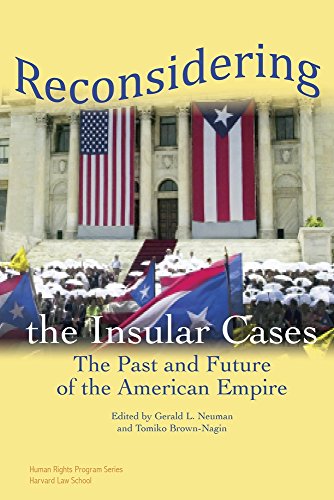

Reconsidering the Insular Cases the past and future of the American empire edited by Gerald L. Neuman and Tomiko Brown-Nagin.
Series Human Rights Program practice seriesEditor: Cambridge, MA Harvard Law School 2015Descripción: xvi, 216 pages 23 centimeters Tipo de medio:- 9780979639579
- 0979639573
- 342.73/0413 23
- P.R. KF 4635 .A75 R43 2015
| Imagen de cubierta | Tipo de ítem | Biblioteca actual | Biblioteca de origen | Colección | Ubicación en estantería | Signatura topográfica | Materiales especificados | Info Vol | URL | Copia número | Estado | Notas | Fecha de vencimiento | Código de barras | Reserva de ítems | Prioridad de la cola de reserva de ejemplar | Reservas para cursos | |
|---|---|---|---|---|---|---|---|---|---|---|---|---|---|---|---|---|---|---|
| Libro | Biblioteca Encarnación Valdés Colección de Puerto Rico | 342.730413 R3113 (Navegar estantería(Abre debajo)) | Disponible | 80000002554692 |
Descripciones mejoradas de Syndetics:
Over a century has passed since the United States Supreme Court decided a series of cases, known as the "Insular Cases," that limited the applicability of constitutional rights in Puerto Rico and other overseas territories and allowed the United States to hold them indefinitely as subordinated possessions without the promise of representation or statehood. Essays in this volume, which originated in a Harvard Law School conference, reconsider the Insular Cases. Leading legal authorities examine the history and legacy of the cases, which are tinged with outdated notions of race and empire, and explore possible solutions for the dilemmas they created. Reconsidering the Insular Cases is particularly timely in light of the latest referendum in Puerto Rico expressing widespread dissatisfaction with its current form of governance, and litigation by American Samoans challenging their unequal citizenship status. This book gives voice to a neglected aspect of U.S. history and constitutional law and provides a rich context for rethinking notions of sovereignty, citizenship, race, and place, as well as the roles of law and politics in shaping them.
"This volume grew out of a conference held at Harvard Law School on February 19, 2014, as a Francis Biddle Memorial Panel."
Includes bibliographical references.
Preface / Martha Minow -- Introduction / Gerald L. Neuman -- When statehood was autonomy / Christina Duffy Ponsa -- The Insular cases : what is there to reconsider? / Efrén Rivera Ramos -- The centennial of Ocampo v. United States : lessons from the Insular cases / Bartholomew H. Sparrow -- The Insular cases : a declaration of their bankruptcy and my Harvard pronouncement / Juan R. Torruella -- From conquest to consent : Puerto Rico and the prospect of genuine free association / Chimène I. Keitner -- The insular cases, differentiated citizenship, and territorial statuses in the twenty-first century / Rogers M. Smith -- The ideological decolonization of Puerto Rico's autonomist movement / Rafael Cox Alomar -- Our journey is not complete / Andrés W. López -- Puerto Rico and the United States at the crossroads / Carlos Iván Gorrín Peralta.
Over a century has passed since the US Supreme Court decided a series of cases, known as the Insular Cases, that limited the applicability of constitutional rights in Puerto Rico and other overseas territories and allowed the United States to hold these lands indefinitely as subordinated possessions without the promise of representation or statehood. Chapters in this volume, which originated in a Harvard Law School conference, reconsider the Insular Cases. Leading legal authorities examine the history and legacy of the cases, which are linked with outdated notions of race and empire, and explore possible solutions for the dilemmas they created. Reconsidering the Insular Cases is particularly timely in light of the latest referendum in Puerto Rico expressing widespread dissatisfaction with its current form of governance and litigation by American Samoans challenging their unequal citizenship status. This book gives voice to a neglected aspect of US history and constitutional law and provides a rich context for rethinking notions of sovereignty, citizenship, race, and place, as well as the roles of law and politics in shaping them.
Bibliographic reference according to APA style manual (6th ed.): Neumann, G. L. & Brown-Nagin, T. (2015). Reconsidering the Insular Cases: The past and future of the American empire. Cambridge, MA: Harvard Law School.
Tabla de contenidos provista por Syndetics
- Preface(p. vii)
- Acknowledgments(p. xi)
- Introduction(p. xiii)
- Chapter 1 When Statehood Was Autonomy(p. 1)
- Chapter 2 The Insular Cases: What Is There to Reconsider?(p. 29)
- Chapter 3 The Centennial of Ocampo v. United States: Lessons from the Insular Cases(p. 39)
- Chapter 4 The Insular Cases: A Declaration of Their Bankruptcy and My Harvard Pronouncement(p. 61)
- Chapter 5 From Conquest to Consent: Puerto Rico and the Prospect of Genuine Free Association(p. 77)
- Chapter 6 The Insular Cases, Differentiated Citizenship, and Territorial Statuses in the Twenty-First Century(p. 103)
- Chapter 7 The Ideological Decolonization of Puerto Rico's Autonomist Movement(p. 129)
- Chapter 8 Our Journey Is Not Complete(p. 167)
- Chapter 9 Puerto Rico and the United States at the Crossroads(p. 183)
- Contributors(p. 213)
Notas de autor provistas por Syndetics
Gerald L. Neuman is J. Sinclair Armstrong Professor of International, Foreign, and Comparative Law at Harvard Law School.Tomiko Brown-Nagin is Daniel P. S. Paul Professor of Constitutional Law at Harvard Law School and Professor of History in the Harvard Graduate School of Arts and Sciences. She is also Co-Director of the Program in Law and History.