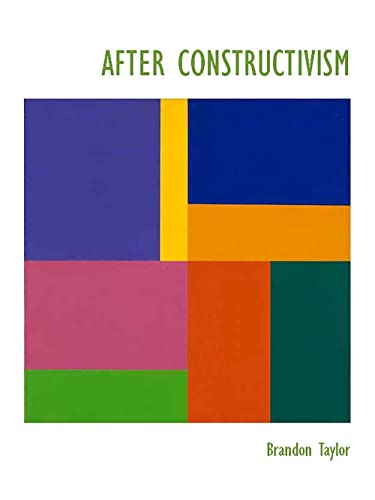
Imagen de portada de Amazon
Imagen de Amazon.com
Imagen de cubierta Syndetics
Portada de Syndetics
Imagen de OpenLibrary

After Constructivism : Brandon Taylor. txt

Por: Idioma: Inglés London : Yale , 2014Descripción: xv, 288 p. col. ill. ; 26 cmTipo de contenido:
  • text
Tipo de medio:
  • unmediaded
Tipo de soporte:
  • volume
ISBN:
  • 9780300195774
Tema(s): Clasificación CDD:
  • 709.04/057 23
Clasificación LoC:
  • N6494.C64 T36 2014
Contenidos:
Contents : IX -- 1 Cubist Things 1 -- Towards a Constructive Ideal 31 -- The Lure of Geometry 63 -- Lyrical Constructivism: A Local Tradition 95 -- Time and the Viewer 127 -- Irregular Curves: Science and The Organic 163 -- Fabricators: The Supremacy of Technique 197 -- Constructivism Now 221 -- Notes 246 -- Index -- Illustration Credits 289 --
Resumen: "When Constructivism emerged shortly after the Russian Revolution, its central principles concerned structure and efficiency in the work of art and the nature and properties of materials. In a series of eight essays, Brandon Taylor examines the origins of these principles and their extraordinary consequences for the rest of modern art. Even before Constructivism, structure was a vital ingredient in Cubist art. After it, ideas about faktura or the "madeness" of an art object and about its rational organization became stock in trade for De Stijl in Holland and Art Concret in France and bore decisively on other currents such as Surrealism and abstract art. After 1945, artistic movements including Systems, Kinetic and Minimal Art were all touched by the long reach of Constructivist ideals. Recent art has proved no exception. Taylor shows that casual attitudes to materials, even the collapse of Constructivist ideals, have helped form the artistic tenor of our times" --
Valoración
    Valoración media: 0.0 (0 votos)
Existencias
Imagen de cubierta Tipo de ítem Biblioteca actual Biblioteca de origen Colección Ubicación en estantería Signatura topográfica Materiales especificados Info Vol URL Copia número Estado Notas Fecha de vencimiento Código de barras Reserva de ítems Prioridad de la cola de reserva de ejemplar Reservas para cursos
Libro CARIBET Biblioteca Arquitectura Colección General CARIBET General N6494.C64 T36 2014 (Navegar estantería(Abre debajo)) Disponible 91000000045690
Total de reservas: 0

Descripciones mejoradas de Syndetics:

When Constructivism emerged shortly after the Russian Revolution, its central principles concerned structure and efficiency in the work of art and the nature and properties of materials. In a series of eight essays, Brandon Taylor examines the origins of these principles and their extraordinary consequences for the rest of modern art. Even before Constructivism, structure was a vital ingredient in Cubist art. After it, ideas about faktura or the "madeness" of an art object--and about its rational organization--became stock-in-trade for De Stijl in Holland and Art Concret in France and bore decisively on other currents such as Surrealism and abstract art. After 1945, artistic movements including Systems, Kinetic and Minimal Art were all touched by the long reach of Constructivist ideals. Recent art has proved no exception. Taylor shows that casual attitudes to materials, even the collapse of Constructivist ideals, have helped form the artistic tenor of our times.

Index.

Includes bibliographical references (pages 246-274) and index.

Contents : IX --
1 Cubist Things 1 -- Towards a Constructive Ideal 31 -- The Lure of Geometry 63 -- Lyrical Constructivism: A Local Tradition 95 -- Time and the Viewer 127 -- Irregular Curves: Science and The Organic 163 -- Fabricators: The Supremacy of Technique 197 -- Constructivism Now 221 -- Notes 246 -- Index -- Illustration Credits 289 --

"When Constructivism emerged shortly after the Russian Revolution, its central principles concerned structure and efficiency in the work of art and the nature and properties of materials. In a series of eight essays, Brandon Taylor examines the origins of these principles and their extraordinary consequences for the rest of modern art. Even before Constructivism, structure was a vital ingredient in Cubist art. After it, ideas about faktura or the "madeness" of an art object and about its rational organization became stock in trade for De Stijl in Holland and Art Concret in France and bore decisively on other currents such as Surrealism and abstract art. After 1945, artistic movements including Systems, Kinetic and Minimal Art were all touched by the long reach of Constructivist ideals. Recent art has proved no exception. Taylor shows that casual attitudes to materials, even the collapse of Constructivist ideals, have helped form the artistic tenor of our times" --

Reseñas proporcionadas por Syndetics

CHOICE Review

Artworks' manufactured and material aspects are traceable as artistic concerns to at least the mid-to-late 19th century. Courbet's paintings, for instance, emphasize artworks' reality as made objects. The Impressionists proffered the sketch, or impression, as a finished work that revealed rather than concealed, as academic paintings did, the process of picture making. In 1890, Maurice Denis famously proclaimed that a picture be recognized as essentially a two-dimensional surface covered in pigment, arranged in a particular order, before being understood for what it represents. Taylor (emer., Southampton Univ., UK) traces this interest in the concept of faktura, the physical and logical organization of artworks, in relationship to Russian constructivist art and to later work inspired by constructivist forms, materials, and ideas. He indicates that the term's meaning shifts in response to the different interests and concerns of different contexts. In eight chapters, he treats the contexts in separate but related case studies that are chronologically and thematically organized. In the first chapter, he explains cubism as an important precedent of constructivism. This broad conceptualization of Russian constructivism distinguishes Taylor's book from other, more narrowly conceived histories of the movement, making it a valuable addition to both the literature of constructivism and to studies in modern, postmodern, and contemporary art. Summing Up: Highly recommended. Upper-division undergraduates and above. --David E. Gliem, Eckerd College

Notas de autor provistas por Syndetics

B randon Taylor is professor emeritus, history of art, Southampton University, and tutor in history and theory of art at the Ruskin School of Fine Art, University of Oxford.
Compartir
logopucpr-y-vive

Contáctanos

¡Queremos saber de ti!

Tel. 787.841.2000 Ext. 1801

bibliotecavaldes@pucpr.edu

⁣Búscanos en las redes

© 2026 Desarrollado por Ignite Online • All Rights Reserved • Powered by Koha.