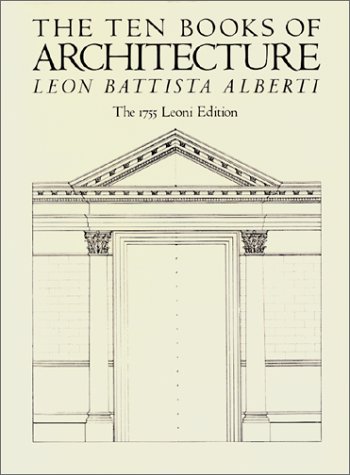

The ten books of architecture : the 1755 Leoni edition. / Leon Battista Alberti ; translated into Italian by Cosimo Bartoli ; translated into English by James Leoni. txt
Idioma: Inglés New York : Dover Publications,Inc. , 1986Descripción: 240 p., [64] pages of plates ill. 29 cmTipo de contenido:- text
- unmediaded
- volume
- 0486252396 (pbk.)
- 9780486252391
- 720 19
- NA2515 A3513 1986
| Imagen de cubierta | Tipo de ítem | Biblioteca actual | Biblioteca de origen | Colección | Ubicación en estantería | Signatura topográfica | Materiales especificados | Info Vol | URL | Copia número | Estado | Notas | Fecha de vencimiento | Código de barras | Reserva de ítems | Prioridad de la cola de reserva de ejemplar | Reservas para cursos | |
|---|---|---|---|---|---|---|---|---|---|---|---|---|---|---|---|---|---|---|
| Libro | CARIBET Biblioteca Arquitectura Colección General CARIBET | General NA2515 A3513 1986 (Navegar estantería(Abre debajo)) | 1 | Disponible | 91000000045385 |
Descripciones mejoradas de Syndetics:
Beautifully illustrated magnum opus of great Renaissance theorist who reintroduced the glories of ancient architecture and applied musical and mathematical principles to achieve perfection of proportion in architectural design. Reprinted from extremely rare British edition. 68 black-and-white plates.
Translation of: De re aedificatoria.
Reprint. Originally published: The architecture of Leon Batista [sic] Alberti in ten books. London : R. Alfray, 1755.
Book I. --
CHAP. I. Of Designs; their Value and Rules. --
CHAP. II. Of the first Occasion of erecting Edifices; of how many Parts the Art of Building confits, and what is necessary to each of those Parts. --
CHAP. III. Of the Region of the Climate or Air, of the Sun and Winds which affect the Air. --
CHAP. IV. Which Region is, and which is not commodious for Building. --
CHAP. V. By what Marks and Characters we are to know the Goodness of the Region. --
CHAP. VI. Of tome bidden Conveniences and Inconveniences of the Region which a wife Man ought to enquire into. --
CHAP. VII. Of the Seat, or Platform, and of the several Sorts of Lines. --
CHAP. VIII. Of the Kinds of Platforms, their Forms and Figures, and which are the moll serviceable and killing. --
CHAP. IX. Of the Compartition, and of the Origin of Building. --
CHAP. X. Of the Columns and Walls, and fame Observations relating to the Columns. --
CHAP. XI. Of the great Usefulness of the Coverings Goth to the Inhabitants and the other Parts of the Building, and that being various in their Natures, they mull be made of various Sorts. --CHAP. XII. Of the Apertures in the Building, that is to fay, of the Windows and Doors, and of those which do not take up the whole Thickness of the Wall, and their Number and Sizes. --
CHAP. XIII. Of the Stair-cafes, and their different Sorts; of Steps of the Stairs which ought to be in odd Numbers, and how many. Of the Resting-places, of the Tunnels for carrying away the Smoke. Of Pipes and Conduits for carrying of the Water, and of the proper placing of Wells and Sinks. --
Book II. --
CHAP. I. Treating of the Materials. That no Man A thought to begin a Building hastily, but should first take a good deal of Time to consider, and revolve in his Mind all the Qualities and Requisites of such a Work : And that be should carefully review and examine, with the Advice of proper fudges, the whole Structure in itself, and the Proportions and Measures of every distinct Part, not only in Draughts or Paintings, but in actual Models of Wood or some other Substance, that when he has finished his Building, be may not repent of his Labour. --
CHAP. II. That we ought to undertake nothing above our Abilities, nor strive against Nature, and that we ought alto not only to consider what we can do, but what is fit for us to do, and in what Place it is that we are to build. --
CHAP. III. That having considered the whole Disposition of the Building in all the Parts of the Model, we ought to take the Advice of prudent and understanding Men, and before we begin our Work, it will not only be proper to know how to raise Money for the Expense, but alto long before-hand to provide all the Materials for compleating filch an Undertaking. --
CHAP. IV. What Materials are to be provided for the Building, what Workmen to be chose, and in what Seasons, according to the Opinions of the Ancients, to cut Timber. --
CHAP. V. Of preserving the Trees after they are cut, what to plaister or anoint them with, of the Remedies against their Infirmities, and of allotting them their pro-per Places in the Building. --
CHAP. VI. What Woods are moll proper for Buildings, their Nature and Uses, how they are to be employed, and in what Part of the Edifice each Kind is molt fit for. --
CHAP. VII. Of Trees more summarily and in general. --
CHAP. VIII. Of Stones in general, when they are to be dug, and when used; which are the softest and which the hardest, and which best and most durable. --
CHAP. IX. Some Things worthy memorial, relating to Stones, left us by the Ancients. --
CHAP. X. Of the Origin of the Use of Bricks, in what Seaton they ought to be made, and in what Shapes, their different Sorts, and the Usefulness; of triangular ones; and briefly, of all other Works made of baked Earth. --
CHAP. XI. Of the Nature of Lime and Plaister of Paris, their Uses and Kinds, wherein they agree and wherein they differ, and of some Things not unworthy of Memory. --
CHAP. XII. Of the three different Kinds of Sands, and of the various Materials used in Building in different Places. --
CHAP. XIII. Whether the Observation of Times and Seasons is of any Use in beginning a Building; what Season is moll convenient; as also, with what Auguries or Prayers we ought to set out upon our Work. --
Book III. --
CHAP. I. OF the Work. Wherein lies the Business of the Work; the different Parts of the Walls, and what they require. That the Foundation is no Part of the Wall; what Soil makes the heft Foundation. --
CHAP. II. That the Foundation chiefly is to be marked out with Lines; and by what Tokens we may know the Goodness of the Ground. --
CHAP. III. That the Nature of Places is various, and therefore we ought not to trust any Place too hastily, till we have first dug Wells or Reservoirs; but that in marshy Places we must make our Foundation with Piles burnt at the Ends, and driven in with their Heads downward with light Beetles, and many repeated Blows, till they are driven quite in to the Head. --
CHAP. IV. Of the Nature, Forms and Qualities of Stones, and of the Tempering of Mortar. --
CHAP. V. Of the lower Courses or Foundations, according to the Precepts and Example of the Ancients. --
CHAP. VI. That there ought to be Vents left open in thick Walls from the Bottom to the Top, the Difference between the Wall and the Foundation: The principal Parts of the Wall; the three Methods of Wailing; the Materials and Form of the first Course or Layer. --
CHAP. VII. Of the Generation of Stones: How they are to be disposed and joined together, as also, which are the strongest and which the weakest. --
CHAP. VIII. Of the Parts of the Finishing; of the Shells, the Stuffing, and their different Sorts. --
CHAP. IX. Of the Girders of Stone, of the Ligament and Fortification of the Cornices, and how to unite several Stones for the Strengthening of the Wall. --
CHAP. X. Of the true Manner of Working the Wall, and of the Agreement there is between Stone and Sand. --
CHAP. XI. Of the Way of Working different Materials; of Plaistering, of Cramps, and how to preserve them; the moll ancient Instructions of Architects; and some Methods to prevent the Mischiefs of Lightning. --
CHAP. XII. Of Coverings of streight Lines; of the Beams and Rafters, and of the uniting the Ribs.
CHAP. XIII. Of Coverings, or Roofs of Curve Lines; of Arches, their Difference and Construction, and how to set the Stones in an Arch. --
CHAP. XIV. Of the several Sorts of Vaults, and wherein they differ; of what Lines they are composed, and the Method of letting them settle. --
CHAP. XV. Of the Shell of the Covering, and its Usefulness; the different Sorts and Shapes of Tiles, and what to make them of. --
CHAP. XVI. Of Pavements according to the Opinion of Pliny and Vitruvius, and the Works of the Ancients; and of the proper Seasons for beginning, and finishing the several Parts of Building. --
Book IV. --
CHAP I. Of works of a publick Nature. That all Buildings, whether contrived for Necessity, Conveniency, or Pleasure, were intended for the Service of Mankind. Of the several Divisions of human Conditions, whence arises the Diversity of Buildings. --
CHAP. II. Of the Region, Place, and Conveniencies, and Inconveniencies of a Situation for a City, according to the Opinion of the Ancients, and that of the Author. --
CHAP. III. Of the Compass, Space and Bigness of a City, of the Form and Disposition of the Walls and Fortifications, and of the Customs and Ceremonies observed by the Ancients in making them out. --
CHAP. IV. Of Walls, Battlements, Towers, Corniches and Gates, and the Timber-work belonging to them. --
CHAP. V. Of the Proportion, Fashion and Construction of great military Ways, and private Ways. --
CHAP. VI. Of Bridges both of Wood and Stone, their proper Situation, their Piers, Arches, Angles, Feet, Keystones, Cramps, Pavements, and Slopes. --
CHAP. VII. Of Drains or Sewers, their different Sorts and Uses; and of Rivers and Canals for Ships. --
CHAP. VIII. Of the proper Structure for a Haven, and of making convenient Squares in the City.
Book V. --
CHAP. I. OF Buildings for particular Persons. Of the Castles or Habitations of a King, or others; their different Properties and Parts. --
CHAP. II. Of the Portico, Vestibule, Court-yard, Hall, Stairs, Lobbies, Apertures, Back-doors, concealed Passages and private Apartments; and wherein the Houses of Princes differ from those of private Men; as also of the separate and common Apartments for the Prince and his Spouse. --
CHAP. III. Of the Properties of the Portico, Lobby, Halls both for Summer and Winter, Watch-Towers and of the Difference between the Castle for a Tyrant, and the Palace for a King. --
CHAP. IV. Of the proper Situation, Structure and Fortification of a Fortress, whether in a Plain, or upon a Hill, its enclosure, Area, Walls, Ditches, Bridges, and Towers. --
CHAP. V. Of those Parts of the Fortress where the Soldiers are to stand either to keep sentinel, or to fight. Of the covering Roof of the Fortress, and in what Manner it is to be made strong, and of the other Conveniencies necessary in the Castle either of a King or a Tyrant. --
CHAP. VI. Of the several Parts of which the Republick consists. The proper Situation and Building for the Houses of those that govern the Republick, and of the Priests. Of Temples as well large as small, Chapels and Oratories. --
CHAP. VII. That the Priests’ Camp is the Cloyster; the Duty of the Priest; the various Sorts of Cloysters and their proper Situation. --
CHAP. VIII. Of Places for Exercise, publick Schools, and Hospitals both for Men and Women. --
CHAP. IX. Of the Senate-house, the Temple, and the Tribunals for the Administration of justice. --
CHAP. X. That Incampments, or Lodgments for Soldiers by Land are of three Sorts; in what Manner they are to be fortified; and the various Methods used by different Nations. --
CHAP. XI. The most convenient Situation for a Camps and its Size, Form and various Parts; together with the different Methods of attacking and defending a Camp or other Fortification.
CHAP. XII. Of Incampments or Stations at Sea; which are Fleets; of Ships and their Parts; as also of Havens and their proper Fortification. --
CHAP. XIII. Of the Commissaries, Chamberlains; publick Receivers and the like Magistrates, whose Business is to supply and preside over the publick Granaries, Chambers of Accounts, Arsenals, Marts, Docks and Stables; as also of the three Sorts of Prisons, their Structures, Situations, and Compartitions. --
CHAP. XIV. Of private Houses and their Differences; as also of the Country House, and the Rules to be observed in its Situation and Structure.
CHAP. XV. That Country Houses are of two Sorts; the proper Disposition of all their Members whether for the Lodging of Men, Animals, or Tools for Agriculture and other necessary Instruments, --
CHAP. XVI. That the Industry of the Farmer or Overfeer ought to be employed as well about all Sorts of Animals, as about the Fruits of the Earth; as also of the Construction of the Threshing-floor. --
CHAP. XVII. Of the Country Houle for a Gentleman; its various Parts, and the proper Disposition of each of those Parts. --
CHAP. XVIII. The Difference between the Country House and Town House for the Rich. The Habitation of the middling Sort ought to resemble those of the Rich; at least in Proportion to their Circumstances. Buildings should be contrived more for Summer than for Winter. --
Book VI. --
CHAP. I. OF the Reason and Difficulty of the Author's Undertaking, whereby it appears how much Pains, Study and Application he has employed in writing upon these Matters. --
CHAP. II. Of Beauty and Ornament, their Effects and Difference, that they arc owing to Art and Exactness of Proportion; as also of the Birth and Progress of Arts. --
CHAP. III. That Architecture began in Afia, flourished in Greece, and was brought to Perfection in Italy. --
CHAP. IV. That Beauty and Ornament in every Thing arise either from Contrivance, or the Hand of the Artificer, or from Nature; and that though the Region indeed can hardly be improved by the Wit or Labour of Man, yet many other Things may be done highly worthy of Admiration, and scarcely credible. --
CHAP. V. A short Recapitulation of the Compartition, and of the just Composition and adorning the Wall and Covering. --
CHAP. VI. In what Manner great Weights and large Stones are moved from one Place to another, or raged to any great Height. --
CHAP. VII. Of Wheels, Pins, Leavers, Pullies, their Parts, Sizes, and Figures. --
CHAP. VIII. Of the Skrew and its Circles or Worm, and in what manner great Weights are either drawn, carried or pushed along. --
CHAP. IX. That the incrustations which are made upon the Wall with Mortar, mull be three in Number: How they are to be made, and to what Purposes they are to serve. Of the several Sorts of Mortar, and in what Manner the Lime is to be prepared for making them: Of Bass-relieves in flue-work and Paintings, with which the Wall may be adorned. --
CHAP. X. Of the Method of cutting of Marble into thin Scantlings, and what Sand is bell for that Purpose; as also of the Difference and Agreement between Mosaic Work in Relieve, and Flat, and of the Cement to be used in that Sort of Work. --
CHAP. XI. Of the Ornaments of the Covering, which consists in the Richness and Beauty of the Rafters, Vaults, and open Terrasses. --
CHAP. XII. That the Ornaments of the Apertures are very pleasing, but are attended with many and various Difficulties and inconveniencies; that the false Apertures are of two Sorts, and what is required in each. --
CHAP. XIII Of Columns and their Ornaments, their Plans, Axes, Out-lines, Sweeps, Diminutions, Swells, Astragals and Fillets. --
Book VII. --
CHAP. I. THAT the Walls of Cities, the Temples, and Courts of Justice, used to be consecreated to the Gods; of the proper Region for the City, its Situation and principal Ornaments. --
CHAP. II. Of bow large and what Kind of Stone the Walls ought to be built, and who were the first that erected Temples. --
CHAP. III. With how much Thought, Care and Diligence we ought to lay out and adorn our Temples; to what Gods and in what Places we should build them, and of the various Kinds of Sacrifices. --
CHAP. IV. Of the Parts, Forms and Figures of Temples and their Chapels, and how these latter should be distributed. --
CHAP. V. Of the Porticoes and Entrance to the Temple, its Ascent and the Apertures and Interspaces of the Portico. --
CHAP. VI. Of Columns, and the different Sorts of Capitals. --
CHAP. VII. A necessary Rehearsal of the several Members of Columns, the Bale, Torus, Scotia, Lifts, Die, and of the [mailer Parts of those Members, the Platband, Corona, Ovolo, small Ogee, Cima-inversa, and Cymatium, both upright and reverted. --
CHAP. VIII. Of the Doric, Ionic, Corinthian and Composite Capitals. --
CHAP. IX. Of the Entablature, the Architrave, Triglyphs, Dentils, Mutules, Cavetto, and Drip or Corona, as also of the Flutings and some other Ornaments belonging to Columns. --
CHAP. X. Of the Pavement of the Temple and its inner Area, of the Place for the Altar, and of the Walls and their Ornaments. --
CHAP. XI. Why the Roofs of Temples ought to be arched. --
CHAP. XII. Of the Apertures proper to Temples, namely, the Windows, Doors, and Valves; together with their Members, Proportions and Ornaments. --
CHAP. XIII. Of the Altar, Communion, Lights, Candlesticks, holy Vessels, and some other noble Ornaments of Temples. --
CHAP. XIV. Of the fist Original of Basiliques, their Porticoes and different Members, and wherein they differ from Temples. --
CHAP. XV. Of Colonnades both with Architraves and with Arches; what Sort of Columns are to be used in Basiliques, and what Cornices, and where they are to be placed; of the Height and Wedth of Windows and their Gratings; of the Roofs and Doors of Basiliques, and their Ornaments. --
CHAP. XVI. Of Monuments railed for preserving the Memory of publick Actions and Events. --
CHAP. XVII. Whether Statues ought to be placed in Temples, and what Materials are the most proper for making them. --
Book VIII. --
CHAP. I. Of the Ornaments of the great Ways either within or without the City, and of the proper Places for interring or burning the Bodies of the Dead. --
CHAP. II. Of Sepulchres, and the various Manners of burial. --
CHAP. III. Of little Chapels, by Way of Sepulchres, Pyramids, Columns, Altars and Moles. --
CHAP. IV. Of the inscriptions and Symbols carved on Sepulchres. --
CHAP. V. Of Towers and their Ornaments. --
CHAP. VI. Of the principal Ways belonging to the City, and the Methods of adorning the Haven, Gates, Bridges, Arches, Croft-ways and Squares. --
CHAP. VII. Of the adorning Theatres and other Places for publick Shows, and of their Usefulness. --
CHAP. VIII. Of the Ornaments of the Amphitheatre, Circus, publick Walks, and Halls, and Courts for petty judges. --
CHAP. IX. Of the proper Ornaments for the Senate-House and Council-Chambers, as also of the adorning the City with Groves, Lakes for Swimming, Libraries, Schools, publick Stables, Arsenals, and mathematical instruments. --
CHAP. X. Of Thermes or publick Baths; their Conveniencies and Ornaments. --
Book IX. --
CHAP. I. THAT particular Regard must be had to Frugality and Parsimony, and of the adorning the Palaces or Houses of the King and principal Magistrates. --
CHAP. II. Of adorning of private Houses, both in City and Country. --
CHAP. III. That the Parts and Members of a House are different both in Nature and Species, and that they are to be adorned in various Manners. --
CHAP. IV. With what Paintings, Plants, and Statues, it is proper to adorn the Pavements, Porticoes, Apartments and Gardens of a private House. --
CHAP. V. That the Beauty of all Edifices arises principally from three Things, namely, the Number, Figure and Collocation of the several Members. --
CHAP. VI. Of the Proportions of Numbers in the Measuring of Areas, and the Rules for some other Proportions drawn neither from natural Bodies, nor from Harmony. --
CHAP. VII. Of the Invention of Columns, their Dimensions and Collocation. --
CHAP. VIII. Some short, but general Observations which may be looked upon as Laws in the Business of Building and Ornaments. --
CHAP, IX. The Business and Duty of a good Architect, and wherein the Excellence of the Ornaments consists. --
CHAP. X. What it is that an Architect ought principally to consider, and what Sciences he ought to be acquainted with. --
CHAP. XI. To what Sort of Persons, the Architect ought to offer his Service. --
Book X. --
CHAP. I. OF the Defects in Building, whence they proceed, and their different Sorts; which of them can be corrected by the Architect, and which cannot; and the various Causes of a bad Air. --
CHAP. II. That Water is the most necessary Thing of all, and of its various Sorts. --
CHAP. III. Four Things to be considered with Relation to Water; ago whence it is engendered or arises, and its Course. --
CHAP. IV. By what Marks to find any hidden Water. --
CHAP. V. Of the Digging and Walling of Wells and Conduits. --
CHAP. VI. Of the Uses of Water; which is bell and moll wholesome; and that which is unwholesome. --
CHAP.VII. Of the Method of conveying Water and accommodating it to the Uses of Men. --
CRAP. VIII. Of Cisterns, their Uses and Conveniencies. --
CHAP. IX. Of planting a Vineyard in a Meadow, or a Wood in a Marsh; and how we may amend a Region which is molested with too much Water. --
CHAP. X. Of Roads; of Passages by Water and of artificial Banks to Rivers. --
CHAP. XI. Of Canals; how they are to be kept well supplied with Water, and the Uses of them not obstructed. --
CHAP. XII. Of the Sea Wall; of strengthening the Ports; and of Locks for confining the Water in it. --
CHAP. XIII. Of the Remedies for some other inconveniencies. --
CHAP. XIV. Some more minute Particulars relating to the Use of Fire. --
CHAP. XV. By what Methods to destroy or drive away Serpents, Gnats, Bugs, Flies, Vice, Fleas, Moths, and the like troublesome Vermin. --
CHAP. XV I. Of making a Room either warmer or cooler; as also amending Defects in the Walls. --
CHAP. XVII. Of some Defects which cannot be provided against, but which may be repaired after they have happened.
Beautifully illustrated magnum opus of great Renaissance theorist who reintroduced the glories of ancient architecture and applied musical and mathematical principles to achieve perfection of proportion in architectural design. Reprinted from extremely rare British edition. 68 black-and-white plates.
Notas de autor provistas por Syndetics
Leon Battista Alberti was born in Genoa, Italy, on February 18, 1404. His father was a major figure in the Florentine political world, and Alberti received a quality education. He studied Latin in Padua and completed his formal training at the University of Bologna, where he received a doctorate in canon law in 1428.In 1432, as a secretary in the Papal Chancery in Rome, Alberti became acquainted with Tommaso Parentucelli who was later elected Pope Nicholas V. Alberti worked for the Pope, studying law cases for seven years. In 1447, he became the Pope's architectural advisor, and upon studying the work of Vitruvius, wrote De Re Aerdificatoria (Ten Books on Architecture) in 1452.
Alberti was a major Humanist figure in the Italian Renaissance. He wrote dialogues, plays, poems, and philosophical books that were widely influential. During the last years of his life, Alberti put many of his architectural ideas into practice and wrote De Iciarchia (On the Man of Excellence and Ruler of His Family).
Albert died in 1472 at the age of 68.
(Bowker Author Biography)