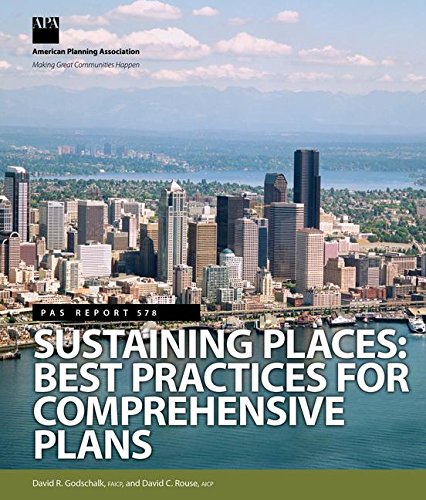

Sustaining Places : best practices for comprehensive plans. / David R. Godschalk, FAICP, and David C. Rouse, AICP. txt
Series Chicago : American Planning Association , 2015Descripción: 63 p. col. ill. ; 26 cmTipo de contenido:- text
- unmediaded
- volume
- 9781611901580
- 1611901588
- HC79.E5 G63 2015
| Imagen de cubierta | Tipo de ítem | Biblioteca actual | Biblioteca de origen | Colección | Ubicación en estantería | Signatura topográfica | Materiales especificados | Info Vol | URL | Copia número | Estado | Notas | Fecha de vencimiento | Código de barras | Reserva de ítems | Prioridad de la cola de reserva de ejemplar | Reservas para cursos | |
|---|---|---|---|---|---|---|---|---|---|---|---|---|---|---|---|---|---|---|
| Libro | CARIBET Biblioteca Arquitectura Colección General CARIBET | General HC79.E5 G63 2015 (Navegar estantería(Abre debajo)) | 1 | Disponible | 91000000040709 |
Descripciones mejoradas de Syndetics:
In 2010, the American Planning Association launched a project with nothing less than the future of the planet at stake. The Sustaining Places Initiative looks at how cities, towns, and regions can meet today's needs without draining the next generation's resources.
Out of that initiative came Sustaining Places: The Role of the Comprehensive Plan , a 2012 guide that makes the case for building sustainability into long-range planning. Now APA has gone further, explaining how to put those plans in place.
Sustaining Places: Best Practices for Comprehensive Plans offers six principles for creating livable, healthy communities in harmony with nature -- communities that have resilient economies, social equity, and strong regional ties. Four steps show how to turn those principles into a plan and score the results. Insights from 10 pilot communities add the real-world perspectives of big cities, small towns, and everything in between.
This report is not a recipe. It's a resource with principles, processes, and pointers communities can use to forge their own solutions as they meet the greatest planning challenge of our time.
Title from cover.
Includes bibliographical references (page 62).
Table of contents :
Executive summary 2 --
Chapter 1 Background of the Sustaining Places Initiative 6 --
Sustaining Places Task Force and Plan Standards Working Group 8 --
Pilot Communities 10 --
Report Framework 13 --
Chapter 2 Comprehensive plan standards for sustaining places 14 --
Required Principles 16 --
Required Processes 19 --
Required Attributes 20 --
Plan Scoring Procedure 21 --
Chapter 3 Applying the standards 24 --
Plan Evaluation Process 25 --
Pilot Community Examples 28 --
Plan Evaluation : Next Steps 30 --
Chapter 4 The future of comprehensive planning practice 32 --
Lessons Learned from the Pilot Communities 33 --
The Twenty First Century Comprehensive Plan 35 --
Appendix A : links to plan documents and updates and sustainability certification systems 38 --
Appendix B : best practice definitions 40 --
Appendix C : plan scoring matrix 51 --
Appendix D : how a comprehensive plan designation program would work 57 --
Appendix E : plan designation application form 60 --
References 62 --
Acknowledgments 63 --
Notas de autor provistas por Syndetics
David R. Godschalk, FAICP, is emeritus professor of city and regional planning at the University of North Carolina, as well as an author and occasional consultant on comprehensive plans. His most recent books are Sustainable Development Projects: Integrating Design, Development, and Regulation and The Dynamic Decade: Creating the Sustainable Campus for the University of North Carolina at Chapel Hill, 2001-2011 . He led the Sustaining Places Task Force and Plan Standards Working Group.
David C. Rouse, AICP , is managing director of research and advisory services for the American Planning Association. In this position, he oversees the Planning Advisory Service and the three National Centers for Planning. Prior to joining APA, he was a principal at WRT, a nationally recognized planning and design firm. He has extensive comprehensive planning experience and served on APA's Sustaining Places Task Force and Plan Standards Working Group.