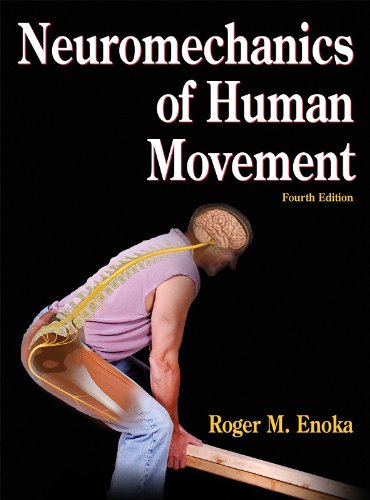

Neuromechanics of human movement Roger M. Enoka.
Detalles de publicación: Champaign, IL Human Kinetics c2008.Edición: 4th edDescripción: ix, 549 p. ill. 29 cmISBN:- 9780736066792 (hard cover)
- 0736066799 (hard cover)
- 612.7/6 22
- QP303 .E56 2008
- 2008 K-141
- WE 103
| Imagen de cubierta | Tipo de ítem | Biblioteca actual | Biblioteca de origen | Colección | Ubicación en estantería | Signatura topográfica | Materiales especificados | Info Vol | URL | Copia número | Estado | Notas | Fecha de vencimiento | Código de barras | Reserva de ítems | Prioridad de la cola de reserva de ejemplar | Reservas para cursos | |
|---|---|---|---|---|---|---|---|---|---|---|---|---|---|---|---|---|---|---|
| Libro | Biblioteca Encarnación Valdés Colección General bev | 612.76 E593n4 (Navegar estantería(Abre debajo)) | Disponible | 80000002541533 |
Descripciones mejoradas de Syndetics:
Drawing on the disciplines of neurophysiology and physics, Neuromechanics of Human Movement, Fourth Edition , explores how the nervous system controls the actions of muscles to produce human motion in relation to biomechanical principles. This contemporary approach is much different from the traditional approach, which focuses solely on mechanics and does not consider the role of the sensory system in the control of human movement.
Neuromechanics of Human Movement, Fourth Edition , provides a scientific foundation to the study of human movement, and as such it uses precise terms and definitions when discussing ideas and utilizing the international metric system (SI). Readers will find an appendix that helps in identifying the SI metric units as well as other learning tools, including a glossary of terms and two other appendixes that cover conversion factors and equations. Throughout the text, the content is visually reinforced with more than 750 illustrations, many of which are new or upgraded from the previous edition and include specific illustrations of the neuromechanics involved in sport and rehabilitation movements. Finally, the text contains more than 1,500 updated references and suggested reading lists for each chapter.
To further enhance this fourth edition, significant content updates have been made to ensure the latest information is presented for both research and clinical environments:
-New coverage regarding electromyography (EMG) that demonstrates the connection between the nervous system and the muscle by measuring the activation signal, allowing readers to better understand how motion is activated
-Additional examples that underscore recent research developments in reaching and grasping activities for rehabilitation
-In-depth coverage of the motor system that addresses excitable membranes, muscle and motor units, and voluntary movement
-Expanded discussion of neuromuscular system adaptations to the aging process
-Neuromuscular system adaptations with particular application to rehabilitation
To encourage a comprehensive learning experience, this updated edition follows a logical progression where each part builds on the material from the previous section. It begins with an introduction to the biomechanical terms and concepts commonly used to describe movement, focusing on the relation between force and motion. Once readers have grasped the basic laws of motion, the text continues by considering the essential neurophysiological concepts that help to explain movement produced by the nervous system and muscle. The author uses a "bottom-up" approach for this explanation that begins with the principles of electricity and extends up to connections within the cerebral cortex. This approach encompasses the essentials of electricity responsible for the excitability of cell membranes and explains the relations between spinal neurons and muscle fibers.
The third and final part of the text concludes by describing the ways in which the motor system adapts to various types of physical stress. These adapative capabilities include altering core temperature, phenomena such as strength and power training, adaptations that occur after periods of reduced activity, motor recovery from injury; and changes that occur with aging. Readers will understand how acute adjustments can be made to the motor system through interventions such as warm-up, flexibility, muscle soreness, and muscle fatigue.
The fourth edition of Neuromechanics of Human Movement provides a scientific basis for the study of human movement while continuing to expand current knowledge in the fields of biomechanics and neurophysiology. By integrating these fields in a unique framework, this text offers professionals and students both valuable clinical information and inspiration to deepen their study of human movement.
Includes bibliographical references (p. 443-522) and index.
Describing motion -- Movement forces -- Forces within the body -- Running, jumping, and throwing -- Excitable membranes -- Muscle and motor units -- Voluntary movement -- Acute adjustments -- Chronic adaptations.
Tabla de contenidos provista por Syndetics
- Part I The Force-Motion Relation
- Chapter 1 Describing Motion
- Measurement Rules
- Motion Descriptors
- Constant Acceleration
- Up and Down
- Graphic Connections
- Scalars and Vectors
- Linear and Angular Motion
- Curve Fitting and Smoothing
- Summary
- Suggested Readings
- Chapter 2 Movement Forces
- Laws of Motion
- Free Body Diagram
- Torque
- Forces Due to Body Mass
- Forces Due to the Surroundings
- Momentum
- Work
- Summary
- Suggested Readings
- Chapter 3 Forces Within the Body
- Musculoskeletal Forces
- Static Analysis
- Dynamic Analysis
- Joint Forces, Torques, and Power
- Summary
- Suggested Readings
- Chapter 4 Running, Jumping, and Throwing
- Walking and Running
- Jumping
- Throwing and Kicking
- Summary
- Suggested Readings
- Part II The Motor System
- Chapter 5 Excitable Membranes
- Essentials of Electricity
- Resting Membrane Potential
- Neurons
- Synaptic Transmission
- Electromyography
- Summary
- Suggested Readings
- Chapter 6 Muscle and Motor Units
- Muscle
- Excitation-Contraction Coupling
- Motor Unit
- Muscle Mechanics
- Summary
- Suggested Readings
- Chapter 7 Voluntary Movement
- Spinal Reflexes
- Automatic Responses
- Voluntary Actions
- Summary
- Suggested Readings
- Part III Adaptability of the Motor System
- Chapter 8 Acute Adjustments
- Warm-Up Effects
- Flexibility
- Muscle Soreness and Damage
- Muscle Fatigue
- Muscle Potentiation
- Arousal
- Summary
- Suggested Reading
- Chapter 9 Chronic Adaptations
- Muscle Strength
- Muscle Power
- Adaptation to Reduced Use
- Motor Recovery From Injury
- Adaptations With Age
- Summary
- Suggested Reading
- Appendix A SI Units
- Appendix B Conversion Factors
- Appendix C Equations
Notas de autor provistas por Syndetics
Roger M. Enoka, PhD , is a professor and chair in the department of integrative physiology at the University of Colorado at Boulder. He is also a professor in the Health Sciences Center, department of medicine, geriatrics, at the University of Colorado. Previously, Enoka was a biomechanist in the department of biomedical engineering at the Cleveland Clinic Foundation and a professor in the department of physiology at the University of Arizona.
For more than 30 years, Enoka has focused his research and teaching on the combination of biomechanics and neurophysiology of movement. He conducts an interdisciplinary research program, which has received continuous funding by the National Institutes of Health for almost two decades. Internationally known for his achievements as a teacher and researcher, Enoka is the author of about 350 journal articles, books, chapters, reviews, and abstracts related to his research. He is also a reviewer for numerous journals and serves on the editorial board for the Journal of Applied Physiology, Journal of Electromyography and Kinesiology, Motor Control, Sports Medicine, Muscle and Nerve, and the Scandinavian Journal of Medicine and Science in Sports .
Enoka's professional affiliations include the American College of Sports Medicine, the American Physiological Society, International Society of Biomechanics, and the Society for Neuroscience. He is a former member of the Advisory Panel on Research for the American Physical Therapy Association and the Respiratory and Applied Physiology Study Section of the National Institutes of Health. Enoka is also a past president and current member of the American Society of Biomechanics.