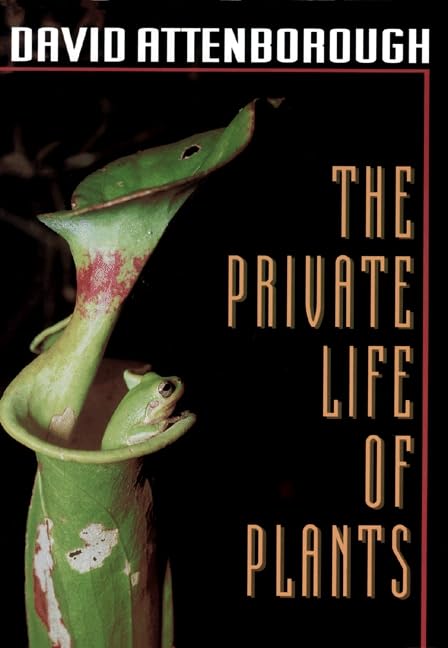
Imagen de portada de Amazon
Imagen de Amazon.com
Imagen de cubierta Syndetics
Portada de Syndetics
Imagen de OpenLibrary

The private life of plants a natural history of plant behaviour David Attenborough.

Por: Detalles de publicación: Princeton, NJ Princeton University Press c1995.Descripción: 320 p. col. ill. 26 cmISBN:
  • 0691006393 (cloth : alk. paper)
Tema(s): Clasificación CDD:
  • 581.5 20
Clasificación LoC:
  • QK50 .A77 1995
Valoración
    Valoración media: 0.0 (0 votos)
Existencias
Imagen de cubierta Tipo de ítem Biblioteca actual Biblioteca de origen Colección Ubicación en estantería Signatura topográfica Materiales especificados Info Vol URL Copia número Estado Notas Fecha de vencimiento Código de barras Reserva de ítems Prioridad de la cola de reserva de ejemplar Reservas para cursos
Libro Biblioteca de Mayagüez Colección General mb QK50 .A77 1995 (Navegar estantería(Abre debajo)) Disponible 50000001826881
Total de reservas: 0

Descripciones mejoradas de Syndetics:

Based on the immensely popular six-part BBC program that aired in the United States during the fall of 1995, this book offers what writer/filmmaker David Attenborough is best known for delivering: an intimate view of the natural world wherein a multitude of miniature dramas unfold. In the program and book, both titled The Private Life of Plants , Attenborough treks through rainforests, mountain ranges, deserts, beaches, and home gardens to show us things we might never have suspected about the vegetation that surrounds us. With their extraordinary sensibility, plants compete endlessly for survival and interact with animals and insects: they can see, count, communicate, adjust position, strike, and capture. Attenborough makes the plant world a vivid place for readers, who in this book can enjoy the tour at their own pace, taking in the lively descriptions and nearly 300 full-color photos showing plants in close detail.


The author reveals to us the aspects of plants' lives that seem hidden from view, such as fighting, avoiding or exploiting predators or neighbors, and struggling to find food, increase their territories, reproduce themselves, and establish their place in the sun. Among the most amazing examples, the acacia can communicate with other acacias and repel enemies that might eat their leaves, the orchid can impersonate female wasps to attract males and ensure the spreading of its pollen, the Venus's flytrap can take other organisms captive and consume them. Covering this remarkable range of information with enthusiasm and clarity, Attenborough helps us to look anew at the vegetation on which all life depends and which has an intriguing life of its own. He has created a book sure to please the plant lover and any other reader interested in exploring the natural world.

Includes index.

Reseñas proporcionadas por Syndetics

Library Journal Review

Intrepid naturalist Attenborough (Trials of Life, Little, Brown, 1991) once again stalks the planet to find the most fascinating and exquisite specimens to illustrate the wonders of the living world. There are plants in this book that this natural history reviewer and botany major never saw before, such as the Sumatran titan arum with its nine-foot-tall inflorescence and the equally elusive British ghost orchid, which regularly reappears after being declared extinct. Attenborough notes that plants "must grapple with much the same problems as animals, including ourselves," and describes these endeavors in chapters on traveling, feeding and growing, flowering, social struggle, living together, and surviving. Other popularizations have covered the same basic territory, but rarely in such a captivating way. Highly recommended for natural history collections at all levels. [This is a companion to a six-part BBC series that will air this fall in the United States.‘Ed.]‘Beth Clewis, Prince William P.L. System, Va. (c) Copyright 2010. Library Journals LLC, a wholly owned subsidiary of Media Source, Inc. No redistribution permitted.

CHOICE Review

Neither a text nor a reference work, this beautifully written, strikingly illustrated book is intended for the general public. Its utility in the college environment comes from its inspirational value. Attenborough's book, based on his BBC program of the same name, is packed with fascinating, generally accurate anecdotes about the plant world and especially about plant/animal interactions. The chapters have titles such as "Travelling," which covers mainly seed dispersal, and "Feeding and Growing," which discusses photosynthesis at a grade-school level but gives many nontechnical examples of herbivory, plant defenses, and carnivorous plants. Attenborough uses common names for plants and there are no references to the primary literature, but the scientific names appear in the index and the book may well stimulate nonscience majors or beginning botany students to explore further on their own. Arthur Galston's Life Processes of Plants (CH, Jun'94) is also intended for the general public, but it focuses on plant physiology, contains more scientific evidence, and includes brief bibliographies with each chapter. H. L. Gorton; St. Mary's College of Maryland

Notas de autor provistas por Syndetics

Sir David Attenborough, a Fellow of the Royal Society, is also a Trustee of the British Museum and an Honorary Fellow of Clare College, Cambridge. He is an internationally esteemed producer, and has written the bestselling books accompanying his television series Trials of Life , The Living Planet , and Life on Earth . For many weeks The Private Life of Plants was a number-one bestseller in the United Kingdom.
Compartir
logopucpr-y-vive

Contáctanos

¡Queremos saber de ti!

Tel. 787.841.2000 Ext. 1801

bibliotecavaldes@pucpr.edu

⁣Búscanos en las redes

© 2026 Desarrollado por Ignite Online • All Rights Reserved • Powered by Koha.