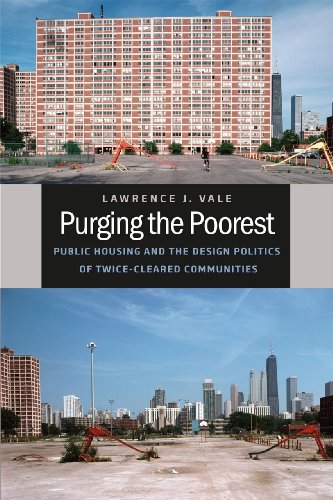

Purging the poorest public housing and the design politics of twice-cleared communities. txt
Editor: Chicago University of Chicago Press 2013Descripción: 428 pages ill. 23 cmTipo de contenido:- text
- unmediaded
- volume
- 9780226012452
- 022601245X
- 363.5
- HD7288.78.U5 V35 2013
| Imagen de cubierta | Tipo de ítem | Biblioteca actual | Biblioteca de origen | Colección | Ubicación en estantería | Signatura topográfica | Materiales especificados | Info Vol | URL | Copia número | Estado | Notas | Fecha de vencimiento | Código de barras | Reserva de ítems | Prioridad de la cola de reserva de ejemplar | Reservas para cursos | |
|---|---|---|---|---|---|---|---|---|---|---|---|---|---|---|---|---|---|---|
| Libro | CARIBET Biblioteca Arquitectura Colección General CARIBET | General HD7288.78.U5 V35 2013 (Navegar estantería(Abre debajo)) | 1 | Disponible | 91000000043034 |
Descripciones mejoradas de Syndetics:
The building and management of public housing is often seen as a signal failure of American public policy, but this is a vastly oversimplified view. In Purging the Poorest , Lawrence J. Vale offers a new narrative of the seventy-five-year struggle to house the "deserving poor."
In the 1930s, two iconic American cities, Atlanta and Chicago, demolished their slums and established some of this country's first public housing. Six decades later, these same cities also led the way in clearing public housing itself. Vale's groundbreaking history of these "twice-cleared" communities provides unprecedented detail about the development, decline, and redevelopment of two of America's most famous housing projects: Chicago's Cabrini-Green and Atlanta's Techwood /Clark Howell Homes. Vale offers the novel concept of design politics to show how issues of architecture and urbanism are intimately bound up in thinking about policy. Drawing from extensive archival research and in-depth interviews, Vale recalibrates the larger cultural role of public housing, revalues the contributions of public housing residents, and reconsiders the role of design and designers.
Includes index.
Includes bibliographical references.
Public housing, design politics, and twice-cleared communities -- Public housing and private initiative : developing Atlanta's Techwood and Clark Howell homes -- Redeveloping Techwood and Clark Howell : the purges of progress -- Up from little hell : developing Chicago's Frances Cabrini homes -- Urban renewal and the rise of Cabrini-Green -- Staving off collapse : mediated violence and the beginning of Cabrini's end -- Bringing the Gold Coast to the slum : Cabrini-Green's redevelopment and the litigation of inclusion -- Conclusion : public housing and the margins of empathy.
Tabla de contenidos provista por Syndetics
- List of Illustrations(p. vii)
- Preface(p. xi)
- Acknowledgments(p. xv)
- 1 Public Housing, Design Politics, and Twice-Cleared Communities(p. 1)
- 2 Public Housing and Private Initiative: Developing Atlanta's Techwood and Clark Howell Homes(p. 39)
- 3 Redeveloping Techwood and Clark Howell: The Purges of Progress(p. 90)
- 4 Up from Little Hell: Developing Chicago's Frances Cabrini Homes(p. 155)
- 5 Urban Renewal and the Rise of Cabrini-Green(p. 193)
- 6 Staving Off Collapse: Mediated Violence and the Beginning of Cabrini's End(p. 230)
- 7 Bringing the Gold Coast to the Slum: Cabrini-Green's Redevelopment and the Litigation of Inclusion(p. 254)
- 8 Conclusion: Public Housing and the Margins of Empathy(p. 314)
- Notes(p. 345)
- Credits(p. 397)
- Index(p. 399)