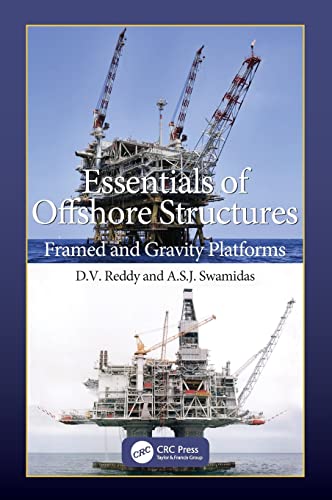

Essentials of offshore structures framed and gravity platforms D.V. Reddy and A.S.J. Swamidas.
Idioma: Inglés Descripción: xvii, 666 pages ill. 26 cmISBN:- 9781420068825 (hardcover : alk. paper)
- 627.98
- TC1665.R43 2013
| Imagen de cubierta | Tipo de ítem | Biblioteca actual | Biblioteca de origen | Colección | Ubicación en estantería | Signatura topográfica | Materiales especificados | Info Vol | URL | Copia número | Estado | Notas | Fecha de vencimiento | Código de barras | Reserva de ítems | Prioridad de la cola de reserva de ejemplar | Reservas para cursos | |
|---|---|---|---|---|---|---|---|---|---|---|---|---|---|---|---|---|---|---|
| Libro | CARIBET Biblioteca Arquitectura Colección General CARIBET | TC1665.R43 2013 (Navegar estantería(Abre debajo)) | Disponible | 91000000043414 |
Descripciones mejoradas de Syndetics:
Essentials of Offshore Structures: Framed and Gravity Platforms examines the engineering ideas and offshore drilling platforms for exploration and production. This book offers a clear and acceptable demonstration of both the theory and application of the relevant procedures of structural, fluid, and geotechnical mechanics to offshore structures. It makes available a multitude of "solved problems" and "sample problems to solve" which give readers a strong understanding of the analysis and design of steel-framed and base-supported concrete gravity offshore structures. The book highlights sensible engineering applications for offshore structural design, research, and development; it can also be useful to those working in the design industry.
The user will have a detailed overview of the various structures used in the offshore environment and the preliminary costing factors that will influence their choice for the site. Analytical principles emphasized in the book will help the user to clearly comprehend the various issues that need to be taken into account in the analysis and design of an offshore structure, using the API code. The book includes extensive worked-out problems and sample problems for use by the students and instructors, with a Solution Manual. The seabed pile/gravity foundation analyses and design are clearly outlined with their embedment characteristics and problems worked out. A global description of environmental forces has been given that includes those due to wave, wind, current, tides, earthquakes, ice floe/sheet action, and limit ice-load on Arctic structures. The book outlines the various factors that influence the material choice for offshore structures including fatigue and corrosion of the platforms in the ocean environment.Separate chapters detail the factors that influence the pile embedment and concrete gravity foundation characteristics, material choice including fatigue and corrosion, estimation of ocean environmental forces that will be exerted on the offshore structures, and the analysis fundamentals that the reader needs to possess. The last two chapters give detailed insights into the analysis and design of framed and concrete gravity platform offshore structures using API code procedures. Overall, this book is a comprehensive presentation of the analysis and design of steel and concrete offshore structures.
Includes bibliographical references and index.
Tabla de contenidos provista por Syndetics
- Preface(p. xv)
- Authors(p. xvii)
- Chapter 1 Offshore Operations and Structural Development(p. 1)
- 1.1 Introduction(p. 1)
- 1.2 Current State of the Industry(p. 3)
- 1.3 Commercial Projections for the Offshore Industry(p. 6)
- 1.4 Structural Concept Evaluation and Innovative Developments(p. 15)
- 1.5 Legal Jurisdiction(p. 30)
- 1.6 History of Offshore Structural Development(p. 32)
- Exercise Problems(p. 35)
- Appendix(p. 39)
- References(p. 43)
- Chapter 2 Components of a Typical Offshore Structure(p. 47)
- 2.1 Introduction(p. 47)
- 2.2 Functional and Structural Requirements of an Offshore Platform(p. 50)
- 2.3 Components of a Fixed Jacket Steel Platform(p. 51)
- 2.3.1 Jacket Substructure(p. 53)
- 2.3.2 Pile Foundation(p. 58)
- 2.4 Components of a Steel Jack-Up Platform(p. 60)
- 2.5 Components of a Concrete Gravity Platform(p. 63)
- 2.6 Components of a Ship Structure(p. 70)
- 2.6.1 Modern Trends(p. 75)
- 2.7 Components of a Semi-Submersible(p. 75)
- Exercise Problems(p. 81)
- References(p. 83)
- Chapter 3 Ocean Environment: Wind, Wave, Current, Tides, Ice, and Seismic Effects(p. 85)
- 3.1 Introduction(p. 85)
- 3.2 Description of the Ocean Environment(p. 85)
- 3.2.1 Winds(p. 85)
- 3.2.2 Currents(p. 88)
- 3.2.3 Waves(p. 89)
- 3.2.4 Tides(p. 90)
- 3.2.5 Earthquakes(p. 92)
- 3.2.6 Sea Ice and Other Forms of Ice in the Ocean(p. 95)
- 3.2.6.1 Icebergs(p. 97)
- 3.3 Ocean Winds and Wind Statistics(p. 100)
- 3.3.1 Introduction to Wind(p. 100)
- 3.3.2 Theoretical Characterization of Wind Regime(p. 102)
- 3.3.2.1 Probabilistic Nature of Wind Regime(p. 103)
- 3.3.3 Wind Velocity Profile(p. 107)
- 3.4 Ocean Waves and Wave Statistics(p. 110)
- 3.4.1 Introduction to Waves(p. 110)
- 3.4.2 Airy's Two-Dimensional Small Amplitude Linear Wave Formulation(p. 111)
- 3.4.2.1 Wave Particle Velocity, Acceleration, and Orbit(p. 115)
- 3.4.2.2 Wave Pressure, Energy, and Flux (or Power)(p. 117)
- 3.4.3 Nonlinear Wave Formulation(p. 120)
- 3.4.4 Wave Statistics and Spectral Characterization(p. 124)
- 3.4.4.1 Theoretical Prediction Based on Statistical Characterization of Waves(p. 125)
- 3.4.4.2 Wave Prediction from Wind Characteristics(p. 132)
- 3.5 Ocean Currents(p. 135)
- 3.5.1 Introduction to Ocean Currents(p. 135)
- 3.5.2 Current Velocity Profile(p. 136)
- 3.6 Solar and Lunar Ocean Tides(p. 139)
- 3.6.1 Introduction to Solar and Lunar Ocean Tides(p. 139)
- 3.6.2 Theory of Tidal Formation(p. 140)
- 3.6.3 Water Level Fluctuations Including Tides(p. 142)
- 3.7 Seismological Considerations, Earthquakes, and Seaquakes(p. 147)
- 3.7.1 Introduction to Seismological Considerations, Earthquakes, and Seaquakes(p. 147)
- 3.7.2 Characteristic Features of Earthquake Phenomena(p. 147)
- 3.7.3 Magnitude and Intensity of Earthquakes(p. 150)
- 3.8 Ice Environment and Properties(p. 153)
- 3.8.1 Introduction to Ice Environment and Properties(p. 153)
- 3.8.2 Ice Properties(p. 154)
- 3.8.3 Modes of Possible Ice-Structure Interaction(p. 157)
- Exercise Problems(p. 160)
- References(p. 167)
- Chapter 4 Seabed Mechanics(p. 171)
- 4.1 Introduction(p. 171)
- 4.2 Ocean Floor Characteristics and Characterization(p. 171)
- 4.3 Offshore Site Investigation and Equipment Used(p. 177)
- 4.3.1 Introduction(p. 177)
- 4.3.2 High-Resolution Geophysical Surveys(p. 178)
- 4.3.3 Drill and Wire-Line Coring Techniques Using Surface Support Vessel(p. 179)
- 4.3.3.1 Drill and Wire-Line Coring Using Surface Support Vessel(p. 179)
- 4.3.3.2 Sea Bottom-Located Rotary Drills with Wire-Line Corers and Operated by Divers(p. 180)
- 4.3.3.3 Vibro-Coring or Flexo-Coring (with Equipment at Sea Bottom) from Surface Support Vessel(p. 180)
- 4.3.3.4 Using Remote-Controlled Rotary Corers(p. 181)
- 4.3.3.5 Use of Gravity or Stationary Piston Corers(p. 181)
- 4.3.4 Remote In Situ Measurements(p. 184)
- 4.3.4.1 Modular Seacalf Cone Penetrometers(p. 184)
- 4.3.4.2 Wire-Line Vane Shear Test Equipment(p. 190)
- 4.4 Ocean Bed Soil Mechanics(p. 195)
- 4.4.1 Introduction(p. 195)
- 4.4.2 Identification of Marine Soil Characteristics(p. 196)
- 4.4.3 Structure of Soil(p. 196)
- 4.4.4 Atterberg Limits(p. 199)
- 4.4.5 Permeability of Soils(p. 201)
- 4.4.6 Stresses in Ocean Soils and Effective Stress Principle(p. 202)
- 4.4.7 Shear Strength and Failure of Ocean Soils(p. 205)
- 4.4.7.1 Laboratory Tests to Measure Shear Strengths(p. 206)
- 4.4.7.2 Stress-Strain Curves and Shear Strength Computation(p. 207)
- 4.4.7.3 Simple Methods for Estimating Undrained Cohesion(p. 210)
- 4.4.8 Consolidation (or Compressibility) of Ocean Soils(p. 212)
- 4.4.9 Stiffness of Soils(p. 217)
- 4.5 Bearing Capacities of Offshore Platforms(p. 220)
- 4.5.1 General(p. 220)
- 4.5.1.1 Scour(p. 220)
- 4.5.1.2 Mudslides(p. 220)
- 4.5.1.3 Sand Waves, Dunes, Banks(p. 221)
- 4.5.1.4 Seabed Subsidence(p. 221)
- 4.5.2 Bottom-Fixed Jacket Platforms on Piles(p. 221)
- 4.5.2.1 Stability of Fixed Platforms in Piles(p. 221)
- 4.5.2.2 Bearing Capacity of Piles in Compression and Tension(p. 224)
- 4.5.3 Bottom-Supported Gravity Platforms(p. 228)
- 4.5.3.1 Geotechnical Issues Related to Installation of Platform Structure on Site(p. 229)
- 4.5.3.2 Stability of Gravity Platform Structure under Static Loads and under Cyclic Environmental Loads(p. 229)
- 4.5.3.3 Settlement of Soil beneath Gravity Platform Foundations(p. 231)
- 4.5.4 Stress Distribution beneath Gravity Platform Foundation(p. 231)
- 4.5.5 Computation of Stability of Gravity Platform Structure(p. 232)
- 4.5.5.1 Installation Requirements(p. 233)
- 4.5.5.2 Slip (or Sliding) of Foundation Structure(p. 235)
- 4.5.5.3 Vertical Bearing Capacity of Soil beneath Gravity Platform Structure(p. 236)
- 4.5.5.4 Stability of Gravity Platform Structure with Respect to Overturning(p. 236)
- Exercise Problems(p. 242)
- References(p. 245)
- Chapter 5 Materials and Their Behavior in the Ocean Environment(p. 249)
- 5.1 Material Requirements for Offshore Structures(p. 249)
- 5.1.1 Introduction(p. 249)
- 5.1.2 Ocean Environment and Materials(p. 252)
- 5.1.2.1 Ocean Water Chemistry(p. 253)
- 5.1.2.2 Biological Considerations(p. 254)
- 5.1.2.3 Marine Atmosphere(p. 254)
- 5.1.3 Development of Materials for Ocean Structures(p. 255)
- 5.1.3.1 Material Issues Relating to Construction Phase(p. 255)
- 5.1.3.2 Material Issues Relating to Operation Phase(p. 260)
- 5.2 Mechanical Properties for Ocean Use(p. 266)
- 5.2.1 Introduction(p. 266)
- 5.2.2 Properties Related to Strength and Deformation(p. 269)
- 5.2.3 Properties Related to Failure, Fatigue, and Fracture(p. 274)
- 5.2.3.1 Failure Strength of Materials(p. 275)
- 5.23.2 Fracture Mechanics(p. 277)
- 5.2.3.3 Fatigue Failure and Crack Initiation(p. 284)
- 5.2.3.4 Fatigue Failure and Crack Propagation(p. 286)
- 5.2.4 Introduction to Properties of a Range of Materials Used in the Ocean(p. 295)
- 5.2.4.1 Alloys of Iron and Steel(p. 296)
- 5.2.4.2 Low-Carbon Steels(p. 296)
- 5.2.4.3 Medium-Strength Steels(p. 296)
- 5.2.4.4 High-Strength Steels(p. 296)
- 5.2.4.5 Aluminum Alloys(p. 300)
- 5.2.4.6 Titanium Alloys(p. 300)
- 5.2.4.7 Nonmetallic Materials(p. 300)
- 5.3 Range of Material Properties and Material Selection(p. 306)
- 5.3.1 Introduction(p. 306)
- 5.3.2 Range of Material Properties for Ocean Structures(p. 307)
- 5.3.3 Selection of Materials for Ocean Structures(p. 307)
- 5.4 Marine Corrosion and Biodegradation(p. 311)
- 5.4.1 Introduction(p. 311)
- 5.4.2 Basic Mechanisms in Corrosion(p. 311)
- 5.4.3 Corrosion and Microbial Effects of Ocean Environment(p. 315)
- 5.4.3.1 Ocean Atmosphere(p. 315)
- 5.4.3.2 Scawater(p. 316)
- 5.43.3 Mineral, Mud, and Hydrocarbon Products(p. 317)
- 5.4.3.4 Carbon Dioxide(p. 318)
- 5.4.3.5 Biological and Microbiological Environments(p. 318)
- 5.4.4 Forms of Corrosion(p. 320)
- 5.4.4.1 General Corrosion(p. 320)
- 5.4.4.2 Galvanic Corrosion(p. 320)
- 5.4.43 Crevice Corrosion(p. 321)
- 5.4.4.4 Pitting Corrosion(p. 321)
- 5.4.4.5 Intergranular Corrosion(p. 322)
- 5.4.4.6 Differential Environmental Influences(p. 322)
- 5.4.4.7 Fretting Corrosion(p. 322)
- 5.4.4.8 Corrosion-Erosion(p. 322)
- 5.4.4.9 Stress Corrosion Cracking(p. 322)
- 5.4.4.10 Corrosion Fatigue(p. 323)
- 5.4.5 Corrosion Protection(p. 324)
- 5.4.5.1 Protective Coatings(p. 324)
- 5.4.5.2 Catholic Protection(p. 325)
- 5.4.5.3 Anodic Protection(p. 326)
- 5.4.5.4 Corrosion Inhibition and Electrolyte Modification(p. 326)
- Exercise Problems(p. 327)
- References(p. 332)
- Chapter 6 Environmental Forces on Offshore Structures(p. 337)
- 6.1 Introduction(p. 337)
- 6.1.1 Permanent (or Dead) Loads(p. 337)
- 6.1.2 Operating (or Live) Loads(p. 337)
- 6.1.3 Environmental Loads (Forces)(p. 338)
- 6.1.4 Construction and Installation Loads (Forces)(p. 338)
- 6.1.4.1 Lifting Forces(p. 339)
- 6.1.4.2 Load-Out Forces(p. 340)
- 6.1.4.3 Transportation Forces(p. 340)
- 6.1.4.4 Launching and Upending Forces(p. 342)
- 6.1.5 Accidental Loads (Forces)(p. 344)
- 6.2 Design Conditions for Loads (Forces) Acting on the Structure(p. 345)
- 6.2.1 Limit State, Probability, and Safety(p. 345)
- 6.2.2 Limit Slate Design(p. 347)
- 6.3 Environmental Forces(p. 350)
- 6.3.1 Introduction(p. 350)
- 6.3.2 Wind Forces(p. 351)
- 6.3.3 Wave Forces(p. 362)
- 6.3.3.1 Wave Statistics(p. 363)
- 6.3.4 Wave Forces on Offshore Structures(p. 363)
- 6.3.4.1 Wave Forces on Slender Vertical Cylindrical Members(p. 364)
- 6.3.4.2 Linearization of Nonlinear Wave Drag Force(p. 366)
- 6.3.4.3 Wave Forces Obtained from Airy's Linear Wave Theory(p. 368)
- 6.3.4.4 Effects of Relative Motion of the Structure(p. 370)
- 6.3.4.5 Wave Forces on Arbitrarily Oriented Cylindrical Members(p. 373)
- 6.3.4.6 Wave Forces on Large Diameter Structures(p. 376)
- 6.3.5 Current Forces(p. 378)
- 6.3.5.1 Current Velocity Profiles(p. 378)
- 6.3.5.2 Current Forces Exerted on the Structure(p. 382)
- 6.3.5.3 Forces Exerted on the Structure due to Current-Wave Interaction(p. 382)
- 6.3.6 Earthquake Forces(p. 386)
- 6.3.7 Ice Forces on Ocean Structures(p. 388)
- 6.3.7.1 Ice Loads on Vertical Cylindrical Structures(p. 389)
- 6.3.7.2 Ice Loads on Sloping Structures(p. 392)
- 6.3.7.3 Limit Loads due to Environmental Interaction(p. 395)
- 6.3.8 Tides(p. 400)
- 6.3.9 Marine Growth(p. 400)
- Exercise Problems(p. 401)
- References(p. 415)
- Chapter 7 Fundamental Considerations for Framed Offshore Structural Analysis(p. 419)
- 7.1 Introduction(p. 419)
- 7.2 Site Characteristics and Modeling Procedures for Analyses(p. 419)
- 7.2.1 Structural Skeleton for Force Application and Analysis(p. 419)
- 7.3 Hydrostatic Pressure and Buoyancy(p. 429)
- 7.4 Preliminary Considerations for Static Analysis and Design(p. 431)
- 7.5 Finite Element Applications for Framed Offshore Structural Analyses(p. 438)
- 7.5.1 Introduction(p. 438)
- 7.5.2 Use of Truss Elements in Offshore Structural Modeling(p. 439)
- 7.5.3 Plane Trusses(p. 439)
- 7.5.4 Space Trusses(p. 449)
- 7.5.5 Use of Beam Elements in Offshore Structural Modeling(p. 452)
- 7.5.5.1 Plane Frames(p. 453)
- 7.5.5.2 Member Stiffness Matrix for Horizontal Beam Member(p. 453)
- 7.5.5.3 Member Stiffness Matrix for Arbitrarily Oriented Member(p. 456)
- 7.5.5.4 Relating Member Stiffness Matrix to System Axes(p. 458)
- 7.5.5.5 Space Frames(p. 463)
- 7.6 Formulation of Solid-Fluid Interaction Problems(p. 471)
- 7.7 Simplified Lumped Mass/Stiffness Considerations for Dynamic Analyses(p. 474)
- 7.7.1 Introduction(p. 474)
- 7.7.2 Characterization of Offshore Structure as an SDOF System(p. 477)
- 7.7.3 SDOF Models in Offshore Structures(p. 480)
- 7.7.4 MDOF Systems(p. 485)
- 7.7.4.1 Two-Degrees-of-Freedom System(p. 485)
- 7.7.4.2 Three-Degrees-of-Freedom System(p. 486)
- 7.7.4.3 Many-Degrees-of-Freedom System(p. 487)
- 7.7.4.4 Solution Procedures(p. 488)
- Exercise Problems(p. 492)
- References(p. 503)
- Chapter 8 Analysis and Design Considerations for Framed Steel Offshore Platforms(p. 507)
- 8.1 Introduction(p. 507)
- 8.1.1 Design Considerations(p. 508)
- 8.1.2 Design Codes and Provisions(p. 510)
- 8.2 Preliminary Design Considerations for Steel Jacket Offshore Structures(p. 511)
- 8.2.1 Typical Preliminary Design(p. 511)
- 8.2.2 Minimum Embedment Length of Piles (of Columns)(p. 513)
- 8.2.2.1 Embedment Length(p. 513)
- 8.2.2.2 Equivalent Short Pile Length(p. 515)
- 8.2.2.3 Sufficiency of Selected Column Pile Section for Short Pile(p. 516)
- 8.2.3 Top Deck Analysis for Imposed Loads(p. 516)
- 8.2.3.1 Sufficiency of Vertical Column below Top Deck(p. 517)
- 8.2.3.2 Analysis and Design of Deck Framing Members(p. 520)
- 8.2.3.3 Truss Structures in the Top Deck(p. 526)
- 8.2.3.4 Reassessing Sufficiency of Vertical Column below the Top Deck(p. 531)
- 8.2.3.5 Tubular Members in Jacket Structure(p. 532)
- 8.2.3.6 Miscellaneous Considerations for Jacket Platform(p. 535)
- 8.3 Analysis of Pile Foundations for Offshore Structures(p. 536)
- 8.3.1 Introduction(p. 536)
- 8.3.2 Soil-Structure Interaction(p. 536)
- 8.3.2.1 Beam-on-Elastic (due to Hetenyi) Foundation(p. 538)
- 8.3.2.2 Beam-on-Winkler Foundation: p-y Curve Approach(p. 540)
- 8.3.2.3 Elastic Continuum Approach(p. 541)
- 8.3.2.4 Finite Element Approaches(p. 541)
- 8.4 p-y Curve Approach(p. 541)
- 8.5 Classical Derivations for Pile-Soil Interaction(p. 546)
- 8.6 Code-Based Foundation Design for Pile-Supported Offshore Structures(p. 549)
- 8.6.1 Axial Resistance of Piles(p. 550)
- 8.6.2 Soil Reaction for Laterally Loaded Piles(p. 555)
- 8.6.2.1 Lateral Bearing Capacity for Piles in Soft Clay(p. 555)
- 8.6.2.2 Load-Deflection Relationships for Piles in Soft Clay(p. 556)
- 8.6.2.3 Lateral Bearing Resistance for Piles in Stiff Clay(p. 557)
- 8.6.2.4 Load-Deflection Relationship for Piles in Stiff Clay(p. 557)
- 8.6.2.5 Lateral Bearing Capacity for Piles in Sand(p. 557)
- 8.6.2.6 Load Deflection (p-y) Curves for Piles in Sand(p. 558)
- 8.6.3 Influence of Group of Piles(p. 558)
- 8.6.4 Thickness of Pile Wall(p. 559)
- 8.6.5 Length of Pile Sections(p. 560)
- Exercise Problems(p. 571)
- Appendix 8A (p. 579)
- Appendix 8B (p. 583)
- References(p. 586)
- Chapter 9 Analysis and Design of Concrete Gravity Platforms(p. 591)
- 9.1 Introduction and Design Environmental Conditions(p. 591)
- 9.1.1 Introduction(p. 591)
- 9.1.2 Structural Components of Gravity Platform(p. 591)
- 9.1.3 Typical Design Environmental Conditions(p. 593)
- 9.1.4 Analysis and Design Aspects of Gravity Platform(p. 594)
- 9.1.5 Salient Features to Be Considered in Analysis and Design(p. 597)
- 9.2 Bearing Capacities of Gravity Platform Foundation(p. 600)
- 9.2.1 Requirements in Design(p. 600)
- 9.2.2 Undrained Bearing Capacity of Foundation Soil(p. 601)
- 9.2.3 Drained Bearing Capacity of Foundation Soil(p. 602)
- 9.2.4 Sliding Resistance of Foundation Soil(p. 603)
- 9.2.5 Ultimate Capacities of Shallow Foundations(p. 603)
- 9.3 Static Deformation of Gravity Platform Foundation(p. 609)
- 9.3.1 Introduction(p. 609)
- 9.3.2 Immediate or Short-Time Deformations(p. 609)
- 9.3.2.1 API Code Provisions(p. 610)
- 9.3.3 Primary Consolidation(p. 610)
- 9.3.3.1 Secondary Consolidation(p. 611)
- 9.3.3.2 API Code Provisions(p. 611)
- 9.3.4 Regional Subsidence(p. 612)
- 9.3.5 Other Considerations(p. 612)
- 9.4 Analysis and Design of Gravity Platform Subjected to Wind and Wave Loads(p. 612)
- 9.4.1 Introduction(p. 612)
- 9.4.2 Assumptions Made in Simplified Analysis(p. 614)
- 9.4.3 Additional Considerations for Dynamic Behavior of Platform Components(p. 616)
- Exercise Problems(p. 640)
- References(p. 649)
- Index(p. 653)
Notas de autor provistas por Syndetics
D. V. Reddy, Ph.D., P.E., P. Eng., C. Eng (U.K.) is a professor of civil, environmental and geomatics engineering, and director, Center for Marine Structures and Geotechnique, Florida Atlantic University, Boca Raton, FL, U.S.A. He has held professorships at the Indian Institute of Technology Madras, Chennai, India; Memorial University of Newfoundland, St. John's, NL, Canada; and University of Florida, Gainesville, FL, U.S.A.; and visiting professorships at a number of universities. He has taught courses on offshore and coastal structures for over 30 years. His research interests are in the areas of marine structures, materials, and geotechnical engineering, with particular focus on concrete technology and computational/analytical mechanics. He is a Fellow of the American Concrete Institute. He has authored over 370 papers, two books, edited three conference volumes; and been recognized by a number of awards.
Dr. A.S.J. Swamidas, Ph.D, has held professorships at the Indian Institute of Technology Madras, Chennai, India; and at Memorial University of Newfoundland, St. John's, NL, Canada. He has taught offshore structures for more than 20 years and acted as a consultant to a number of companies. His research interests are in the area of dynamics of offshore and onshore structures. He has authored over 210 papers/reports, and edited two conference volumes.