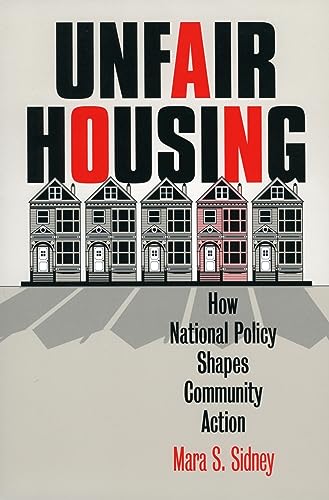

Unfair housing : how national policy shapes community action. txt
Series Studies in government and public policyUnited States of America University Press of Kansas 2003Descripción: 186 p. 24 cmTipo de contenido:- text
- unmediaded
- volume
- 0700612769
- 0700612750
- 363.5
- HD7288.76.U5 S53 2003
| Imagen de cubierta | Tipo de ítem | Biblioteca actual | Biblioteca de origen | Colección | Ubicación en estantería | Signatura topográfica | Materiales especificados | Info Vol | URL | Copia número | Estado | Notas | Fecha de vencimiento | Código de barras | Reserva de ítems | Prioridad de la cola de reserva de ejemplar | Reservas para cursos | |
|---|---|---|---|---|---|---|---|---|---|---|---|---|---|---|---|---|---|---|
| Libro | CARIBET Biblioteca Arquitectura Colección General CARIBET | General HD7288.76.U5 S53 2003 (Navegar estantería(Abre debajo)) | 1 | Disponible | 91000000043463 |
Descripciones mejoradas de Syndetics:
It is difficult to ignore the fact that, even as the United States becomes much more racially and ethnically diverse, our neighborhoods remain largely segregated. The 1968 Fair Housing Act and 1977 Community Reinvestment Act promised to end discrimination, yet for millions of Americans housing options remain far removed from the American Dream. Why do most neighborhoods in American cities continue to be racially divided?
The problem, suggests Mara Sidney, lies with the policies themselves. She contends that to understand why discrimination persists, we need to understand the political challenges faced by advocacy groups who implement them. In Unfair Housing she offers a new explanation for the persistent color lines in our cities by showing how weak national policy has silenced and splintered grassroots activists.
Sidney explains how political compromise among national lawmakers with divergent interests resulted in housing legislation that influenced how community activists defined discrimination, what actions they took, and which political relationships they cultivated. As a result, local governments became less likely to include housing discrimination on their agendas, existing laws went unenforced, and racial segregation continued.
A former undercover investigator for a fair housing advocacy group, Sidney takes readers into the neighborhoods of Minneapolis and Denver to show how federal housing policy actually works. She examines how these laws played out in these cities and reveals how they eroded activists' capability to force more sweeping reform in housing policy.
Sidney also shows how activist groups can cultivate community resources to overcome these difficulties, looking across levels of government to analyze how national policies interact with local politics. In the first book to apply policy design theories of Anne Schneider and Helen Ingram to an empirical case, Sidney illuminates overlooked impacts of fair housing and community reinvestment policies and extends their theories to the study of local politics and nonprofit organizations.
Sidney argues forcefully that understanding the link between national policy and local groups sheds light on our failure to reduce discrimination and segregation. As battles over fair housing continue, her book helps us understand the shape of the battlefield and the prospects for victory.
Includes index.
Includes bibliographical references (p. 159-180)
Housing discrimination : problems, politics, policies -- Crafting housing policy in spotlight and shadow -- Linking housing policy to advocacy -- Advocacy for housing equality in Minneapolis -- Advocacy for housing equality in Denver -- A comparative analysis of fair housing and community reinvestment movements : national and local impacts on advocacy -- Advancing the struggle for housing equality : opportunities and constraints.