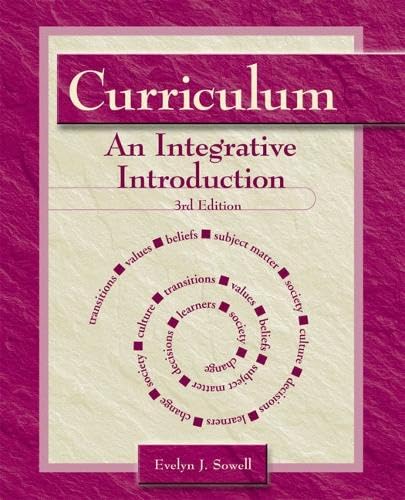
Imagen de portada de Amazon
Imagen de Amazon.com
Imagen de cubierta Syndetics
Portada de Syndetics
Imagen de OpenLibrary

Curriculum an integrative introduction Evelyn J. Sowell.

Por: Detalles de publicación: Upper Saddle River, N.J. Pearson/Merrill/Prentice Hall c2005.Edición: Third editionDescripción: xvii, 326 p. ill. 25 cmISBN:
  • 0131112910
Tema(s):
Contenidos:
Overview of curriculum products and processes -- Curriculum decision making : its nature and personnel -- Curriculum organization -- Knowledge and subject matter -- Society and culture -- Learners -- Introductions for instructional level curriculum projects -- Content for instructional level curriculum projects -- Creation of instructional level outcomes projects -- Implementation of instructional level outcomes projects -- Creation and enactment of instructional level experiences projects -- Curriculum evaluation.
Valoración
    Valoración media: 0.0 (0 votos)
Existencias
Imagen de cubierta Tipo de ítem Biblioteca actual Biblioteca de origen Colección Ubicación en estantería Signatura topográfica Materiales especificados Info Vol URL Copia número Estado Notas Fecha de vencimiento Código de barras Reserva de ítems Prioridad de la cola de reserva de ejemplar Reservas para cursos
Libro Biblioteca Mons. Iñaki Mallona (Arecibo) Colección General ab 375.001 S731c3 (Navegar estantería(Abre debajo)) Disponible 60000010164660
Total de reservas: 0

Descripciones mejoradas de Syndetics:

Intended for undergraduate and graduate courses in Curriculum Development and Curriculum Planning. This text bridges curriculum theory to practice, exploring ways to develop curriculum, and assess a school's curriculum by applying chapter content to sample curriculum projects. It shows how use of theory helps educators engage in curriculum tasks.

Includes bibliographical references and indexes.

Overview of curriculum products and processes -- Curriculum decision making : its nature and personnel -- Curriculum organization -- Knowledge and subject matter -- Society and culture -- Learners -- Introductions for instructional level curriculum projects -- Content for instructional level curriculum projects -- Creation of instructional level outcomes projects -- Implementation of instructional level outcomes projects -- Creation and enactment of instructional level experiences projects -- Curriculum evaluation.

Tabla de contenidos provista por Syndetics

  • Part 1 Introduction To Curriculum Processes, Products, And Personnel
  • 1 Overview of Curriculum Processes and Products
  • 2 Curriculum Decision Making: Its Nature and Personnel
  • Part 2 Bases For Curriculum Processes
  • 3 Curriculum Organization
  • 4 Knowledge and Subject Matter
  • 5 Society and Culture
  • 6 Learners
  • Part 3 Development, Use, And Evaluation Of Instructional Level Curriculum Projects
  • 7 Introductions of Instructional Level Curriculum Projects
  • 8 Content for Instructional Level Curriculum Projects
  • 9 Creation of Instructional Level Outcomes Projects
  • 10 Implementation of Instructional Level Outcomes Projects
  • 11 Creation and Enactment of Instructional Level Experience Projects
  • 12 Curriculum Evaluation
  • Answers to Action Points
  • Appendix A Curriculum Projects
  • Appendix B The Program Evaluation Standards
  • Glossary
  • References

Extracto provisto por Syndetics

Curriculum is a topic about which educators as well as laypersons have knowledge, because we all attended school. For most of us, everything in and around schools seems somehow related to curriculum. If we're pressed for its exact meaning, we may hesitate to define it, because the boundaries of "curriculum" are not clear. In this text, curriculum refers to what is taught in schools, a deliberately open definition that promotes consideration of curricula serving different purposes and contexts. Written for teachers and nonteaching school staff, this text seeks to bridge curriculum theory and practice by presenting information in practical settings. It's one thing to read and comprehend how curriculum processes work at the level of book knowledge, and quite another to put these processes into practice. This text seeks to show how practice informs theory, and how use of theory helps individuals engage in curriculum tasks appropriately. One major theme of this text is that the curriculum processes (i.e., development, implementation/enactment, and evaluation) involve decision making by people who are guided by their beliefs and values about what students should learn. Furthermore, because the processes are sociopolitical, the beliefs and values incorporated in any particular curriculum may or may not be held by those who use them in classrooms. Both developers and users must arrive at decisions after careful thought, because living with the consequences of decisions made by default or in haste is difficult. A second major theme is that curricular change occurs only after individuals have made internal transitions. That is, people must "end the old" before they can "begin the new." Transitions take time, understanding, and support on the part of all of the people involved. The text discusses the change processes involved when initiating curriculum revisions or when using "new" curricula in classrooms. NEW TO THIS EDITION The third edition provides new content and new features: Instructional level curricula developed by schools or departments are the focus of the development processes. See Chapters 1, 7, 8, 9, and 11. The revised Bloom's taxonomy is used in discussions of cognitive learning out comes. See Chapters 4 and 9. Information about technology in curriculum (e.g., WebQuests) has been updated. See Chapters 8, 9, and 11, as well as Appendix A6. Information about state and national standards as curriculum content sources has been updated and related to the revised Bloom's taxonomy. See Chapters 4 and 8. The discussion of curriculum evaluation has been updated and focused on the application of Sanders-Davidson's School Evaluation Model. See Chapter 12. One specific goal given at the beginning of each chapter helps to focus attention on major points. For Additional Information is a new section at the end of each chapter. These sections list suggested readings and Web resources about selected chapter topics. TEXT FEATURES The text provides the following features: Action Points in every chapter invite readers to participate in the construction of their own curriculum knowledge. Readers who are involved in curriculum processes as they study this text are assisted with their own projects through work on the final Action Point in each chapter, beginning in Chapter 3. The answers to selected Action Points can be found immediately following Chapter 12. Questions for Discussion focus on chapter main points. Some questions are open ended to allow individuals with alternate views to present their ideas. Other questions integrate information from different chapters and require higher-order thinking. Exhibits of instructional curriculum in Chapters 7-11 assist developers in planning their own curriculum. Curriculum documents in Appendix A furnish illustrations and provide content for analyses of the curriculum processes. For Additional Information sections suggest sources of readings and/or Web resources that extend information about selected chapter topics. ORGANIZATION Part I introduces several major ideas, including outcomes and experiences approaches to curriculum processes. Outcomes approaches, which prevail at most public district or school decision-making levels, result in subject-based curricula. Experiences approaches can be found in schools, classrooms, and other educational institutions (e.g., scouts, art museums) where learner- or society-based curricula are the norm. Part II discusses the bases for curriculum, including the following content sources: Knowledge and subject matter, society and culture, and learners. The intent of these chapters is to help readers consider and clarify their values about the relative contributions of these sources to school curricula. Five conceptions of curriculum with unique purposes of education and organization or design use content from these sources in different combinations. Part III discusses and illustrates instructional curriculum development, use, and evaluation. This part details the cyclic nature of curriculum processes. Typically, a curriculum targeted for revision is incompatible with state guidelines, district or school needs, or the desires of the community. After it is revised, the curriculum is used in classrooms where its effects on students and the school community are evaluated, beginning the cycle anew. Connections between the bases for curriculum and the development-use-evaluation processes are elaborated within this text. Both the exhibits mentioned on page vi and the end-of-chapter Action Points in Chapters 3 through 12 link curriculum processes. Connections such as these provide a rationale for the book's title, Curriculum: An Integrative Introduction. Excerpted from Curriculum: An Integrative Introduction by Evelyn J. Sowell All rights reserved by the original copyright owners. Excerpts are provided for display purposes only and may not be reproduced, reprinted or distributed without the written permission of the publisher.
Compartir
logopucpr-y-vive

Contáctanos

¡Queremos saber de ti!

Tel. 787.841.2000 Ext. 1801

bibliotecavaldes@pucpr.edu

⁣Búscanos en las redes

© 2026 Desarrollado por Ignite Online • All Rights Reserved • Powered by Koha.