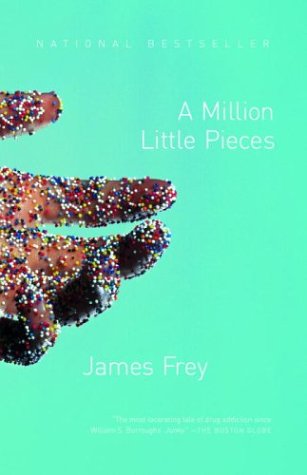

A million little pieces James Frey.
Detalles de publicación: New York Anchor Books 2004.Edición: 1st Anchor Books edDescripción: 430 p. 21 cmISBN:- 1400031087
- 362.29092 22
- HV5831.M6 F74 2004
| Imagen de cubierta | Tipo de ítem | Biblioteca actual | Biblioteca de origen | Colección | Ubicación en estantería | Signatura topográfica | Materiales especificados | Info Vol | URL | Copia número | Estado | Notas | Fecha de vencimiento | Código de barras | Reserva de ítems | Prioridad de la cola de reserva de ejemplar | Reservas para cursos | |
|---|---|---|---|---|---|---|---|---|---|---|---|---|---|---|---|---|---|---|
| Libro | Biblioteca Encarnación Valdés Colección General bev | 362.29092 F8931m (Navegar estantería(Abre debajo)) | Disponible | 80000002526435 |
Descripciones mejoradas de Syndetics:
The most lacerating tale of drug addiction since William S. Burroughs' Junky. --The Boston Globe
Again and again, the book delivers recollections that leave the reader winded and unsteady. James Frey's staggering recovery memoir could well be seen as the final word on the topic.--San Francisco Chronicle
A brutal, beautifully written memoir.--The Denver Post
Gripping . . . A great story . . . You can't help but cheer his victory. --Los Angeles Times Book Review
"Oprah's book club"--Cover.
In response to allegations published in The Smoking Gun Web site that the author had fabricated many of the facts and experiences described in the book, later printings include an insert in which the publisher states that "Memoir is a personal history whose aim is to illuminate, by way of example, events and issues of broader social consequence. By definition, it is highly personal. In the case of Mr. Frey, we decided 'A Million Little Pieces' was his story, told in his own way, and he represented to us that his version of events was true to his recollections. Recent accusations against him notwithstanding, the power of the overall reading experience is such that the book remains a deeply inspiring and redemptive story for millions of readers."
Extracto provisto por Syndetics
Reseñas proporcionadas por Syndetics
Library Journal Review
Frey wakes up on an airplane with four broken teeth, a broken nose, a massive cut on his cheek, and unsure where he is or where he's going. Where he ends up is a residential treatment center based in Minnesota. This is the story of his experiences in that center as an addict and alcoholic. Listeners will meet the residents, including some who helped Frey continue his treatment and his work toward sobriety. The author's tale is brutal and honest, providing a realistic view of the life of an addict, something not for the faint of heart. It's full of profanity and graphic depictions of violence and drug use. In fact, Frey's description of the repair of his teeth without painkillers or anesthesia may keep people from ever going to the dentist again. That said, this presentation, read by Oliver Wyman, is an important addition for all library collections. Organizations that provide support for substance abusers, counseling centers, and prison libraries also should consider purchase.-Danna Bell-Russel, Library of Congress (c) Copyright 2010. Library Journals LLC, a wholly owned subsidiary of Media Source, Inc. No redistribution permitted.Publishers Weekly Review
Frey is pretender to the throne of the aggressive, digressive, cocky Kings David: Eggers and Foster Wallace. Pre-pub comparisons to those writers spring not from Frey's writing but from his attitude: as a recent advance profile put it, the 33-year-old former drug dealer and screenwriter "wants to be the greatest literary writer of his generation." While the Davids have their faults, their work is unquestionably literary. Frey's work is more mirrored surface than depth, but this superficiality has its attractions. With a combination of upper-middle-class entitlement, street credibility garnered by astronomical drug intake and PowerPoint-like sentence fragments and clipped dialogue, Frey proffers a book that is deeply flawed, too long, a trial of even the most nave reader's credulousness-yet its posturings hit a nerve. This is not a new story: boy from a nice, if a little chilly, family gets into trouble early with alcohol and drugs and stays there. Pieces begins as Frey arrives at Hazelden, which claims to be the most successful treatment center in the world, though its success rate is a mere 17%. There are flashbacks to the binges that led to rehab and digressions into the history of other patients: a mobster, a boxer, a former college administrator, and Lilly, his forbidden love interest, a classic fallen princess, former prostitute and crack addict. What sets Pieces apart from other memoirs about 12-stepping is Frey's resistance to the concept of a higher power. The book is sure to draw criticism from the recovery community, which is, in a sense, Frey's great gimmick. He is someone whose problems seem to stem from being uncomfortable with authority, and who resists it to the end, surviving despite the odds against him. The prose is repetitive to the point of being exasperating, but the story, with its forays into the consciousness of an addict, is correspondingly difficult to put down. (Apr. 15) Forecast: Gus Van Sant, director of Drugstore Cowboy and Good Will Hunting, is negotiating to bring Pieces to the screen, so wise readers will not commit to 400 pages but wait for the 96-minute version, but booksellers should stock up as the chiseled Frey hits the interview circuit. (c) Copyright PWxyz, LLC. All rights reservedSchool Library Journal Review
Adult/High School-Frey's high school and college years are a blur of alcohol and drugs, culminating in a full-fledged crack addiction at age 23. As the book begins, his fed-up friends have convinced an airline to let him on the plane and shipped him off to his parents, who promptly put him in Hazelden, the rehabilitation clinic with the greatest success rate, 20 percent. Frey doesn't shy away from the gory details of addiction and recovery; all of the bodily fluids make major appearances here. What really separates this title from other rehab memoirs, apart from the author's young age, is his literary prowess. He doesn't rely on traditional indentation, punctuation, or capitalization, which adds to the nearly poetic, impressionistic detail of parts of the story. Readers cannot help but feel his sickness, pain, and anger, which is evident through his language. Ken Kesey's One Flew over the Cuckoo's Nest (Viking, 1962) seems an apt comparison for this work-Frey maintains his principles and does not respect authority at all if it doesn't follow his beliefs. And fellow addicts are as much, if not more, help to him than the clinicians who are trying to preach the 12 steps, which he does not intend to follow in his path to sobriety. This book is highly recommended for teens interested in the darker side of human existence.-Jamie Watson, Enoch Pratt Free Library, Baltimore (c) Copyright 2010. Library Journals LLC, a wholly owned subsidiary of Media Source, Inc. No redistribution permitted.Booklist Review
At 23, Frey allowed his parents to check him into a rehabilitation facility in Minnesota. An alcoholic and a crack addict, Frey had hit absolute rock bottom. The doctor at the rehab center told him another drinking binge might kill him. To Frey, who was vomiting blood and dreaming of copious amounts of drugs and alcohol, there didn't seem to be another option. And then, on the night he attempted his escape from the center, a fellow patient named Leonard stopped him. And thus began the horrible, hard climb to sobriety. Frey was inundated with success stories and 12-step dogma, but he continued to resist both AA and the idea that only a belief in a higher power can save someone who has fallen so far. Leonard remained a constant friend in Frey's struggle, sharing the story of his own tragic past and bolstering Frey's determination. Frey found a different kind of support in Lilly, a vulnerable young woman with whom he fell in love. Anger, hurt, love, and pain are all laid bare; his writing style is as naked and forthright as the raw emotions that life in the rehab center brings to the surface. Starkly honest and mincing no words, Frey bravely faces his struggles head on, and readers will be mesmerized by his account of his ceaseless battle against addiction. Kristine HuntleyNotas de autor provistas por Syndetics
James Frey was born on September 12, 1969. He graduated from Denison University in 1992. He eventually moved to Los Angeles and found work as a screenwriter, director, and producer. He wrote the screenplays to the films Kissing a Fool and Sugar: The Fall of the West, which he also directed.He is an American author who was thrust into the spotlight after he published his "autobiographical" book, A Million Little Pieces in 2003. By 2006 it became common knowledge that parts of the memoir were fictitious. This lead Frey and his publisher to a public confrontation on the Oprah show. After admitting that he had made parts of the book up, a note was published in future editions of the book to that effect. Also, readers who felt that they were "defrauded" and who bought the book prior to the 2006 date were offered a refund by Random House.
His other books include My Friend Leonard, Bright Shiny Morning, and The Final Testament of the Holy Bible. In 2009 he formed a young adult publishing company, Full Fathom Five, which wrote the novels I Am Number Four and The Power of Six under the name of Pittacus Lore. I Am Number Four was made into a movie in 2011. Frey's title, The Calling, co-authored with Nils Johnson-Shelton, made the New York Times bestseller list in 2014.
(Bowker Author Biography)