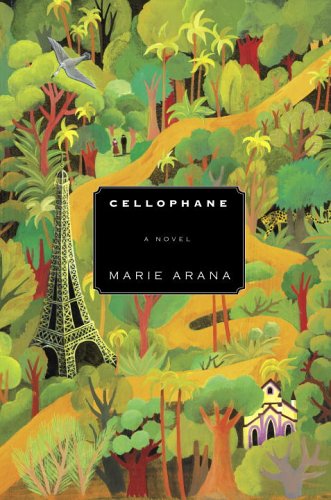

Cellophane a novel Marie Arana.
Detalles de publicación: New York Dial Press 2006.Descripción: 367 p. 25 cmISBN:- 0385336640
- 9780385336642
- 813/.6 22
- PS3601.R345 C46 2006
| Imagen de cubierta | Tipo de ítem | Biblioteca actual | Biblioteca de origen | Colección | Ubicación en estantería | Signatura topográfica | Materiales especificados | Info Vol | URL | Copia número | Estado | Notas | Fecha de vencimiento | Código de barras | Reserva de ítems | Prioridad de la cola de reserva de ejemplar | Reservas para cursos | |
|---|---|---|---|---|---|---|---|---|---|---|---|---|---|---|---|---|---|---|
| Libro | Biblioteca Encarnación Valdés Colección General bev | 813.6 A6621c (Navegar estantería(Abre debajo)) | Disponible | 80000002529447 |
Descripciones mejoradas de Syndetics:
Don Victor Sobrevilla, a lovable, eccentric engineer, always dreamed of founding a paper factory in the heart of the Peruvian rain forest, and at the opening of this miraculous novel his dream has come true--until he discovers the recipe for cellophane. In a life already filled with signs and portents, the family dog suddenly begins to cough strangely. A wild little boy turns azurite blue. All at once Don Victor is overwhelmed by memories of his erotic past; his prim wife, Doña Mariana, reveals the shocking truth about her origins; the three Sobrevilla children turn their love lives upside down; the family priest blurts out a long-held secret.... A hilarious plague of truth has descended on the once well-behaved Sobrevillas, only the beginning of this brilliantly realized, generous-hearted novel. Marie Arana's style, originality, and trenchant wit will establish her as one of the most audacious talents in fiction today andCellophaneas one of the most evocative and spirited novels of the year. From the Hardcover edition.
Extracto provisto por Syndetics
Reseñas proporcionadas por Syndetics
Library Journal Review
On the banks of the Peruvian Amazon in the late 1940s, Don Victor Sobrevilla presides over a paper factory and farm, a small village of his workers, and his sprawling, garrulous family. His regular visits to his shaman elicit alarm from the local priest, but overall life in Floralinda is everything Don Victor dreamed of as a city boy mesmerized by engineering, paper, and the Amazon. His wife, Dona Mariana, ably runs the household and copes with her three grown children's failed marriages and her daughter-in-law's mental illness. Then, Don Victor perfects his recipe for cellophane and turns his factory over to its production. Seemingly overnight, as the mesmerizing beauty and transparency of his invention invades and uncovers their insulated world, the Sobrevillas find themselves taken by irresistible urges to confess past transgressions and passions and to seek more satisfying and authentic relationships. As the family upheaval grows, the dictatorship of Manuel Odria threatens the autonomy and safety of Floralinda itself. Acclaimed Peruvian American author Arana (American Chica) treads the ground between the stark realities of midcentury Peruvian politics and changing social mores and the sensitive and honest portrayal of a family in chaos as adroitly as the giants of the genre, including Gabriel Garc!a M rquez and Isabel Allende. A powerful debut with broad international appeal, this is highly recommended for both public and academic libraries. [See Prepub Alert, LJ 3/1/05.] Jennifer Stidham, Houston Community Coll., Northeast (c) Copyright 2010. Library Journals LLC, a wholly owned subsidiary of Media Source, Inc. No redistribution permitted.Publishers Weekly Review
Arana, author of American Chica and editor of Washington Post Book World, revisits her native Peru with a tale as bawdy, raucous and dense as the jungle whose presence encroaches on every page. Arana's first novel depicts a family-and a country-on the fulcrum between the old ways and the new, between feudalism and revolution. At the height of the Great Depression, paper engineer Don Victor Sobrevilla pitches his small empire where the trees are-in the heart of the rain forest-constructing a highly successful paper factory and a vast hacienda, Floralinda, far from the political centers of Trujillo and Lima, linked only to the outside world by the dangerous and unpredictable Amazon. When, in 1952, Don Victor discovers the formula for cellophane, his household is afflicted with a "plague of truth," a compulsion to confess their most shameful histories and most hidden yearnings, to make their stories as transparent as the paper itself. When desires are laid bare, so are the conflicts that the family has kept hidden for so long, resulting in interlocking quests for power. The novel's broadly comic first half makes the story's violent culmination even more harrowing. (June 27) (c) Copyright PWxyz, LLC. All rights reservedBooklist Review
Can cellophane become an aphrodisiac and a catalyst for disaster? Only in a world as profusely and purposefully imagined as Floralinda, a paper factory deep in the cellulose-rich Amazon rain forest. Readers familiar with Arana's fascinating memoir, American Chica0 (2001), will discern her clever improvisation on family history in Don Victor Sobrevilla Paniagua, a visionary mid-twentieth-century Peruvian engineer. Armed with an encouraging prognostication, and married to resourceful Mariana, he settles his family in the jungle, builds a state-of-the-art factory and a modest church, and turns to a shaman for his own spiritual guidance. Life isn't perfect in the isolated hacienda where Victor's high-strung adult children fail to find happiness, but things are at least decorous until he starts manufacturing cellophane, a seemingly magical substance that somehow upsets the cosmic balance. Family secrets with serious repercussions are abruptly exposed, inappropriate lust erupts, and deadly confrontations ensue. Arana's keenly satirical, erotic, and fabulist novel encompasses the bitter legacy of imperialism and technology's assault on nature's fine-tuned equilibrium. With a spectacular cast of passionate characters and a plot as lushly complex as the rain forest, Arana tells a bewitching story shaped by a profound understanding of the oneness of life. --Donna Seaman Copyright 2006 BooklistNotas de autor provistas por Syndetics
Marie Arana is editor of "The Washington Post Book World" as well as a feature writer for "The Post". She has served on the board of directors of the National Association of Hispanic Journalists as well as the National Book Critics Circle. She lives in Washington, D.C.(Bowker Author Biography)