Descripciones mejoradas de Syndetics:
It is 1947 and Israel Levis, a Cuban composer whose life had once been a dream of music, love and sadness, is returning to Habana, Cuba, from Spain, where he has just recovered from the physical and spiritual malaise resulting from his experiences in Paris, then Buchenwald, during the Nazi occupation of France. (A devout Catholic, Levis had been mistakenly identified as a Jew because of his name.)
When Levis arrives back in Habana, after an absence of many years, his mind is reeling with beautiful memories of his life in Cuba and in Paris before the war, a life of pleasure and excitement that he owes, in part, to an unrequited, nearly "chivalrous" romance with a certain Rita Valladares, a singer for whom Levis had written his most famous song, "Rosas Puras," or "Pretty Roses." This 1928 composition becomes the most famous rumba in the world and changes both American and European tastes in music and dance -- forever; and it is the song, symbolic of the composer's love for Rita Valladares, that sets Levis's life in Europe in motion. This is at once a love story -- for art, family and country -- as well as a portrait of Habana at the turn of the last century, when "the world was good." A Simple Habana Melody is a virtuoso performance from one of our most important writers.
Reseñas proporcionadas por Syndetics
Library Journal Review
The melody is simple, but the protagonist's commitment to his art is complex and powerful, fueling this novel. (c) Copyright 2010. Library Journals LLC, a wholly owned subsidiary of Media Source, Inc. No redistribution permitted.
Publishers Weekly Review
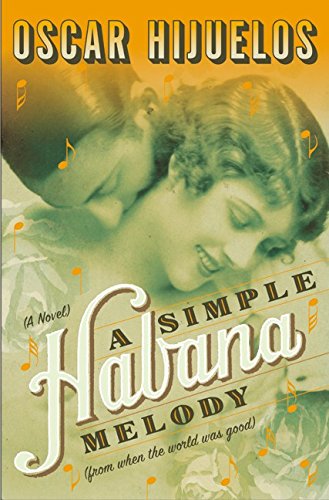
After Auschwitz, there can be no poetry, Adorno famously, and wrongly, intoned. Hijuelos is after a milder, and seemingly more eccentric, moral conundrum: can there be, after Buchenwald, any more rumbas? The question is not as silly as it sounds at first - as Hijuelos points out, the rumba was the invention of a "lonely, begrieved slave" who "took up guitars and drums, and eventually created the rumba - a dance of a few closely held (chain-bound) steps..." The maker of rumbas at the center of this novel is Cuban musician Israel Levis, sent to Buchenwald in 1943. Hijuelos begins his story with Levis, now a thin, elderly-looking man, coming back to Habana in 1947, then leads up to the events that foreground that return. Brought up as a child prodigy in a good, upper-class family, Levis progresses from recitals of the classics to compositions soaked in the music of the street. In particular, Levis loves the zarzuela, a type of Cuban operetta in which rumbas prominently feature. "Rosas Puras," the most famous rumba of the '20s and '30s, was Levis's composition. He wrote it with his favorite lyricist, Manny Cortez, in the Campana Bar, for his favorite singer and the love of his life, Rita Valladores. Unfortunately for Levis, Cuba is ruled at this time by Geraldo Machado, a dictator, and Levis is eventually forced to leave his city because of Machado's harassment. He settles in Paris; takes a Jewish dance instructor, Sarah Rubinstein, as his lover; and collaborates on an opera with her brother, George, until the world falls down in 1940. While there is a faintly contrived air about Levis's experience of the Holocaust, Hijuelos triumphs in capturing the sights and sounds of Habana at the edge of modernity. (June) Forecast: Pulitzer-winning Hijuelos (The Mambo Kings Play Songs of Love, etc.) is poised for blockbuster sales again with his big-buzz latest, which sports an eye-catching '40s-style jacket. (c) Copyright PWxyz, LLC. All rights reserved
Booklist Review
Perhaps no other contemporary novelist has managed to sustain a melancholy mood more convincingly than Hijuelos does in this haunting story of a Cuban composer whose life is an agonizing mix of joy and sadness, creativity and repression. The story begins in 1947, when the 58-year-old Israel Levis returns to his native Habana after spending most of the 1930s in Paris and then enduring two years in Buchenwald (Levis, a Catholic, was assumed by the Nazis to be a Jew because of his name). Hijuelos jumps gracefully between past and present, lingering on Levis' early years in Cuba, when he emerged as a musician and composer, enjoying "small ecstasies of creativity and public acclaim" and reveling in Habana's cafesociety. Torn between Old World propriety and sensual craving, Levis frequents bordellos but is too timid either to pursue young singer Rita Valledares, whom he loves passionately, or to act on his attraction to men. The pull and push between the joy and freedom he feels in his creative life and the sadness and lack of fulfillment that torment his personal life reverberate in his music, especially in the song Rosas Puras ("Pure Roses"), which he writes for Rita and whose success paves the way for his later triumphs in Paris. No one writes about cities more vividly than Hijuelos. Whether describing Levis enjoying drinks and cigars with his fellow musicians in the Campana Bar in Habana or strolling with Rita along the Rue de Seine in Paris, he allows us to experience setting not as background but as an extension of a character's soul, a force inextricably entangled with every kind of sensual pleasure, especially music. As in The Mambo Kings Play Songs of Love (1989), Hijuelos uses music to accentuate his characters' moments of triumph, to mourn their losses, and to evoke their longing for a time "when the world was good." Like the most tender of ballads, this heartbreaking novel laments lost love while it helps us remember how love felt when we were young. --Bill Ott