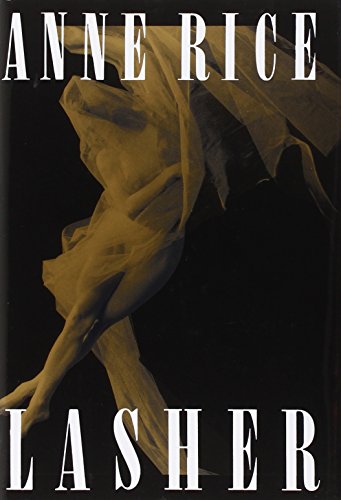

Lasher a novel Anne Rice.
Detalles de publicación: New York Alfred A. Knopf Distributed by Random House, Inc. 1993.Edición: 1st edDescripción: 577 p. 25 cmISBN:- 0679412956
- 813.54 R4951L 20
- PS3568.I265 L36 1993
| Imagen de cubierta | Tipo de ítem | Biblioteca actual | Biblioteca de origen | Colección | Ubicación en estantería | Signatura topográfica | Materiales especificados | Info Vol | URL | Copia número | Estado | Notas | Fecha de vencimiento | Código de barras | Reserva de ítems | Prioridad de la cola de reserva de ejemplar | Reservas para cursos | |
|---|---|---|---|---|---|---|---|---|---|---|---|---|---|---|---|---|---|---|
| Libro | Biblioteca Encarnación Valdés Colección General bev | 813.54 R4951L (Navegar estantería(Abre debajo)) | Disponible | 80000002525403 |
Descripciones mejoradas de Syndetics:
From the day her first Vampire Chronicle was published, critics and readers--readers by the hundreds of thousands--have been mesmerized by the writings of Anne Rice.nbsp;nbsp;And with the publication of The Witching Hour , she created for us yet another world and legend, and both the chorus of praise and the multitudes of her readers once more increased.
Now, Anne Rice brings us again--even more magically--into the midst of the dynasty of witches she introduced in The Witching Hour .
At the center:nbsp;nbsp;the brilliant an beautiful Rowan Mayfair, queen of the coven, and Lasher, the darkly compelling demon whom she finds irresistible and from whose evil spell and vision she must now flee.nbsp;nbsp;She takes with her their terrifying and exquisite child, one of "a brood of children born knowing, able to stand and talk on the first day."
Rowan's attempt to escape Lasher and his pursuit of her and their child are at the heart of this extraordinary saga.nbsp;nbsp;It is a novel that moves around the globe, backward and forward through time, and between the human and demonic worlds.nbsp;nbsp;Its many voices--of women, of men, of demons and angels, present and past--haunt and enchant us.nbsp;nbsp;With a dreamlike power, the novel draws us through twilight paths, telling a chillingly hypnotic story of occult and spiritual aspirations and passion.
Sequel to: The witching hour.
Extracto provisto por Syndetics
Reseñas proporcionadas por Syndetics
Publishers Weekly Review
Returning to the Mayfair clan she introduced in The Witching Hour , Rice offers another vast, transcontinental saga of witchcraft and demonism in the tradition of Gothic melodrama. The eponymous Lasher is a demon spirit who preys on female Mayfairs in his attempt to procreate. Rowan Mayfair, queen of the coven who has borne Lasher's child, has now disappeared. At times this main narrative is lost as the story moves from the Louisiana Mayfairs to the Scottish Donnelaiths and the clandestine London Telamasca society, with copious personal histories and myriad characters. Long sections ramble without a compelling point of view, and are dampened by stock elements: cliched wind storms, sexy witches, the endless supply of money the Telemasca has at its disposal. At times, Lasher is too much in evidence (rattling the china, gnashing his teeth) to be frightening. But embedded in this antique demonism is a contemporary tale of incest and family abuse that achieves resonance. It is maintained through the character of Lasher, both child and man at the same time, who manipulates his victims with his own pain. At their best, Rice's characters rise above the more wooden plot machinations with an ironic and modern complexity: Mona, the young feminist witch with sharklike business instincts; Julien, the dead patriarch, who movingly recalls his male lovers; Yuri, the clever Serbian orphan. Despite lapses into uninspired language, ultimately the novel is compelling through its exhaustive monumentality. 700,000 first printing; Literary Guild main selection. (Oct.) (c) Copyright PWxyz, LLC. All rights reservedBooklist Review
So stunningly bad is the first third of this book that only the lunatic and the true devotee are likely to get beyond it. It is actually a riot of Rice's worst sins: strained and wooden characterizations, the abandonment of plot for the sake of a tangled and murky history, and a sort of mutant prose stumbling between a modern person's idea of old-fashioned elegance and an old-fashioned person's idea of how people actually talk in the 1990s. Part of the purpose of this 200-page cancer is to make the transition from the novel's progenitor, The Witching Hour (1990), but this could have been accomplished in 10 or 15 pages. Well, let's say you made it through. What you get now is the best of Rice: a deliciously perverse image of an infant, Lasher, who grows to sexual maturity within days of his birth and immediately starts copulating with his mother even while she swoons with the pleasure of his suckling. Of course, it's always nice to read about sex, and Rice's romantic imagination doesn't let her down: Lasher is dark, handsome, sadistic, childlike, and tender. His mother cannot resist him even after she has twice miscarried in the space of three months. But Rice cannot quite bring home the promising story of Lasher's desire to repopulate the earth with his own kind, and the story limps to an unsatisfying conclusion. By the end, then, we've had a bit of everything: the good, the bad, and the truly ugly. Indeed, without her reputation, Rice would never have found a publisher for this wretched mess. (Reviewed Aug. 1993)0679412956Stuart WhitwellNotas de autor provistas por Syndetics
Anne Rice was born Howard Allen O'Brien on October 4, 1941 in New Orleans, Louisiana. She received a bachelor's degree in political science in 1964 and master's degree in English and creative writing in 1972 from San Francisco State University.She published her first short story in 1965 called October 4, 1948. Her first book, Interview with the Vampire, was published in 1976. It was made into a film starring Brad Pitt, Kirsten Dunst, and Tom Cruise in 1994. She wrote various series in the same genre including the rest of the Vampire Chronicles, the Mayfair Witches books, and The Wolf Gift Chronicles. Her novel, Feast of All Saints, became a Showtime mini-series in 2001. Her other works include Cry to Heaven, Servant of the Bones, and Violin.
In 1998, Rice returned to the Catholic Church and for some time only wrote for Christ or about Christ. These works include Christ the Lord: Out of Egypt, Christ the Lord: The Road to Cana, and Called Out of Darkness.
Anne Rice died on December 11, 2021 at the age of 80.
(Bowker Author Biography)