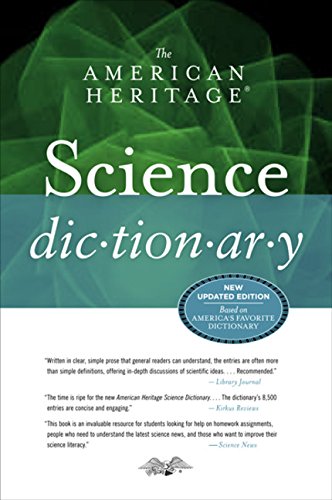
The American Heritage® Science Dictionary defines the vocabulary of the sciences in language general readers will understand and enjoy. With 8,500 entries, it covers all the major fields of science, from the fundamental disciplines of chemistry, physics, biology, and mathematics to the applied realms of medicine, earth science, technology, and anthropology.
Each entry has a clear, concise definition that gets to the meaning and importance of each term. There are 175 notes on key scientific concepts, such as relativity, genomic sequencing, nanotechnology, and plate tectonics, as well as 320 biographies of notable scientists from ancients such as Aristotle and Archimedes to modern greats like Rosalyn Yalow and Leo Szilard. Illustrations accompany more than 350 entries.
Fully updated for 2011, the dictionary covers the latest scientific discoveries and developments. There is information on the newest named element, copernicium, and the discovery of element 117. Entries encompass the latest finds in anthropology, including information on Homo floresiensis, as well as newsworthy items such as the suspected carcinogen bisphenol A.
This is the perfect resource for people looking to improve their science literacy or understand the scientific breakthroughs reported in the news.
Reseñas proporcionadas por Syndetics
Library Journal Review
Published under the well-known American HeritageR name, this inexpensive science dictionary includes 8500 terms in anthropology, biology, chemistry, earth science, mathematics, medicine, physics, and technology. There are also 320 biographical entries of noted scientists as well as 30 biographical notes that explain how certain researchers found answers to major scientific problems. Written in clear, simple prose that general readers can understand, the entries are often more than simple definitions, offering in-depth discussions of scientific ideas. The text includes 350 black-and-white drawings and photographs, although some entries would have benefited from having an illustration (e.g., Hertzsprung-Russell diagram). Information traditionally provided in appendixes, such as the periodic table and units of measurement, is located in the particular entry. The only appendix is a time line of scientific discovery. Much smaller in size and scope than the comprehensive Larousse Dictionary of Science and Technology, this volume is more comparable to The New Penguin Dictionary of Science. Both resources are suitable for high school students and undergraduates, and each has enough unique information to justify maintaining both titles in a science reference collection. Bottom Line The American HeritageR Science Dictionary cannot serve as the library's sole science dictionary, but it is a nice, inexpensive supplement. Recommended for public and college libraries.-Teresa U. Berry, Univ. of Tennessee Libs., Knoxville (c) Copyright 2010. Library Journals LLC, a wholly owned subsidiary of Media Source, Inc. No redistribution permitted.
School Library Journal Review
Gr 5-7-In this computerized age, some people dismiss dictionaries as anachronisms barely worth the shelf space. How wrong they are can be easily seen in this nifty volume. A wide variety of information boxes pop up like succulent raisins in a tasty cake. For example, "A Closer Look" pieces examine topics such as the Doppler effect, magnetic reversal, and iridium; "Usage" pop-ups differentiate between terms students may confuse, such as "revolution" and "rotation"; and biography boxes feature cameos of such disparate subjects as Andreas Vesalius, Maria Mitchell, and Linus Pauling. Diagrams large and small dot the landscape, as do maps and small black-and-white photos. All this is embedded in a solid backdrop of more than 8,000 standard definitions of scientific relevance. This valuable tool is clearly written and often lively, and will no doubt introduce dictionary neophytes to the joys of word-surfing while on the hunt for a specific term.-Patricia Manning, formerly at Eastchester Public Library, NY (c) Copyright 2012. Library Journals LLC, a wholly owned subsidiary of Media Source, Inc. No redistribution permitted.
CHOICE Review
Essential for ready reference in all libraries, this dictionary is written for general readers but does not insult professional scientists. In the format of American Heritage Dictionary (4th ed., 2000), it offers pronunciation guides for its 8,000 headwords, 300 brief biographies of noted scientists, several tables, pictures, charts to illustrate more technical entries, and at the back a concise time line of scientific discovery. Few dictionaries nowadays give this much information for such a reasonable price. ^BSumming Up: Essential. All collections. L. Windsor Ohio University
Notas de autor provistas por Syndetics
The Editors of the American Heritage Dictionaries and of other reference titles published by Houghton Mifflin Harcourt are trained lexicographers with a varied array of interests and expertise. Most of the editors hold graduate degrees and have studied at least one foreign language. Several have degrees in linguistics or in the history of the English language. Others have degrees in science or sometimes other disciplines. All the editors familiarize themselves with the vocabulary in specific subject areas, collect materials on new developments and usage, and work in association with consultants to ensure that the content of our publications is as accurate and up-to-date as possible.
The American heritage science dictionary/
APA
(2011). The American heritage science dictionary. Boston, MA: Houghton Mifflin Harcourt.
Chicago
2011. The American heritage science dictionary. Boston, MA: Houghton Mifflin Harcourt.
Harvard
(2011). The American heritage science dictionary. Boston, MA: Houghton Mifflin Harcourt.
MLA
The American heritage science dictionary. Boston, MA: Houghton Mifflin Harcourt. 2011.