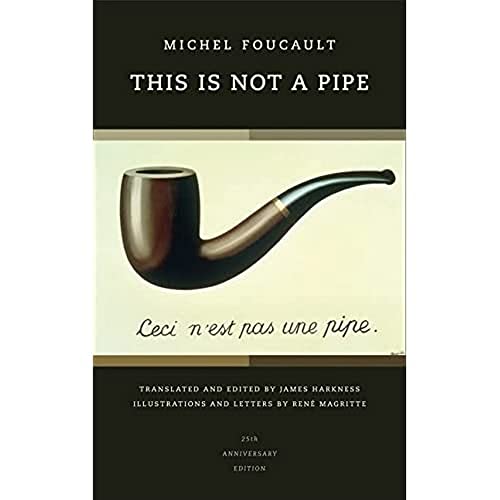

This is not a pipe / Foucault, Michel, 1926-1984 txt
London, England : University of California Press , 2008Edición: Second paperback edition 2008Descripción: 66p. ill 21cmTipo de contenido:- text
- unmediaded
- volume
- 9780520236943
- 759.9493
- ND673.M35 F6813 2008
| Imagen de cubierta | Tipo de ítem | Biblioteca actual | Biblioteca de origen | Colección | Ubicación en estantería | Signatura topográfica | Materiales especificados | Info Vol | URL | Copia número | Estado | Notas | Fecha de vencimiento | Código de barras | Reserva de ítems | Prioridad de la cola de reserva de ejemplar | Reservas para cursos | |
|---|---|---|---|---|---|---|---|---|---|---|---|---|---|---|---|---|---|---|
| Libro | CARIBET Biblioteca Arquitectura Colección General CARIBET | General ND673.M35 F6813 2008 (Navegar estantería(Abre debajo)) | 1 | Disponible | 91000000040527 |
Descripciones mejoradas de Syndetics:
What does it mean to write "This is not a pipe" across a bluntly literal painting of a pipe? René Magritte's famous canvas provides the starting point for a delightful homage by French philosopher and historian Michel Foucault. Much better known for his incisive and mordant explorations of power and social exclusion, Foucault here assumes a more playful stance. By exploring the nuances and ambiguities of Magritte's visual critique of language, he finds the painter less removed than previously thought from the pioneers of modern abstraction.
Includes Index.
Contentes
Translator's introduction --
Two pipes --
The unraveled calligram --
Klee, Kandinsky, Magritte --
Burrowing words --
Seven seals of affirmation --
Nonaffirmative painting --
Two letters by René Magritte.
What does it mean to write 'this is not a pipe' across a bluntly literal painting of a pipe? René Magritte's famous canvas provides the starting point for a delightful homage by French philosopher and historian Michel Foucault.
Tabla de contenidos provista por Syndetics
- List of Plates(p. vii)
- Acknowledgments(p. ix)
- Translator's Introduction(p. 1)
- 1 Two Pipes(p. 15)
- 2 The Unraveled Calligram(p. 19)
- 3 Klee, Kandinsky, Magritte(p. 32)
- 4 Burrowing Words(p. 36)
- 5 Seven Seals of Affirmation(p. 43)
- 6 Nonaffirmative Painting(p. 53)
- Two Letters by Rene Magritte(p. 55)
- Notes(p. 59)
- Index(p. 65)
- Plates(p. 66)
Notas de autor provistas por Syndetics
Michel Foucault was born on October 15, 1926, in Poitiers, France, and was educated at the Sorbonne, in Paris. He taught at colleges all across Europe, including the Universities of Lill, Uppsala, Hamburg, and Warsaw, before returning to France. There he taught at the University of Paris and the College of France, where he served as the chairman of History of Systems of Thought until his death.Regarded as one of the great French thinkers of the twentieth century, Foucault's interest was in the human sciences, areas such as psychiatry, language, literature, and intellectual history. He made significant contributions not just to the fields themselves, but to the way these areas are studied, and is particularly known for his work on the development of twentieth-century attitudes toward knowledge, sexuality, illness, and madness.
Foucault's initial study of these subjects used an archaeological method, which involved sifting through seemingly unrelated scholarly minutia of a certain time period in order to reconstruct, analyze, and classify the age according to the types of knowledge that were possible during that time. This approach was used in Madness and Civilization: A History of Insanity in the Age of Reason, for which Foucault received a medal from France's Center of Scientific Research in 1961, The Birth of the Clinic, The Order of Things, and The Archaeology of Knowledge.
Foucault also wrote Discipline and Punishment: The Birth of the Prison, a study of the ways that society's views of crime and punishment have developed, and The History of Sexuality, which was intended to be a six-volume series. Before he could begin the final two volumes, however, Foucault died of a neurological disorder in 1984.
(Bowker Author Biography)