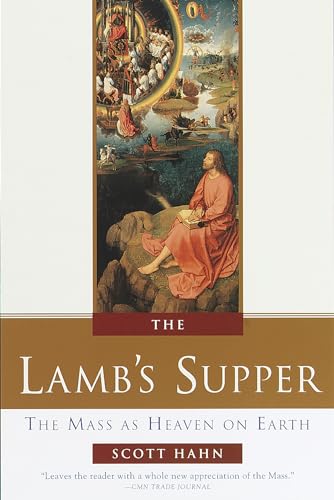
Imagen de portada de Amazon
Imagen de Amazon.com
Imagen de cubierta Syndetics
Portada de Syndetics
Imagen de OpenLibrary

La cena del Cordero la Misa, el cielo en la tierra Scott Hahn

Por: Detalles de publicación: Madrid Ediciones RIALP, S. A. 2010Edición: Décimocuarta ediciónDescripción: 204 p. 19 centimetersISBN:
  • 0385496591
Títulos uniformes: Tema(s): Clasificación CDD:
  • 264/.02036 21
Clasificación LoC:
  • BX2230.5 .H29 1999
Recursos en línea:
Valoración
    Valoración media: 0.0 (0 votos)
Existencias
Imagen de cubierta Tipo de ítem Biblioteca actual Biblioteca de origen Colección Ubicación en estantería Signatura topográfica Materiales especificados Info Vol URL Copia número Estado Notas Fecha de vencimiento Código de barras Reserva de ítems Prioridad de la cola de reserva de ejemplar Reservas para cursos
Libro Biblioteca de Mayagüez Colección General mb BX2230.5 .H2918 2010 (Navegar estantería(Abre debajo)) Disponible 50000003260246
Total de reservas: 0

Descripciones mejoradas de Syndetics:

AS SEEN ON EWTN * Bestselling author Scott Hahn "leaves the reader with a whole new appreciation of the Mass" ( CMN Trade Journal ) as he unveils the mysteries of the most familiar of Catholic rituals.

Of all things Catholic, there is nothing that is so familiar as the Mass. With its unchanging prayers, the Mass fits Catholics like their favorite clothes. Yet most Catholics sitting in the pews on Sundays fail to see the powerful supernatural drama that enfolds them. Pope John Paul II described the Mass as "Heaven on Earth," explaining that what "we celebrate on Earth is a mysterious participation in the heavenly liturgy."

The Lamb's Supper reveals a long-lost secret of the Church: The early Christians' key to understanding the mysteries of the Mass was the New Testament Book of Revelation. With its fantastical imagery, mystic visions of heaven, and end-of-time prophecies, Revelation mirrors the sacrifice and celebration of the Eucharist.

Written in clear, direct language, Scott Hahn's beautiful book will help you see the Mass with new eyes, pray the liturgy with a renewed heart, and enter into the Mass more fully, enthusiastically, intelligently, and powerfully than ever before.

Translation of: The Lamb's Supper : the Mass as heaven on Earth.

Tabla de contenidos provista por Syndetics

  • Foreword(p. XI)
  • Part 1 The Gift of the Mass
  • Introduction: Christ Stands at the Door: The Mass Revealed(p. 3)
  • 1 In Heaven Right Now: What I Found at My First Mass(p. 7)
  • 2 Given for You: The Story of Sacrifice(p. 14)
  • 3 From the Beginning: The Mass of the First Christians(p. 28)
  • 4 Taste and See (and Hear and Touch) the Gospel: Understanding the Parts of the Mass(p. 40)
  • Part 2 The Revelation of Heaven
  • 1 "I Turned to See": The Sense amid the Strangeness(p. 61)
  • 2 Who's Who in Heaven: Revelation's Cast of Thousands(p. 72)
  • 3 Apocalypse Then! The Battles of Revelation and the Ultimate Weapon(p. 90)
  • 4 Judgment Day: His Mercy Is Scary(p. 104)
  • Part 3 Revelation for the Masses
  • 1 Lifting the Veil: How to See the Invisible(p. 115)
  • 2 Worship Is Warfare: Which Will You Choose: Fight or Flight?(p. 130)
  • 3 Parish the Thought: Revelation as Family Portrait(p. 146)
  • 4 Rite Makes Might: The Difference Mass Makes(p. 155)
  • Sources and References(p. 164)

Extracto provisto por Syndetics

In Heaven Right Now WHAT I FOUND AT MY FIRST MASS THERE I STOOD, a man incognito, a Protestant minister in plainclothes, slipping into the back of a Catholic chapel in Milwaukee to witness my first Mass. Curiosity had driven me there, and I still didn't feel sure that it was healthy curiosity. Studying the writings of the earliest Christians, I'd found countless references to "the liturgy," "the Eucharist," "the sacrifice." For those first Christians, the Bible--the book I loved above all--was incomprehensible apart from the event that today's Catholics called "the Mass." I wanted to understand the early Christians; yet I'd had no experience of liturgy. So I persuaded myself to go and see, as a sort of academic exercise, but vowing all along that I would neither kneel nor take part in idolatry. I took my seat in the shadows, in a pew at the very back of that basement chapel. Before me were a goodly number of worshipers, men and women of all ages. Their genuflections impressed me, as did their apparent concentration in prayer. Then a bell rang, and they all stood as the priest emerged from a door beside the altar. Unsure of myself, I remained seated. For years, as an evangelical Calvinist, I'd been trained to believe that the Mass was the ultimate sacrilege a human could commit. The Mass, I had been taught, was a ritual that purported to "resacrifice Jesus Christ." So I would remain an observer. I would stay seated, with my Bible open beside me. SOAKED IN SCRIPTURE As the Mass moved on, however, something hit me. My Bible wasn't just beside me. It was before me--in the words of the Mass! One line was from Isaiah, another from the Psalms, another from Paul. The experience was overwhelming. I wanted to stop everything and shout, "Hey, can I explain what's happening from Scripture? This is great!" Still, I maintained my observer status. I remained on the sidelines until I heard the priest pronounce the words of consecration: "This is My body . . . This is the cup of My blood." Then I felt all my doubt drain away. As I saw the priest raise that white host, I felt a prayer surge from my heart in a whisper: "My Lord and my God. That's really you!" I was what you might call a basket case from that point. I couldn't imagine a greater excitement than what those words had worked upon me. Yet the experience was intensified just a moment later, when I heard the congregation recite: "Lamb of God . . . Lamb of God . . . Lamb of God," and the priest respond, "This is the Lamb of God . . ." as he raised the host. In less than a minute, the phrase "Lamb of God" had rung out four times. From long years of studying the Bible, I immediately knew where I was. I was in the Book of Revelation, where Jesus is called the Lamb no less than twenty-eight times in twenty-two chapters. I was at the marriage feast that John describes at the end of that very last book of the Bible. I was before the throne of heaven, where Jesus is hailed forever as the Lamb. I wasn't ready for this, though--I was at Mass! HOLY SMOKE! I would return to Mass the next day, and the next day, and the next. Each time I went back, I would "discover" more of the Scriptures fulfilled before my eyes. Yet no book was as visible to me, in that dark chapel, as the Book of Revelation, the Apocalypse, which describes the worship of the angels and saints in heaven. As in that book, so in that chapel, I saw robed priests, an altar, a congregation chanting "holy, holy, holy." I saw the smoke of incense; I heard the invocation of angels and saints; I myself sang the alleluias, for I was drawn ever more into this worship. I continued to sit in the back pew with my Bible, and I hardly knew which way to turn--toward the action in the Apocalypse or the action at the altar. More and more, they seemed to be the very same action. I plunged with renewed vigor into my study of ancient Christianity and found that the earliest bishops, the Fathers of the Church, had made the same "discovery" I was making every morning. They considered the Book of Revelation the key to the liturgy, and the liturgy the key to the Book of Revelation. Something powerful was happening to me as a scholar and a believer. The book of the Bible that I had found most perplexing--the Book of Revelation--was now illuminating the ideas that were most foundational to my faith: the idea of the covenant as the sacred bond of the family of God. Moreover, the action that I had considered the supreme blasphemy--the Mass--now turned out to be the event that sealed God's covenant. "This is the cup of My blood, the blood of the new and everlasting covenant." I was giddy with the newness of it all. For years I had been trying to make sense of the Book of Revelation as some kind of encoded message about the end of the world, about worship in faraway heaven, about something most Christians couldn't experience while still on earth. Now, after two weeks of daily Mass attendance, I found myself wanting to stand up during the liturgy and say, "Hey, everybody. Let me show you where you are in the Apocalypse! Turn to chapter four, verse eight. You're in heaven right now." Excerpted from The Lamb's Supper: Experiencing the Mass by Scott Hahn All rights reserved by the original copyright owners. Excerpts are provided for display purposes only and may not be reproduced, reprinted or distributed without the written permission of the publisher.

Reseñas proporcionadas por Syndetics

Publishers Weekly Review

As with his earlier Rome Sweet Home, Hahn's The Lamb's Supper seeks to bring scriptural exegesis and Roman Catholic ritual tradition into fruitful dialogue. The central thrust of this piece is that Catholic liturgy offers the best interpretive paradigm for studying the Book of Revelation. Hahn divides his subject matter into three main sections, considering in turn Scripture in the canon of the Mass, various interpretive approaches to the Book of Revelation and the mutual illumination of the Catholic Mass and John's Apocalypse. Apart from vapid section titles (e.g., "Guided Missal," "Resisting a Rest" and "The Need to Heed the Creed"), which detract from the serious themes presented, Hahn treats the material quite competently, and he is candid in his enthusiasm for both biblical liturgics and liturgical exegesis. Hahn's work is a fine introduction to eucharistic theology for the Catholic layperson, offering a crash course in the history of sacrificial worship in ancient Israel. The book has an ecumenical appeal, especially for Lutherans and Anglicans desiring to better acquaint themselves with Catholic ritual and the New Testament. The only consideration noticeably absent from Hahn's liturgical review of Revelation is whether the doxological splendors of the Mass are marred or made manifest in the hastily prepared English translations of the Latin Rite issued in the wake of the Second Vatican Council. (Oct.) (c) Copyright PWxyz, LLC. All rights reserved

Notas de autor provistas por Syndetics

Scott Hahn, an internationally renowned Catholic lecturer & apologist, is a professor of theology at the Franciscan University of Steubenville. His books include "A Father Who Keeps His Promises", "Rome, Sweet Home", the best-selling story, coauthored with his wife, of their conversion to Catholicism, & most recently, "The Lamb's Supper". He lives in Steubenville, Ohio.

(Bowker Author Biography)

Compartir
logopucpr-y-vive

Contáctanos

¡Queremos saber de ti!

Tel. 787.841.2000 Ext. 1801

bibliotecavaldes@pucpr.edu

⁣Búscanos en las redes

© 2026 Desarrollado por Ignite Online • All Rights Reserved • Powered by Koha.