A bedside visit -- How Kennedy awoke: Jack's reading and Why England slept -- John Hersey's "Survival": a literary experiment and its political adaptation -- The old man and the boy: Papa Hemingway and Profiles in courage -- The Hollywood screen and Kennedy's televised showdown with Truman -- The erotics of a presidency -- An assassination and its fictions.
Resumen: The author explores the mythology that grew up around John F. Kennedy who "was not only a president, but also a symbol for America's most cherished ideals."--Jacket.
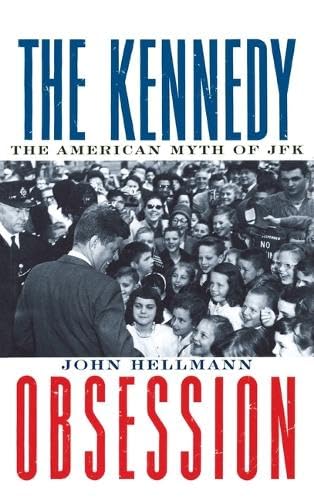
John F. Kennedy was not only a president, but also a symbol for America's most cherished ideas. In The Kennedy Obsession, John Hellmann takes a thoroughly original approach to understanding Kennedy's star power and his carefully crafted public image. Tracing Kennedy's self-creation as diligent scholar, bashful hero, and sensitive rebel-cued by cultural figures such as Lord Byron, Ernest Hemingway, and Cary Grant-and the images of Kennedy in the aftermath of his assassination, Hellmann reveals the painstaking transformation of private life into public persona, of a man into perhaps the major American myth of our time.
Includes bibliographical references (p. 181-193) and index.
A bedside visit -- How Kennedy awoke: Jack's reading and Why England slept -- John Hersey's "Survival": a literary experiment and its political adaptation -- The old man and the boy: Papa Hemingway and Profiles in courage -- The Hollywood screen and Kennedy's televised showdown with Truman -- The erotics of a presidency -- An assassination and its fictions.
The author explores the mythology that grew up around John F. Kennedy who "was not only a president, but also a symbol for America's most cherished ideals."--Jacket.
Tabla de contenidos provista por Syndetics
Prologue: A Bedside Visit
1 How Kennedy Awoke: Jack's Reading and Why England Slept
2 John Hersey's "Survival": A Literary Experiment and Its Political Adaptation
3 The Old Man and the Boy: Papa Hemingway and Profiles in Courage
4 The Hollywood Screen and Kennedy's Televised Showdown with Truman
5 The Erotics of a Presidency
6 An Assassination and Its Fictions
Reseñas proporcionadas por Syndetics
Publishers Weekly Review
Hellman, who teaches English at Ohio StateLima, isn't out to strip away the mythic veneer to disclose all the failings underneath, but rather to show the evolution of those myths in the first place. He starts by looking at the influence that individual works such as David Cecil's The Young Melbourne, John Buchan's Pilgrim's Way, the movie Red River, or figures such as Byron and Hemingway had on Kennedy's imagined self. Hellman proposes that Kennedy was deeply aware of image: for example, he wrote Profiles in Courage because he knew that as a national candidate, he needed to "cue the media to move his characterization forward from the role of immature boy." The most interesting pages are those few that show how Kennedy's heroic self-image influenced his time in office. For Kennedy, says Hellman, a dilemma was best dealt with as a crisisU.S. Steel crisis, Civil Rights crisis and, most of all, Cuban Missile crisiscomplete with a deadline, "in which he played the role of hero in the decisive confrontation." The most vexatious issue in studies of personal myth-building is the key question of consciousness. Kennedy, in Hellman's thesis, seems to have been greatly aware of subtle influences. Of Kennedy's admiration for Montgomery Clift's character in Red River, for example Hellman notes, "Kennedy... may even have recognized a correspondence between the macho masquerade he himself performed to cover his `feminine' aspects and the homosexual actor's role." (Oct.) FYI: Hellman notes that Jackie's White House restoration, "offered a heightened version of the domestic role of the average housewife." Van Nostran Reinhold will release a lengthy illustrated analysis in Designing Camelot: The Kennedy White House Restoration by James A. Abbott and Elaine M. Rice. ($50 256p ISBN 0-442-02532-7; Oct.) (c) Copyright PWxyz, LLC. All rights reserved
CHOICE Review
Written by a professor of English, this is an intriguing, sometimes poignant, and occasionally annoying work. Adopting a psychohistorical thrust, Hellmann reexplores the American obsession with the late president. In carefully crafted chapters, he examines the early intellectual precocity of a sickly lad, the wartime heroism of the young man, the deliberate devising of a "profiles in courage" image, and the impact of Hollywood on this nation's most glamorous politician. Tellingly and too painstakingly, concluding essays examine the machismo surrounding JFK's erotically charged presidency and his assassination's impact. Most significantly, Hellmann gives lie to recent charges by Thomas Reeves and others that Kennedy's aura and persona were largely fabricated. Kennedy's courageous feats in the PT-109 affair, for example, ring true, as does his role in the production of his Pulitzer Prize-winning work, notwithstanding Theodore Sorenson's extensive involvement. Less convincing is the purported influence of Ernest Hemingway on the young senator. Nevertheless, The Kennedy Obsession should cause readers to remember or to discover why its subject captured so many hearts and minds during his lifetime and afterward. This is a serious study that must be considered by both Kennedy scholars and general readers, who might find the textual analyses difficult and disconcerting. R. C. Cottrell California State University, Chico
Notas de autor provistas por Syndetics
John Hellmann is professor of English at the Ohio State University at Lima and the author of American Myth and the Legacy of Vietnam and Fables of Fact: The New Journalism as New Fiction.
The Kennedy obsession
APA
Hellmann J., . (1997). The Kennedy obsession: the American myth of JFK. New York: Columbia University Press.
Chicago
Hellmann John, . 1997. The Kennedy obsession: the American myth of JFK. New York: Columbia University Press.
Harvard
Hellmann J., . (1997). The Kennedy obsession: the American myth of JFK. New York: Columbia University Press.
MLA
Hellmann John, . The Kennedy obsession: the American myth of JFK. New York: Columbia University Press. 1997.