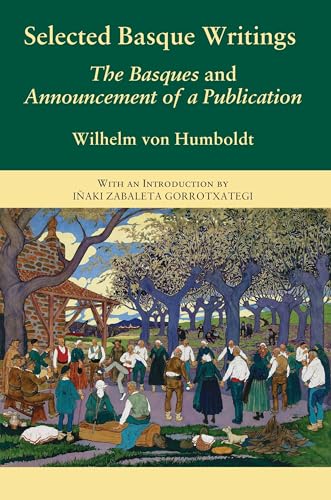

Selected basque writings the Basques and announcement of a publication Willhelm von Humboldt with an Introduction by Inaki Zabaleta Gorrotxategi ; translated by Andreas Corcoran.
Series Basque classics series, no. 9Detalles de publicación: Reno Center for Basque Studies, University of Nevada, Reno ©2013.Descripción: 181 pages 24 cm Tipo de medio:- 9781935709442 (pbk.)
- 9781935709459 (cloth)
- 305.89992 H9198s I 23
- GN549.B3 H85 2013
| Imagen de cubierta | Tipo de ítem | Biblioteca actual | Biblioteca de origen | Colección | Ubicación en estantería | Signatura topográfica | Materiales especificados | Info Vol | URL | Copia número | Estado | Notas | Fecha de vencimiento | Código de barras | Reserva de ítems | Prioridad de la cola de reserva de ejemplar | Reservas para cursos | |
|---|---|---|---|---|---|---|---|---|---|---|---|---|---|---|---|---|---|---|
| Libro | Biblioteca Encarnación Valdés Colección General bev | 305.89992 H9198s I (Navegar estantería(Abre debajo)) | Disponible | 80000002514050 |
Descripciones mejoradas de Syndetics:
The Selected Basque Writings of Wilhelm von Humboldt fills a gap in the scholarly literature on the renowned Prussian philosopher, linguist, and statesman by providing the first English-language translation of his own account of the second of two seminal trips to the Basque Country in 1801. Humboldt's encounter with Basque culture was crucial to the later development of his influential thinking on progressive liberalism, and in particular his reconciliation of nationalism and liberalism, especially as a result of his first-hand observation of how the Basques' strong sense of Basque national identity underpinned the vibrancy of their self-governing institutions and, likewise, how this independence of spirit was the bedrock of what he viewed as their well-governed and efficient society: a modern-day echo, for Humboldt, of the ancient Greek republics. Moreover, the work demonstrates Humboldt's use of the comparative study technique, and can with reason be interpreted as an early example of both comparative anthropology and comparative linguistics. Part travelogue, part ethnography, and part treatise on the intimate relationship between language, history, and identity, the rich prose of Humboldt's exuberant account transports readers back to the Basque Country on the eve of modernity. Here he depicts in vivid brilliance the landscape he traverses and the people he meets and observes--their clothes, food, songs and dances, working habits, business dealings, and political discussions. This work is essential to a greater appreciation for Humboldt's pivotal encounter with the Basque culture, and to a broader historical understanding of studies on the Basque Country itself.
Includes bibliographical references and index.
"Classic texts on the Basque people and language by the German man of letters Wilhelm von Humboldt with a new scholarly introduction to his Basque works"-- Provided by publisher.