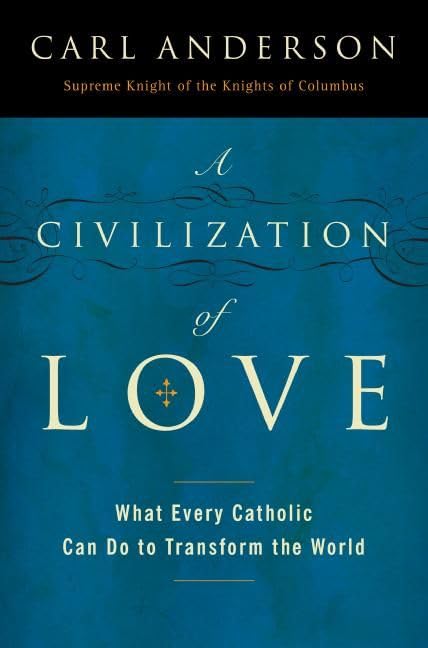
Imagen de portada de Amazon
Imagen de Amazon.com
Imagen de cubierta Syndetics
Portada de Syndetics
Imagen de OpenLibrary

A civilization of love what every Catholic can do to transform the world Carl Anderson.

Por: Detalles de publicación: New York HarperOne c2008.Edición: 1st edDescripción: xvii, 203 p. 22 cmISBN:
  • 9780061335310
  • 0061335312
Tema(s): Clasificación CDD:
  • 261 A5451c 22
Clasificación LoC:
  • BX1753 .A525 2008
Contenidos:
The power of Christ to transform culture -- A culture of suspicion -- Craftsmen of a new humanity -- A dignity which brings demands -- The domestic church -- Globalization and the gospel of work -- Ethics in the marketplace -- A people of life and for life -- A continent of baptized Christians.
Valoración
    Valoración media: 0.0 (0 votos)
Existencias
Imagen de cubierta Tipo de ítem Biblioteca actual Biblioteca de origen Colección Ubicación en estantería Signatura topográfica Materiales especificados Info Vol URL Copia número Estado Notas Fecha de vencimiento Código de barras Reserva de ítems Prioridad de la cola de reserva de ejemplar Reservas para cursos
Libro Biblioteca Encarnación Valdés Colección General bev 261 A5451c (Navegar estantería(Abre debajo)) Disponible 80000002513672
Total de reservas: 0

Descripciones mejoradas de Syndetics:

In A Civilization of Love, Carl Anderson, leader of the Knights of Columbus, explains Pope John Paul II's revolutionary ideas on how Christians can change the world through love. Through embracing the culture of life and standing with those most marginalized and deemed "useless" or a "burden" by modern society, Christians can change the tone and direction of our culture. Anderson demonstrates that not everyone has to agree on the fundamental questions of life in order to come together on the centrality of loving and caring for others. This message of inclusion and hope will help Christians everywhere to understand their role in the world.

Carl A. Anderson is the chief executive officer and chairman of the board of the Knights of Columbus. From 1983 to 1987, he served in various positions in the Executive Office of the President of the United States, including Special Assistant to the President and acting Director of the White House Office of Public Liaison. In 1998, Pope John Paul II appointed Anderson to the Pontifical Academy for Life. He holds degrees in philosophy from Seattle University and in law from the University of Denver. He is a member of the Bar of the District of Columbia and is admitted to practice law before the United States Supreme Court."Anderson has written a book brimming with insights into the transforming power of Christian faith. A Civilization of Love is both a call to personal holiness and a handbook for Catholics who are prepared to take seriously Christ's command to his disciples to be 'salt and light' in the world."- Robert P. George, McCormick Professor of Jurisprudence, Princeton University

Includes bibliographical references (p. [187]-203).

The power of Christ to transform culture -- A culture of suspicion -- Craftsmen of a new humanity -- A dignity which brings demands -- The domestic church -- Globalization and the gospel of work -- Ethics in the marketplace -- A people of life and for life -- A continent of baptized Christians.

Extracto provisto por Syndetics

A Civilization of Love What Every Catholic Can Do to Transform the World Chapter One The Power of Christ to Transform Culture Pope John Paul II often spoke of the Christian's responsibility living in what he called the new "Areopagus of culture." 1 The phrase recalls the apostle Paul's preaching to the citizens of Athens in the first century--one of the first great encounters of Christianity with pagan civilization. Today it is commonplace to speak of a "clash of civilizations." Several years ago, it was just as common to speak of "culture wars," and some people continue to do so. But such encounters between civilizations or cultural values are nothing new. They have happened over and over again in the course of history, in episodes that are sometimes cataclysmic, sometimes subtle, and almost unnoticed. One such moment is Paul's preaching in Athens as recorded in the Acts of the Apostles. 2 By recalling the Areopagus so often in the context of culture, I think John Paul II was suggesting to us that what St. Paul did in Athens remains an important model for every Christian in understanding the promise of Christ to transform culture. Paul's visit took place probably sometime between A.D. 50 and 58. 3 The setting was Athens, "the school of Greece." 4 The Romans, who had ruled the city for over a hundred years, called it doctae Athenae , "learned Athens." For the Romans, Athens held a central place in the evolution of their culture. Here, wrote Cicero, "civilization, learning, religion . . . laws and institutions are supposed to have arisen, and to have been disseminated over the whole earth." 5 If Athens was the symbolic center of civilization, the center of activity in Athens was the Areopagus, the "hill of Ares." Today the Areopagus, a rocky outcropping in the center of Athens, is chiefly a tourist site, from which one can photograph the much more famous and imposing Acropolis or the sprawling modern city below. In the first century, however, the Areopagus was the seat of the city's council, the core of its administrative and judicial system. Just as important, it was one of the places in which the Athenians gathered to indulge the restless curiosity for which they were so renowned. "All the Athenians and the foreigners who lived there spent their time in nothing except telling or hearing something new." 6 In his discourse, St. Paul would not disappoint the Athenians in their expectation to hear something new. But he begins disarmingly by mentioning an altar he has seen in Athens to "an unknown god." Building such an artifact was a strange act of reverence, and Paul hints at the highly ambiguous nature of classical religion by saying that the Athenians must be "very religious" 7 --a word in the Greek original that could also be translated as "very superstitious." For the Greeks, the world was teeming with gods that inhabited the sky, the earth, and, it seemed, each tree and rock and stream. As charming as this may look to us, it had a sinister aspect. Any of these countless gods could be offended, bringing ruin to a city, and it was not always easy to tell which god might have been the culprit. So the Athenians hedged their bets with an altar to an "unknown god"--some deity that might have been overlooked in the crowd. But the God of whom Paul speaks is not some minor spirit. He is the one, transcendent God in whom "we live, and move, and have our being," 8 and he does not dwell in temples or in statues made of silver and gold. Then Paul departs still more radically from the classical pagan mentality. He says that God has resurrected a man whom the world has killed, and it is this man who will judge the world in righteousness at the end of history, when, indeed, all the dead will be raised. Paul's listeners hardly know what to make of his speech. Although their myths tell of a distant past in which the gods came down to earth and lived and even mated with humans, the Athenians have never heard such a claim made about a man who has lived in recent times. And while they were familiar with a full gamut of beliefs about the afterlife (including heaven, hell, and reincarnation), no one has ever proposed to them that the dead might rise again, or that God might intervene in human history and even bring it to an end. Some laugh at Paul; others put him off, saying, "We will hear you again about this." 9 Only a few believe. Scholars and theologians have debated whether St. Paul's style of preaching at the Areopagus was effective--was it a success or a failure? But what I think is more important is what Paul is saying to us about Christian-ity's mission in regard to culture. Although the Areopagus hill had extraordinary influence historically in regard to pagan culture, perhaps its greatest influence was its role in myth as the place signifying the dependence of human law upon divine law. This role was recorded in Aeschylus's great Greek tragic play The Eumenides (first produced in 458 B.C. ). In his drama, Aeschylus portrays the founding of the council of the Areopagus as the result of a moral contest for the establishment of an entirely new order of community justice. Orestes, who has killed his own mother in retribution for her murdering Agamemnon, her husband and his father, is haunted by the Furies, who cry out for vengeance. The goddess Athena intervenes to supplant the rule of vengeance with the rule of law, thereby transforming the institutions of classical society. At the end of the play, the dark forces of the Furies are transmuted into the Eumenides--the "kindly ones of light." Those listening to Paul proclaim a new Gospel on the site of the Areopagus would no doubt have understood the parallel he was making. They would have seen him as proclaiming a new era in which the darkness of a society that worships before "the altar of the unknown god" gives way to a new order. The Christ whom God has raised from the dead is the one who will transform their culture and their history. A Civilization of Love What Every Catholic Can Do to Transform the World . Copyright © by Carl Anderson. Reprinted by permission of HarperCollins Publishers, Inc. All rights reserved. Available now wherever books are sold. Excerpted from A Civilization of Love: What Every Catholic Can Do to Transform the World by Carl Anderson All rights reserved by the original copyright owners. Excerpts are provided for display purposes only and may not be reproduced, reprinted or distributed without the written permission of the publisher.
Compartir
logopucpr-y-vive

Contáctanos

¡Queremos saber de ti!

Tel. 787.841.2000 Ext. 1801

bibliotecavaldes@pucpr.edu

⁣Búscanos en las redes

© 2026 Desarrollado por Ignite Online • All Rights Reserved • Powered by Koha.