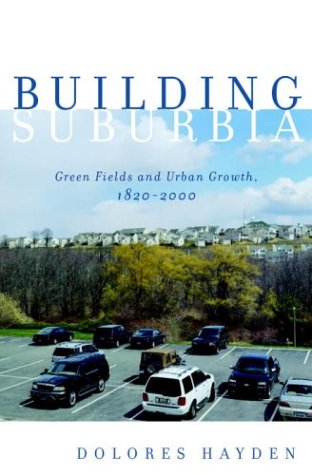

Building Suburbia : green fields and urban growth, 1820-2000. / Dolores Hayden. txt
Idioma: Inglés New York : Vintage Books , 2003Edición: 1st edDescripción: xiii, 318 p. ill. ; 25 cmTipo de contenido:- text
- unmediaded
- volume
- 0375421289
- 9780375727214
- 307.76/0973 21
- HT352.U6 H39 2003
| Imagen de cubierta | Tipo de ítem | Biblioteca actual | Biblioteca de origen | Colección | Ubicación en estantería | Signatura topográfica | Materiales especificados | Info Vol | URL | Copia número | Estado | Notas | Fecha de vencimiento | Código de barras | Reserva de ítems | Prioridad de la cola de reserva de ejemplar | Reservas para cursos | |
|---|---|---|---|---|---|---|---|---|---|---|---|---|---|---|---|---|---|---|
| Libro | CARIBET Biblioteca Arquitectura Colección General CARIBET | General HT352.U6 H39 2003 c.1 (Navegar estantería(Abre debajo)) | 1 | Disponible | 91000000036616 |
Descripciones mejoradas de Syndetics:
For almost two centuries Americans have been moving to the suburbs in search of affordable family housing, unspoiled nature, and small-town sociability--only to find that their leafy new neighborhoods are part of the growing metropolitan sprawl. It is to this contested cultural landscape, where most Americans now live, that Dolores Hayden draws our attention. From nineteenth-century utopian communities and elite picturesque enclaves to early twentieth-century streetcar subdivisions and owner-built tracts to the vast postwar sitcom suburbs and the subsidized malls and office parks that followed (on a scale that earlier builders could never have imagined), Hayden reveals the cultural and economic patterns that have brought us to the present. She explores the interplay of natural and built environments, the complex antagonisms between real-estate developers and suburban residents, the hidden role of federal government, and the religious and ideological overtones of the "American dream" embedded in the suburbs. Hayden asks hard questions about who has benefited from the suburban building process and about "smart" growth and "green" building. And she makes a strong case for the revitalization of existing neighborhoods in place of unchecked new growth on rural fringes. Few readers will see our ubiquitous suburbs in the same way again.
Index
Bibliography
Contents:
Preface and acknowledgments xi --
Part One: The American Metropolitan Landscape --
One The Shapes of Suburbia 3 --
Two The Suburban City 10 --
Part Two: Historic Patterns in The Landscape --
Three Borderlands 21 --
Four Picturesque Enclaves 45 --
Five Streetcar Buildouts 71 --
Six Mail Order and Self-Built Suburbs 97 --
Seven Sitcom Suburbs 128 --
Eight Edge Nodes 154 --
Nine Rural Fringes 181 --
Part Three: The Next Suburbs
Ten Nostalgia and Futurism 201 --
Eleven The Importance of Older Suburbs 230 --
Notes 249 --
Selected Bibliography 287 --
Index 303 --
"A lively history of the contested landscapes where the majority of Americans now live, 'Building Suburbia' chronicles two centuries in the birth and development of America's metropolitan regions. From rustic cottages reached by steamboat to big box stores at the exit ramps of eight-lane highways, Dolores Hayden defines seven eras of suburban development since 1820. An urban historian and architect, she portrays housewives and politicians as well as designers and builders making the decisions that have generated America's diverse suburbs. Residents have sought home, nature, and community in suburbia. Developers have cherished different dreams, seeking profit from economies of scale and increased suburban densities, while lobbying local and federal government to reduce the risk of real estate speculation. Encompassing environmental controversies as well as the complexities of race, gender, and class, Hayden's fascinating account will forever alter how we think about the communities we build and inhabit."
Tabla de contenidos provista por Syndetics
- Preface and Acknowledgments(p. xi)
- Part 1 The American Metropolitan Landscape
- 1 The Shapes of Suburbia(p. 3)
- 2 The Suburban City(p. 10)
- Part 2 Historic Patterns in the Landscape
- 3 Borderlands(p. 21)
- 4 Picturesque Enclaves(p. 45)
- 5 Streetcar Buildouts(p. 71)
- 6 Mail-Order and Self-Built Suburbs(p. 97)
- 7 Sitcom Suburbs(p. 128)
- 8 Edge Nodes(p. 154)
- 9 Rural Fringes(p. 181)
- Part 3 The Next Suburbs
- 10 Nostalgia and Futurism(p. 201)
- 11 The Importance of Older Suburbs(p. 230)
- Notes(p. 249)
- Selected Bibliography(p. 287)
- Index(p. 303)