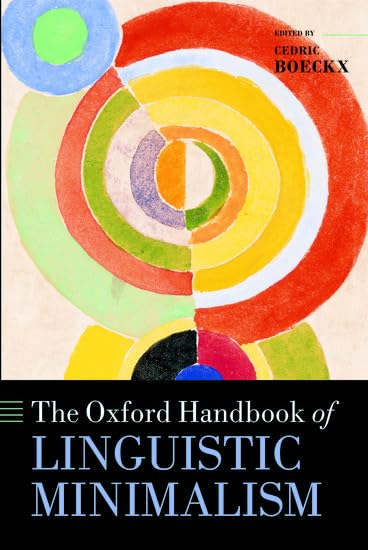

The Oxford handbook of linguistic minimalism edited by Cedric Boeckx.
Series Oxford handbooks in linguisticsDetalles de publicación: Oxford New York, NY Oxford University Press c2011.Descripción: xxvi, 707p. ill 25 cmISBN:- 9780199549368
- Linguistic minimalism
- 410 O982
- P158.28 .O94 2011
| Imagen de cubierta | Tipo de ítem | Biblioteca actual | Biblioteca de origen | Colección | Ubicación en estantería | Signatura topográfica | Materiales especificados | Info Vol | URL | Copia número | Estado | Notas | Fecha de vencimiento | Código de barras | Reserva de ítems | Prioridad de la cola de reserva de ejemplar | Reservas para cursos | |
|---|---|---|---|---|---|---|---|---|---|---|---|---|---|---|---|---|---|---|
| Referencia | Biblioteca Encarnación Valdés Sala de Referencia bev | 410 O982 (Navegar estantería(Abre debajo)) | Disponible | 80000002510702 |
Descripciones mejoradas de Syndetics:
This Handbook provides a complete assessment of the current achievements and challenges of the Minimalist Program. Established 15 years ago by Noam Chomsky with the aim of making all statements about language as simple and general as possible, linguistic minimalism is now at the centre of efforts to understand how the human language faculty operates in the mind and manifests itself in languages. In this book leading researchers from all over the world explore the origins of the program, the course of its sometimes highly technical research, and its connections with other disciplines, such as parallel developments in fields such as developmental biology, cognitive science, computational science, and philosophy of mind. The authors examine every aspect of the enterprise, show how each part relates to the whole, and set out current methodological and theoretical issues and proposals. The various chapters in this book trace the development of minimalist ideas in linguistics, highlight their significance and distinctive character, and relate minimalist research and aims to those in parallel fields. They focus on core aspects in syntax, including feature, case, phrase structure, derivations, and representations, and on interface issues within the grammar. They also take minimalism outside the domain of grammar to consider its role in closely related biolinguistic projects, including the evolution of mind and language and the relation between language and thought. The handbook is designed and written to meet the needs of students and scholars in linguistics and cognitive science at graduate level and above, as well as to provide a guide to the field for researchers other disciplines.
Tabla de contenidos provista por Syndetics
- 1 Some Roots of Minimalism in Generative Grammar
- 2 Features in Minimalist Syntax
- 3 Case
- 4 Merge and Bare Phrase Structure
- 5 Structure and Order: Asymmetric Merge
- 6 Multidominance
- 7 The Copy Theory
- 8 A-bar Dependencies
- 9 Head-Movement and the Minimalist Program
- 10 Minimality
- 11 Derivational Cycles
- 12 Anti-Locality: Too-close Relations in Grammar
- 13 Derivation(s)
- 14 No Derivation Without Representation
- 15 Last Resort with Move and Agree in Derivations and Representations
- 16 Optionality
- 17 Syntax and Interpretation Systems: How is their labour Divided?
- 18 Minimalist Construal: Two Approaches to A and B
- 19 A Minimalist Approach to Argument Structure
- 20 Minimalist Semantics
- 21 Minimal Semantic Instructions
- 22 Language and Thought
- 23 Parameters
- 24 Minimalism and Language Acquisition
- 25 A Minimalist Program for Phonology
- 26 Minimizing Language Evolution: The Minimalist Program and teh Evolutionary Shaping of Language
- 27 Computational perspectives on Minimalism
- Bibliography
- Index