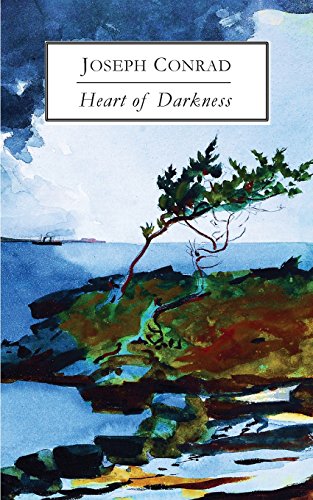

Heart of darkness Joseph Conrad.
Detalles de publicación: London Miller/Strauss ©2013.Descripción: 104 pages 21 cmISBN:- 9781492350804
| Imagen de cubierta | Tipo de ítem | Biblioteca actual | Biblioteca de origen | Colección | Ubicación en estantería | Signatura topográfica | Materiales especificados | Info Vol | URL | Copia número | Estado | Notas | Fecha de vencimiento | Código de barras | Reserva de ítems | Prioridad de la cola de reserva de ejemplar | Reservas para cursos | |
|---|---|---|---|---|---|---|---|---|---|---|---|---|---|---|---|---|---|---|
| Libro | Biblioteca Encarnación Valdés Colección General bev | 823.912 C7541h (Navegar estantería(Abre debajo)) | Disponible | 80000002509985 |
Descripciones mejoradas de Syndetics:
"We live as we dream--alone...." HEART OF DARKNESS is a short novel written by Joseph Conrad, presented as a frame narrative, about Charles Marlow's job as an ivory transporter down the Congo River in Central Africa. This river is described to be "... a mighty big river, that you could see on the map, resembling an immense snake uncoiled, with its head in the sea, its body at rest curving afar over a vast country, and its tail lost in the depths of the land." In the course of his commercial-agent work in Africa, the seaman Marlow becomes obsessed by Mr. Kurtz, an ivory-procurement agent, a man of established notoriety among the natives and the European colonials.The story is a thematic exploration of the savagery-versus-civilization relationship, and of the colonialism and the racism that make imperialism possible.
Extracto provisto por Syndetics
Reseñas proporcionadas por Syndetics
CHOICE Review
Undergraduate courses designed to introduce students to the study of literature or, more particularly, to the study of critical approaches to fiction, would find Murfin's collection of essays on Joseph Conrad's Heart of Darkness a useful text. The essays, written by five respected critics (including Federick R. Karl) specifically for this collection, are designed to model each of five current critical schools: the psychoanalytic, reader-response, feminist, deconstructive, and new historicist perspectives. Murfin introduces the collection with a history of 20th-century criticism that beginners will find helpful, and prefaces each of the essays with his own commentary on the techniques of the critical approach being illustrated. The volume also includes the text of Conrad's masterpiece with a detailed review of the biographical and historical context of the story, and a glossary of key terms used in the literature of contemporary literary theory and criticism. Murfin (Univeristy of Miami) is also the editor of Conrad Revisited: Essays for the Eighties (1985), and the author of books on Thomas Hardy and D.H. Lawrence. P. D. O'Connor Aquinas CollegeNotas de autor provistas por Syndetics
Joseph Conrad is recognized as one of the 20th century's greatest English language novelists.He was born Jozef Konrad Nalecz Korzeniowski on December 3, 1857, in the Polish Ukraine. His father, a writer and translator, was from Polish nobility, but political activity against Russian oppression led to his exile. Conrad was orphaned at a young age and subsequently raised by his uncle.
At 17 he went to sea, an experience that shaped the bleak view of human nature which he expressed in his fiction. In such works as Lord Jim (1900), Youth (1902), and Nostromo (1904), Conrad depicts individuals thrust by circumstances beyond their control into moral and emotional dilemmas. His novel Heart of Darkness (1902), perhaps his best known and most influential work, narrates a literal journey to the center of the African jungle. This novel inspired the acclaimed motion picture Apocalypse Now.
After the publication of his first novel, Almayer's Folly (1895), Conrad gave up the sea. He produced thirteen novels, two volumes of memoirs, and twenty-eight short stories. He died on August 3, 1924, in England.
(Bowker Author Biography)