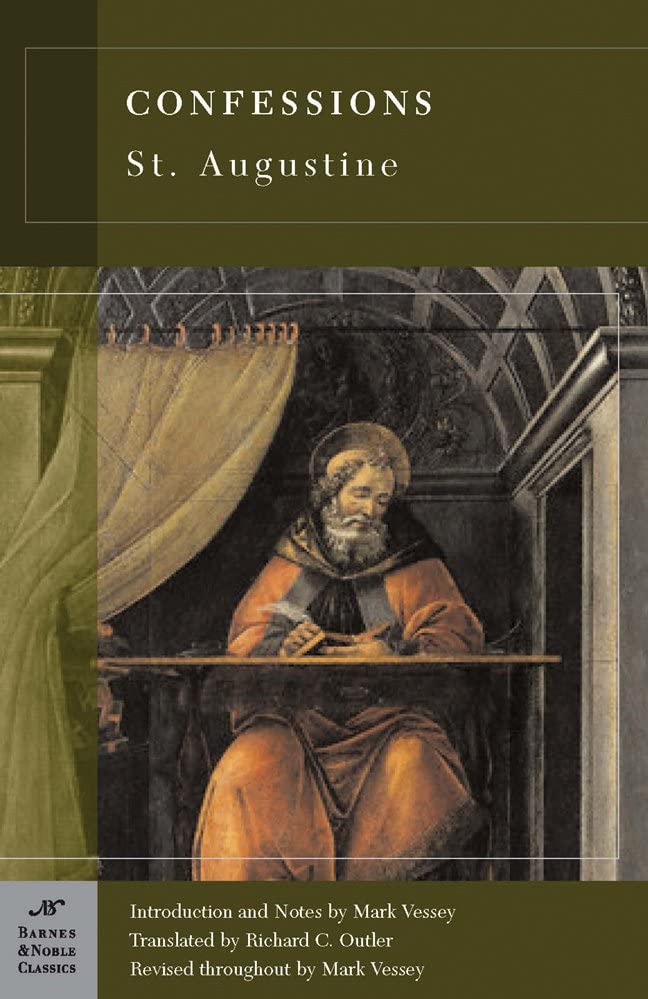
Imagen de portada de Amazon
Imagen de Amazon.com
Imagen de cubierta Syndetics
Portada de Syndetics
Imagen de OpenLibrary

Confessions Augustine ; [edited by] George Stade.

Por: Series Barnes & Noble classicsDetalles de publicación: New York, NY Barnes & Noble Classics 2007.Descripción: 304 p. 21 cmISBN:
  • 1593082592
Tema(s): Clasificación LoC:
  • BR65.A52 E6 2007
Recursos en línea:
Valoración
    Valoración media: 0.0 (0 votos)
Existencias
Imagen de cubierta Tipo de ítem Biblioteca actual Biblioteca de origen Colección Ubicación en estantería Signatura topográfica Materiales especificados Info Vol URL Copia número Estado Notas Fecha de vencimiento Código de barras Reserva de ítems Prioridad de la cola de reserva de ejemplar Reservas para cursos
Libro Biblioteca de Mayagüez Colección General mb BR65 .A52 E6 2007 (Navegar estantería(Abre debajo)) Disponible 50000003244125
Total de reservas: 0

Descripciones mejoradas de Syndetics:

&&LDIV&&R&&LDIV&&R&&LDIV&&R&&LI&&RConfessions&&L/I&&R, by &&LB&&RSt. Augustine&&L/B&&R, is part of the &&LI&&R &&LI&&RBarnes & Noble Classics&&L/I&&R &&L/I&&Rseries, which offers quality editions at affordable prices to the student and the general reader, including new scholarship, thoughtful design, and pages of carefully crafted extras. Here are some of the remarkable features of &&LI&&RBarnes & Noble Classics&&L/I&&R: &&LDIV&&R New introductions commissioned from todays top writers and scholars Biographies of the authors Chronologies of contemporary historical, biographical, and cultural events Footnotes and endnotes Selective discussions of imitations, parodies, poems, books, plays, paintings, operas, statuary, and films inspired by the work Comments by other famous authors Study questions to challenge the readers viewpoints and expectations Bibliographies for further reading Indices & Glossaries, when appropriate All editions are beautifully designed and are printed to superior specifications; some include illustrations of historical interest. &&LI&&RBarnes & Noble Classics &&L/I&&Rpulls together a constellation of influences--biographical, historical, and literary--to enrich each readers understanding of these enduring works.&&L/DIV&&R&&L/DIV&&R&&L/DIV&&R&&LDIV&&R &&L/DIV&&R&&LDIV&&ROne of the first personal histories ever written, &&LI&&RThe Confessions of St. Augustine&&L/I&&R offers more than a gripping narrative of one man's battle against doubt. It is also a brilliant work of theology that helped set the foundation for much of modern Christian thought.&&LBR&&R &&LBR&&RIn a series of thirteen books, &&LSTRONG&&RSaint Augustine&&L/B&&R displays a profound and searching intellect as he examines his life: his early memories of growing up in Roman North Africa during the fourth century A.D., his disgusted response to his mother's faith, his agonies and sins as a student, and finally his dramatic conversion in a garden in Milan. Along the way, the &&LI&&RConfessions&&L/I&&R explores with great force and artistry the nature of time, mind, and memory, and lays out Augustine's interpretation of the Book of Genesis.&&L/DIV&&R&&LDIV&&R&&LBR&&RThroughout, Augustine's remarkable depth of thinking is matched only by his elegance of expression, which has powerfully moved readers for more than 1500 years. A timeless classic, the &&LI&&RConfessions&&L/I&&R remains an unforgettable portrait of an individual's struggle for self-definition in the presence of a powerful God.&&L/DIV&&R&&LDIV&&R &&L/DIV&&R&&LDIV&&R&&LDIV&&R&&LSTRONG&&RMark Vessey&&L/B&&R &&L/B&&Ris Professor of English at the University of British Columbia. He is the author of &&LI&&RLatin Christian Authors in Late Antiquity and Their Texts&&L/I&&R and co-editor of &&LI&&RAugustine and the Disciplines: Cassiciacum to "Confessions".&&L/I&&R He has written extensively on the reception of early Christian Latin writings in the Renaissance and later periods.&&L/DIV&&R&&L/DIV&&R&&L/DIV&&R

gcc/1/2014

Extracto provisto por Syndetics

From Mark Vessey's Introduction to the Confessions The Confessions stands in a unique relationship to the Western idea of the literary classic. Augustine's most famous work challenges one of the supreme classics of ancient Latin literature, Virgil's Aeneid , the epic of Rome's imperial destiny. It contends against that sacred Roman model in an idiom derived from the Jewish and Christian scriptures, texts with their own strong claim to normative status in cultures of the ancient, medieval, and modern worlds. In the Confessions we witness the collision of two mighty traditions of storytelling, alike devoted to the long-term dealing of god(s) with human beings and societies. This alone would guarantee the work's historic interest. What makes it startling, even now, is Augustine's attempt to tell a story of the entire human race throughout all time, in the first person singular . The example of Roman epic encouraged narrative ambition. The Hebrew psalms provided an alternative dramatic voice. To say much more than that is to say more than we can know for certain about the genesis of this strange and utterly original creation. For a long while after Augustine's death, no one knew what to make of the Confessions. By the time we find readers responding to it with real excitement, between the twelfth and fourteenth centuries of the Christian era, they already resemble the modern selves we call our own. 1 "To Carthage then I came / Burning burning burning burning." The mood and movement are Augustine's, at the beginning of book 3 of the Confessions . As a Roman citizen of the late Empire, Augustine spoke and wrote in Latin. The English lines occur in a modern classic, T. S. Eliot's The Waste Land (1922), arguably the most influential English-language literary work of the twentieth century. (Its nearest competitor would be James Joyce's Ulysses , published in the same year, another composition that plays on a long tradition of poetry and myth from Homer forward.) In the explanatory notes that he added to his poem, Eliot acknowledged Augustine as a source, quoting the Confessions in the first translation ever made of it in English, by Tobie Matthew (1620). "To Carthage then I came" was Matthew's rendering of Augustine's "Veni Carthaginem." The Latin phrase had a special resonance for Augustine's readers in the early fifth century. In the far-off days of the Roman Republic, Carthage had been Rome's great enemy. A Carthaginian army under Hannibal once encamped beneath the walls of the city itself. "Carthage must be destroyed!" That was the famous refrain of the Roman statesman Cato in his speeches to the Senate. Ancient Punic Carthage was destroyed, politically and physically. The city razed, its territories became Roman possessions. But the rivalry lingered in historical and mythological accounts of the rise of Roman power. In the time of Augustus Caesar, the first Roman emperor, the poet Virgil devised a prophetic storyline in which the Trojan refugee Aeneas, making his way to Italy under the gods' direction to found the future nation of Rome, was hospitably received at Carthage by Queen Dido. Aeneas' tale of the fall of Troy, told to Dido and her entourage in books 2 and 3 of the Aeneid, is the leading first-person narrative in Roman literature. Augustine, who composed mock speeches based on episodes in the Aeneid as a schoolboy and taught the poem to his own students for years afterward, would have known it by heart. After relating the wearisome journey of himself and his fellows down to the moment of his father's death in Sicily, before the storm at sea that cast them on the shore of Dido's kingdom, Aeneas comes to a stop. Having come to Carthage, he has no more to tell in his own person, and reverts to being the third-person subject of a poet's tale. In the inner time of the poem, meanwhile, Dido has fallen fatally in love with her storytelling guest. Fatally , because the fate or destiny of Rome and Aeneas is against her. The hero will go on his god-driven way, leaving Carthage and its queen behind without so much as a word of parting. Abandoned and betrayed, Dido takes her own life. As the Trojans sail over the horizon, they look back and see the city lit up by her funeral pyre. It is also the reader's last sight of Carthage in the poem, burning. When T. S. Eliot was asked to give a lecture on Virgil in wartime London--another city lit by fire--he made his subject the question "What Is a Classic?" (1944). He answered it by claiming Virgil as the universal classic of European literature, and the Aeneid as the poem par excellence of European civilization. For Eliot, the Roman destiny of Aeneas already prefigured the Christian destiny of the Western nations after Rome. The idea was not altogether original; like others who appealed to Virgil as guardian spirit of "the West" during the dark years of the mid-twentieth century, Eliot was deeply indebted to Dante, the Christian poet who, in the Commedia ( Divine Comedy ) had taken the pagan Virgil as guide for part of his journey. Central to Eliot's vision of the literary classic is a scene of poignant separation that is also a promise for the future. There are only two moments in "What Is a Classic?" when he refers to a specific place in a literary text. The first is when he remembers how the shade of Dido refused to speak to Aeneas on his visit to the nether world. That passage in book 6 of the Aeneid Eliot calls "one of the most civilized . . . in poetry," because of the assurance that he found in it--in his own intuition of what Aeneas must have felt--that Virgil's hero possessed a "consciousness and conscience" suitable to the forerunner of European civilization. The second moment occurs at the very end of the lecture when Eliot quotes the lines spoken by the figure of Virgil as he takes his leave of Dante in the Commedia , having, says Eliot, "led Europe towards the Christian culture which he [Virgil] could never know." These twin scenes of Virgilian wayfaring provided Eliot in 1944 with the emotional grounds for a joint definition of the literary classic and of the Christian destiny of the West, one that appealed at the time to audiences on both sides of the Atlantic and whose echo has not yet died away. Neither scene, however, could have appeared in such a light without the intervention, between the pagan Virgil and the Christian Dante, of the wayfarer of Augustine's Confessions. Augustine, not Virgil, created the plot of the "divine comedy" onto which Eliot and other post-Romantic readers of Dante would one day graft their personal histories of the West. And that is perhaps the best reason for rating this work a classic in the twenty-first century. To read the Confessions is to go back to a place in memory from which the most expansive projections of Western civilization have been made--the place that Augustine, like Virgil before and Eliot after him, calls "Carthage." Excerpted from Confessions by Augustine All rights reserved by the original copyright owners. Excerpts are provided for display purposes only and may not be reproduced, reprinted or distributed without the written permission of the publisher.

Reseñas proporcionadas por Syndetics

Library Journal Review

Augustine's classic work, originally published between 397 and 400 CE, has appealed to readers far beyond the Christian world and been translated a number of times. Ruden (visiting scholar, Brown Univ.; Paul Among the People) seeks to make her translation different by not looking at the text from the perspective of later theological issues and sticking as closely as possible to the sense of the original Latin. This approach does not seem to make much difference in the first nine books-the autobiographical part-when compared to other translations. However, Ruden's format works very well in the final three books, which are highly philosophical, with meditations on memory and time. Ruden seeks to bring to the contemporary English reader the same experience the original Latin reader would have had. To do this, she often uses two or more words to translate one of Augustine's, since his original language has nuances not easily conveyed by one word. Footnotes give references to the biblical allusions in the text and explain contemporary controversies. VERDICT Ruden's translation makes Augustine's ancient text accessible to a new generation of readers with a real taste of the original Latin.-Augustine J. Curley, Newark Abbey, NJ © Copyright 2017. Library Journals LLC, a wholly owned subsidiary of Media Source, Inc. No redistribution permitted.

Notas de autor provistas por Syndetics

Saint Augustine was born to a Catholic mother and a pagan father on November 13, 354, at Thagaste, near Algiers. He studied Latin literature and later taught rhetoric in Rome and Milan. He originally joined the Manicheans, a religious sect, but grew unhappy with some of their philosophies. After his conversion to Christianity and his baptism in 387, Augustine developed his own approach to philosophy and theology, accommodating a variety of methods and different perspectives. He believed that the grace of Christ was indispensable to human freedom, and he framed the concepts of original sin and just war. His thoughts greatly influenced the medieval worldview.

One of Augustine's major goals was a single, unified church. He was ordained a priest in 391 and appointed Bishop of Hippo, in Roman Africa, in 396. Augustine was one of the most prolific Latin authors in terms of surviving works, and the list of his works consists of more than one hundred separate titles. His writings and arguments with other sects include the Donatists and the Pelagians. On the Trinity, The City of God, and On Nature and Grace are some of his important writings. Confessions, which is considered his masterpiece, is an autobiographical work that recounts his restless youth and details the spiritual experiences that led him to Christianity. Many of Augustine's ideas, such as those concerning sin and predestination, became integral to the doctrines of the Roman Catholic Church.

In the Catholic Church he is a saint and pre-eminent Doctor of the Church, and the patron of the Augustinians. He is the patron saint of brewers, printers, and theologians.

Augustine died on August 28, 430.

(Bowker Author Biography)

Compartir
logopucpr-y-vive

Contáctanos

¡Queremos saber de ti!

Tel. 787.841.2000 Ext. 1801

bibliotecavaldes@pucpr.edu

⁣Búscanos en las redes

© 2026 Desarrollado por Ignite Online • All Rights Reserved • Powered by Koha.