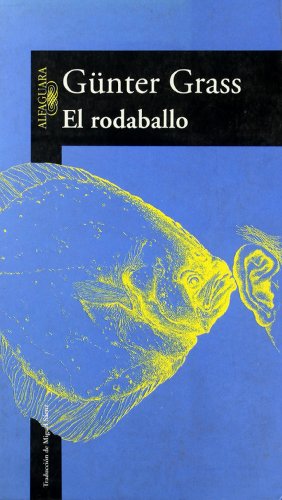

El rodaballo Günter Grass ; traducción de Miguel Sáenz.
Detalles de publicación: Madrid Grupo Santillana c1999.Descripción: 611 p. 22 cmISBN:- 8420441864
- 833.914 G768b E 19
- PT2613.R338 B8
| Imagen de cubierta | Tipo de ítem | Biblioteca actual | Biblioteca de origen | Colección | Ubicación en estantería | Signatura topográfica | Materiales especificados | Info Vol | URL | Copia número | Estado | Notas | Fecha de vencimiento | Código de barras | Reserva de ítems | Prioridad de la cola de reserva de ejemplar | Reservas para cursos | |
|---|---|---|---|---|---|---|---|---|---|---|---|---|---|---|---|---|---|---|
| Libro | Biblioteca Encarnación Valdés Colección General bev | 833.914 G768b E (Navegar estantería(Abre debajo)) | Disponible | 80000002507211 |
Descripciones mejoradas de Syndetics:
An outstanding collection of award-winning books and authors Santillana USA has compiled a selection of the most popular books in Spanish under the Alfaguara imprint. The world-renowned authors cover a range of genres including novels, short stories, anthologies, and poetry.
The author uses nine women to help him narrate the history of humanity, from prehistoric times to the uprising of the workers of Gdansk. Hundreds of thousands of years of battles between the sexes and social classes, between progress and superstition, distributed among nine chapters that correspond to the nine months of the pregnancy of the author's wife.
Notas de autor provistas por Syndetics
Günter Wilhelm Grass was born on October 16, 1927 in the Free City of Danzig, which is now Gdansk, Poland. He was a member of the Hitler Youth and at the age of 17, he was drafted into the German army. Near the end of the war, he served as a tank gunner in the 10th SS Panzer Division. He was captured by the Americans and forced to visit the newly liberated Dachau concentration camp. After his release from a POW camp in 1946, he worked in a potash mine and as a stonemason's apprentice and studied painting and sculpture in Düsseldorf.His first novel, The Tin Drum, was published in 1959. It was adapted into a film and won the Academy Award for Best Foreign Film in 1979. His other works included Cat and Mouse, Dog Years, From the Diary of a Snail, The Flounder, The Rat, and Crabwalk. He also wrote a memoir entitled Peeling the Onion. He received the Nobel Prize for Literature in 1999. He was also a political activist and liberal provocateur. He advocated for environmental conservation, debt relief for poor countries, and generous policies regarding political asylum. He died on April 13, 2015 at the age of 87.
(Bowker Author Biography)