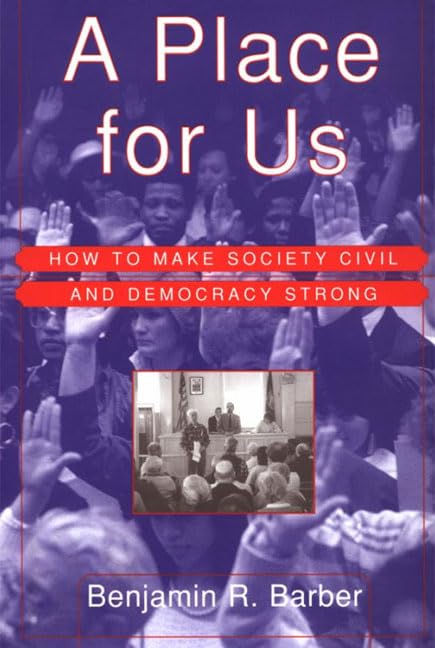

A place for us how to make society civil and democracy strong Benjamin R. Barber.
Detalles de publicación: New York Hill and Wang 1998.Edición: 1st edDescripción: 166 p. 22 cmISBN:- 0809076578 (alk. paper)
- 301 B2341p 21
- JC336 .B25 1998
| Imagen de cubierta | Tipo de ítem | Biblioteca actual | Biblioteca de origen | Colección | Ubicación en estantería | Signatura topográfica | Materiales especificados | Info Vol | URL | Copia número | Estado | Notas | Fecha de vencimiento | Código de barras | Reserva de ítems | Prioridad de la cola de reserva de ejemplar | Reservas para cursos | |
|---|---|---|---|---|---|---|---|---|---|---|---|---|---|---|---|---|---|---|
| Libro | Biblioteca Encarnación Valdés Colección General bev | 301 B2341p (Navegar estantería(Abre debajo)) | Disponible | 80000002506601 |
Descripciones mejoradas de Syndetics:
In our crowded, noisy world--too many people, too much crime, too many wars, not enough time--it seems almost impossible to locate and preserve the common ground where a civil society might flourish. Whatever happened to the civic virtue and community life that nourished true democracy?
In this provocative, hard-hitting book, political scientist Benjamin Barber tackles these questions head-on and, in answering them, retrieves the ideals of "civil society" from the nostalgists who want to re-create old-fashioned (and discriminatory) small communities and from the free-marketeers who associate it with unfettered commercial activity. Commentators have been making a fashion of civil society, but they tend to mean many different things by the phrase: this bracingly clear book shows how diverse the various notions are and how best to think about them.
Barber proposes practical strategies for making civil society real, for civilizing public discourse and promoting civic debate, and for affirming values beyond those of work and leisure, commerce and bureaucracy.
Includes bibliographical references (p. [149]-157) and index.
Reseñas proporcionadas por Syndetics
CHOICE Review
This extremely lively volume makes a welcome contribution to current discussions on the importance of civil society for healthy democracies. The book undertakes two broad tasks. First, it presents a sweeping overview of the many--and at times incompatible--uses of the term "civil society," using these readings to explain various weaknesses in democratic practice (e.g., why are some close-knit associations so much more democratic than others?) The second half of the book presents a series of tangible plans for improving (particularly American) democracy by reinvigorating civil society. This section of the work argues that proponents of both governmental and market solutions to social problems have corrupted the concept of civil society and the promise of democracy more generally. Barber argues that we are weakened by excessive reliance on either the market or government--and for the same reasons. From both extremes, the enemy of a vigorous, engaged, and creative citizenry, he argues, is bureaucratic control and individual fragmentation. The work is particularly interesting in its discussion of corporate responsibility for healthy civil society. Recommended for all levels. D. R. Imig; University of MemphisBooklist Review
Barber examines the concept of civil society, that "independent domain of free social life," a space of commonality that, controlled by neither government nor private industry, is available to all. He briefly describes the concept's history and the ways in which various groups have attempted to put concept into practice. After describing libertarian and communitarian models of civil society, he proposes a third, the strong democratic model. Arguing that neither government nor the private sector will guarantee a channel for the public voice, he calls individuals to take the first step in creating a civil society for themselves. He proposes six areas for legislative action in support of civil society, and he identifies nine characteristics of civil discourse--commonality, deliberation, inclusiveness, provisionality, listening, learning, lateral communication, imagination, and empowerment. So doing, Barber offers starting points for solving the problems--among them, those of voter apathy, inadequate education, and mistrust of special interest groups--that, in a democracy, arise from citizens' perceived disempowerment and disillusionment. --Bonnie JohnstonNotas de autor provistas por Syndetics
Benjamin Reynolds Barber was born in Manhattan, New York on August 2, 1939. He received a bachelor's degree in political science from Grinnell College in 1960 and a master's degree in government in 1963 and a doctorate in 1966 from Harvard University. In 1969, he began teaching political science at Rutgers University, where he was the director of the Walt Whitman Center for the Culture and Politics of Democracy for many years. In 2001, he joined the University of Maryland as the Kekst Professor of Civil Society.He was a political theorist and author. His books included Strong Democracy: Participatory Politics for a New Age, The Conquest of Politics: Liberal Philosophy in Democratic Times, Jihad vs. McWorld: How Globalism and Tribalism Are Reshaping the World, The Truth of Power: Intellectual Affairs in the Clinton White House, Fear's Empire: War, Terrorism and Democracy, If Mayors Ruled the World: Dysfunctional Nations, Rising Cities, and Cool Cities: Urban Sovereignty and the Fix for Global Warming.
In addition to his books, Barber was a frequent contributor to several magazines including The Atlantic, Harper's Magazine, and The New York Times. In 1974, he helped found the journal Political Theory, which he edited for the next decade. He coauthored the prize-winning, ten-part PBS/CBC television series The Struggle for Democracy. He died from pancreatic cancer on April 24, 2017 at the age of 77.
(Bowker Author Biography)