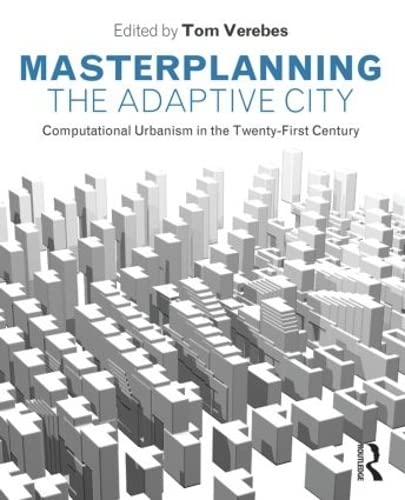

Masterplanning the Adaptive City : computational urbanism in the twenty-first century. / edited by Tom Verebes txt
New York : Routledge , 2014Edición: First published 2014Descripción: xiv, 296 p. ill. ; 21cmTipo de contenido:- text
- unmediaded
- volume
- 9780415534802
- 9780415534796
- 9780203428054
- 307.12160285
- HT166 V463 2014
| Imagen de cubierta | Tipo de ítem | Biblioteca actual | Biblioteca de origen | Colección | Ubicación en estantería | Signatura topográfica | Materiales especificados | Info Vol | URL | Copia número | Estado | Notas | Fecha de vencimiento | Código de barras | Reserva de ítems | Prioridad de la cola de reserva de ejemplar | Reservas para cursos | |
|---|---|---|---|---|---|---|---|---|---|---|---|---|---|---|---|---|---|---|
| Libro | CARIBET Biblioteca Arquitectura Colección General CARIBET | General HT166 V463 2014 (Navegar estantería(Abre debajo)) | 1 | Disponible | 91000000034850 |
Descripciones mejoradas de Syndetics:
Computational design has become widely accepted into mainstream architecture, but this is the first book to advocate applying it to create adaptable masterplans for rapid urban growth, urban heterogeneity, through computational urbanism. Practitioners and researchers here discuss ideas from the fields of architecture, urbanism, the natural sciences, computer science, economics, and mathematics to find solutions for managing urban change in Asia and developing countries throughout the world. Divided into four parts (historical and theoretical background, our current situation, methodologies, and prototypical practices), the book includes a series of essays, interviews, built case studies, and original research to accompany chapters written by editor Tom Verebes to give you the most comprehensive overview of this approach.
Essays by Marina Lathouri, Jorge Fiori, Jonathan Solomon, Patrik Schumacher, Peter Trummer, and David Jason Gerber.
Interviews with Dana Cuff, Xu Wei Guo, Matthew Prior, Tom Barker, Su Yunsheng, and Brett Steele.
Built case studies by Zaha Hadid Architects, James Corner Field Operations, XWG Studio, MAD, OCEAN Consultancy Network, Plasma Studio, Groundlab, Peter Trummer, Serie Architects, dotA, and Rocker-Lange Architects.
Includes Index.
Includes Bibliographical references (p.275)
Departments:
1 INTRODUCTION Tom Verebes --
5 PART I Context: Endurance, Obsolescence, and Change a Theoretical Foundation --
7 CHAPTER 1 The City as a Cultural and Technological Expression Tom Verebes --
7 1.1 Globalization and Networks --
13 1.2 The Edge of Chaos --
15 1.3 The Associative Logic of Urbanism --
20 CHAPTER 2 Projective Arquitectures: The Question of Borders in a Connected World Marina Lathouri --
23 CHAPTER 3 Conversation 1 Dana Cuff with Tom Verebes --
28 CHAPTER 4 The New New Tom Verebes --
28 4.1 Ancient China and The New --
30 4.2 Urban Europe: A Brief History of its Industrialization and Planning --
34 4.3 The Paradigm of the New World Instant City --
36 4.4 The Dubai Mirage --
40 CHAPTER 5 Informal City: Design as Political Engagement Jorge Fiori --
48 CHAPTER 6 Conversation 2 Xu Weiguo, Xu Feng and Gao Yun --
54 CHAPTER 7 Urbanization and Erasure Tom Verebes --
54 7.1 The Trouble with Speed Freaks --
57 7.2 Ghost of the Past --
60 7.3 An Ecological Model for Twenty First Century Urbanism --
62 7.4 The Problem of Functionality, Endurance, and Obsolescence --
64 7.5 Time, Change, and Adaptation --
68 CHAPTER 8 Public Spheres: Atmosphere and Adaptable Space in Hong Kong Jonathan D. Solomon --
69 Something in the Air --
71 Hong Kong's Public Sphere --
73 The City as Natural Artice --
75 CHAPTER 9 Conversation 3 Matthew Pryor with Tom Verebes --
80 Case Study Qianhai Masterplan, Shenzen, China James Corner Field Operations --
82 Case Study Flowing Gardens, International Horticultural Expo, Xi'an, China Plasma Studio --
85 PART II Concepts / Paradigms: New Paradigms And Practices In Urbanism :
87 CHAPTER 10 The Death of Masterplanning in the Age of Indeterminacy Tom Verebes --
87 10.1 Planning and / or Emergence --
92 10.2 Teleological Fallacies of the Masterplanner --
95 10.3 Principles of Uncertainty: Planning after the Global Financial Crisis --
99 10.4 Complex systems, Equilibrium, and Emergence --
106 10.5 Parametric Patterns and Models of Evolutionary Urbanism --
118 CHAPTER 11 Free Market Urbanism: Urbanism Beyond Planning Patrik Schumacher --
123 CHAPTER 12 Conversation 4 Tom Barker and Tom Verebes --
129 Case Study One North Singapore Science Hub, Singapore Zaha Hadid Architects --
132 Case Study Urban China Research Ocean CN --
135 Case Study Kaili Ethnic Cultural Compound, Guizhou, China dotA and Shanghai Tongji Urban Planning and Design Institute --
139 PART III Methodologies: Tools and Moving Targets :
141 CHAPTER 13 A New Toolbox for Adaptable Masterplanning Tom Verebes --
141 13.1 Models as Information --
144 13.2 Parameter Space, Solution Space, Urban Space --
148 13.3 Simulation and Gaming Enviroments as Management Systems --
153 CHAPTER 14 Morphogenetic Urbanism: Toward a Materialist Approach to Masterplanning Peter Trummer --
154 The Aggregated Figure --
156 The Ground as Matter --
158 Case Study Parametric Pearl River Delta Ocean CN --
162 Case Study Serial Systems: Remodeling Hong Kong Housing Ocean CN --
165 Case Study Density and Openness Revisited: Recoding Building Bulk in Hong Kong Rocker Lange Architects --
168 CHAPTER 15 Computational Urbanism Tom Verebes --
168 15.1 The Evolution of Computational Methodologies and Urbanism --
175 15.2 Automation, Optioneering, and Optimization --
180 15.3 Parametric Urbanism --
186 CHAPTER 16 Parametric Urbanism Redux: Urban Design and Complexity in a Age of Infinite Computing David Jason Gerber --
193 CHAPTER 17 Conversation 5 Su Yunsheng with Tom Verebes --
198 Case Study Yan Jiao Hua Run 4D City, Hebei Province, China dotA and Ocean CN --
205 Case Study Mica Urban Picturesque, Geneva, Switzerland Group8 Architects and Kaisersrot --
209 Case Study The Megablock and its Populated Field, and the Aggregation of Streets Peter Trummer, Associative Desing Program, Berlage Institute --
214 Case Study Endurance and Obsolescence Toolbox: Studies of Adaptable Masterplanning The University of Hong Kong --
221 PART IV Projections: Prototyping Multiple Futures :
223 CHAPTER 18 Endurance, Obsolescence, and the Adaptive City Tom Verebes --
223 18.1 New Prototypical Practices --
226 18.2 Typological Variants and Topological Transformations --
230 18.3 Icons and Innovation --
232 18.4 Control, Resilience, and Change --
237 Case Study Deep Ground: Regeneration Masterplanning for Longgang Center and Longcheng Square, Shenzhen, China Groundlab --
241 Case Study Xin Tian Di Factory H, Hangzhou, China Serie Architects --
245 Case Study Regeneration of Phoenix Shopping Street, Beijing, China XWG Studio --
248 Case Study Ordos Museum, Ordos, Inner Mongolia, China MAD --
253 Case Study Liantang / Heung Yuen Wai Boundary Control Point Passenger Terminal Building, Hon Kong Parametric Design Association, dotA, and Ocean CN --
259 Case Study Counterpart Cities: Futureport, Hong Kong Sar, Shenzhen, China The University of the Hong Kong Research Team, Led by Tom Verebes --
266 CHAPTER 19 Conversation 6 Brett Steele with Tom Verebes --
273 Conclusion Tom Verebes --
275 Bibliography --
283 Notes on Contributions --
291 Index --
Tabla de contenidos provista por Syndetics
- Foreword(p. xi)
- Preface and Acknowledgments(p. xiii)
- Introduction(p. 1)
- Part I Context: Endurance, Obsolescence, and Change-a Theoretical Foundation(p. 5)
- Chapter 1 The City as Cultural and Technological Expression(p. 7)
- 1.1 Globalization and Networks(p. 7)
- 1.2 The Edge of Chaos(p. 13)
- 1.3 The Associative Logic of Urbanism(p. 15)
- Chapter 2 Projective Architectures; The Question, of Borders in a Connected World(p. 20)
- Chapter 3 Conversation 1(p. 23)
- Chapter 4 The New New(p. 28)
- 4.1 Ancient China and The New(p. 28)
- 4.2 Urban Europe: a Brief History of Its Industrialization and Planning(p. 30)
- 4.3 The Paradigm of the New World Instant City(p. 34)
- 4.4 The Dubai Mirage(p. 36)
- Chapter 5 Informal City: Design as Political Engagement(p. 40)
- Chapter 6 Conversation 2(p. 48)
- Chapter 7 Urbanization and Erasure(p. 54)
- 7.1 The Trouble with Speed Freaks(p. 54)
- 7.2 Ghosts of the Past(p. 57)
- 7.3 An Ecological Model for Twenty-First Century Urbanism(p. 60)
- 7.4 The Problem of Functionality, Endurance, and Obsolescence(p. 62)
- 7.5 Time, Change, and Adaptation(p. 64)
- Chapter 8 Public-Spheres: Atmosphere and Adaptable Space in Hong Kong(p. 68)
- Something in the Air(p. 69)
- Hong Kong's Public-Sphere(p. 71)
- The City as Natural Artifice(p. 73)
- Chapter 9 Conversation 3(p. 75)
- Case Study(p. 80)
- Case Study Flowing Gardens, International Horticultural Expo, Xi'an, China(p. 82)
- Part II Concepts/Paradigms: New Paradigms and Practices in Urbanism(p. 85)
- Chapter 10 The Death of Masterplanning in the Age of Indeterminacy(p. 87)
- 10.1 Planning and/or Emergence(p. 87)
- 10.2 Teleological Fallacies of the Masterplanner(p. 92)
- 10.3 Principles of Uncertainty: Planning after the Global Financial Crisis(p. 95)
- 10.4 Complex systems, Equilibrium, and Emergence(p. 99)
- 10.5 Parametric Patterns and Models of Evolutionary Urbanism(p. 106)
- Chapter 11 Free-Market Urbanism: Urbanism Beyond Planning(p. 118)
- Chapter 12 Conversation 4(p. 123)
- Case Study One North Singapore Science Hub, Singapore(p. 129)
- Case Study Urban China Research(p. 132)
- Case Study Kaili Ethnic Cultural Compound, Guizhou, China dotA and Shanghai Tongji Urban Planning and Design Institute(p. 135)
- Part III Methodologies: Tools and Moving Targets(p. 139)
- Chapter 13 A New Toolbox For Adaptable Masterplanning(p. 141)
- 13.1 Models as Information(p. 141)
- 13.2 Parameter Space, Solution Space, Urban Space(p. 144)
- 13.3 Simulation and Gaming Environments as Management Systems(p. 148)
- Chapter 14 Morphogenetic Urbanism: Toward a Materialist Approach to Masterplanning(p. 153)
- The Aggregated Figure(p. 154)
- The Ground as Matter(p. 156)
- Case Study Parametric Pearl River Delta Ocean CN(p. 158)
- Case Study Serial Systems: Remodeling Hong Kong Housing Ocean CN(p. 162)
- Case Study Density and Openness Revisited: Recoding Building Bulk in Hong Kong(p. 165)
- Chapter 15 Computational Urbanism(p. 168)
- 15.1 The Evolution of Computational Methodologies and Urbanism(p. 168)
- 15.2 Automation, Optioneering, and Optimization(p. 175)
- 15.3 Parametric Urbanism(p. 180)
- Chapter 16 Parametric Urbanism Redux: Urban Design and Complexity in an Age of Infinite Computing(p. 186)
- Chapter 17 Conversation 5(p. 193)
- Case Study Yan Jiao Hua Run 4D City, Hebei Province, China dotA and Ocean CN(p. 198)
- Case Study Mica Urban Picturesque, Geneva, Switzerland Group8 Architects and Kaisersrot(p. 205)
- Case Study The Megablock and Its Populated Field, and the Aggregation of Streets(p. 209)
- Case Study Endurance and Obsolescence Toolbox: Studies of Adaptable Masterplanning The University of Hong Kong(p. 214)
- Part IV Projections: Prototyping Multiple Futures(p. 221)
- Chapter 18 Endurance, Obsolescence, and the Adaptive City(p. 223)
- 18.1 New Prototypical Practices(p. 223)
- 18.2 Typological Variants and Topological Transformations(p. 226)
- 18.3 Icons and Innovation(p. 230)
- 18.4 Control, Resilience, and Change(p. 232)
- Case Study Deep Ground: Regeneration Masterplan for Longgang Center and Longcheng Square, Shenzhen, China Groundlab(p. 237)
- Case Study Xin Tian Di Factory H, Hangzhou, China Serie Architects(p. 241)
- Case Study Regeneration of Phoenix Shopping Street, Beijing, China Xwg Studio(p. 245)
- Case Study Ordos Museum, Ordos, Inner Mongolia, China Mad(p. 248)
- Case Study Liantang/Heung Yuen Wai Boundary Control Point Passenger Terminal Building, Hong Kong Sar/Shenzhen, China Hong Kong Parametric Design Association, dotA, and Ocean CN(p. 253)
- Case Study Counterpart Cities: Futureport, Hong Kong Sar, Shenzhen, China The University of Hong Kong Research Team, Led By Tom Verebes(p. 259)
- Chapter 19 Conversation 6 Brett Steele with Tom Verebes(p. 266)
- Conclusion Tom Verebes(p. 273)
- Bibliography(p. 275)
- Notes on Contributors(p. 283)
- Index(p. 291)