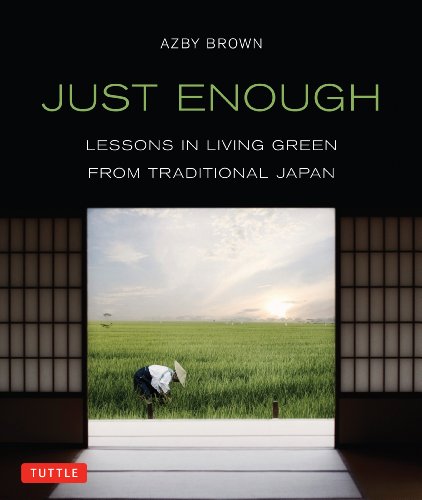

Just Enough : lessons in living green from traditional Japan. / Azby Brown. txt
North America : Japan : Asia Pacific : Tuttle Publishing , 2012Descripción: 224 p. ill. ; 23 cmTipo de contenido:- text
- unmediaded
- volume
- 9784805312544
- 4770030746
- 333.720952 22
- GE199.J3 B76 2012
| Imagen de cubierta | Tipo de ítem | Biblioteca actual | Biblioteca de origen | Colección | Ubicación en estantería | Signatura topográfica | Materiales especificados | Info Vol | URL | Copia número | Estado | Notas | Fecha de vencimiento | Código de barras | Reserva de ítems | Prioridad de la cola de reserva de ejemplar | Reservas para cursos | |
|---|---|---|---|---|---|---|---|---|---|---|---|---|---|---|---|---|---|---|
| Libro | CARIBET Biblioteca Arquitectura Colección General CARIBET | General GE199.J3 B76 2012 (Navegar estantería(Abre debajo)) | 1 | Disponible | 91000000033787 |
Descripciones mejoradas de Syndetics:
"Brown's book Just Enough is a compelling account of how Edo Japan confronted similar environmental problems and created solutions that connected farms and cities, people and nature." -- Huffington Post
The world has changed immeasurably over the last thirty years, with more, bigger, better being the prevailing mantra. But in the midst of this constantly evolving world, there is a growing community of people who are looking at our history, searching for answers to issues that are faced everywhere, such as energy, water, materials, food and population crisis.
In Just Enough , author Azby Brown turned to the history of Japan, where he finds a number of lessons on living in a sustainable society that translate beyond place and time. This book of stories depicts vanished ways of life from the point of view of a contemporary observer and presents a compelling argument around how to forge a society that is conservation-minded, waste-free, well-housed, well-fed and economically robust.
Included at the end of each section are lessons in which Brown elaborates on what Edo Period life has to offer us in the global battle to reverse environmental degradation. Covering topics on everything from transportation, interconnected systems, and waste reduction to the need for spiritual centers in the home, there is something here for everyone looking to make changes in their life.
Just Enough is a much-needed beacon in our evolving world, giving us hope in our efforts to achieve sustainability now.
"In a work of astonishing imagination and intelligence, Brown, a professor of design based in Japan, looks back to the Edo era (Tokyo, 1603-1868) and sees parallels between the ecological collapse then and environmental malaise now. The challenge: "to link our sophisticated technical systems to the kind of mentality that those prescient forbears displayed." -- Library Journal
Includes index (p. 222-224).
Includes bibliographical references (p. 219-221).
Table of contents:
preface to the new edition 4 --
foreword 7 --
Part I: field and forest --
the farmer from kai province 18 --
rice cultivation 72 --
rice production and its byproducts 80 --
thatching a roof 82 --
building materials and their virtues 86 learning from field and forest 88 --
Part II: the sustainable city --
The carpenter of edo 110 --
Ground transportation 164 --
learning from the sustainable city 166 --
Part III: a life of restraint --
the samurai edo 176 --
daimyo estate 208 --
learning from a life of restraint 210 --
acknowledgement 218 --
bibliography 219 --
index 222 --
Tabla de contenidos provista por Syndetics
- preface to the new edition(p. 4)
- foreword(p. 7)
- part I field and forest
- the farmer from kai province(p. 18)
- rice cultivation(p. 72)
- rice production and its byproducts(p. 80)
- thatching a roof(p. 82)
- building materials and their virtues(p. 86)
- learning from field and forest(p. 88)
- part II the sustainable city
- the carpenter of edo(p. 110)
- ground transportation(p. 164)
- learning from the sustainable city(p. 166)
- part III a life of restraint
- the samurai of edo(p. 176)
- daimyo estates(p. 208)
- learning from a life of restraint(p. 210)
- acknowledgments(p. 218)
- bibliography(p. 219)
- index(p. 222)