Imagen de portada de Amazon
Imagen de Amazon.com
Imagen de cubierta Syndetics
Portada de Syndetics
Imagen de OpenLibrary

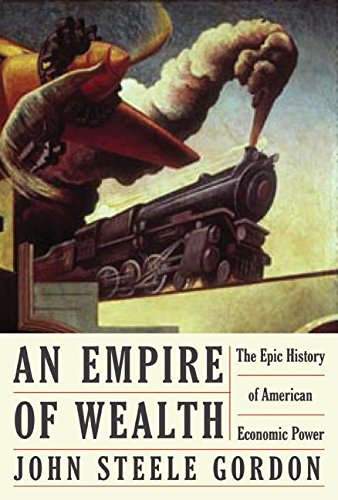
An empire of wealth the epic history of American economic power John Steele Gordon.

Por: Detalles de publicación: New York HarperCollins c2004.Edición: 1st edDescripción: xviii, 460 p. 24 cmISBN:
  • 0060093625
Tema(s): Clasificación CDD:
  • 330.973 G6621e 22
Clasificación LoC:
  • HC103 .G673 2004
Valoración
    Valoración media: 0.0 (0 votos)
Existencias
Imagen de cubierta Tipo de ítem Biblioteca actual Biblioteca de origen Colección Ubicación en estantería Signatura topográfica Materiales especificados Info Vol URL Copia número Estado Notas Fecha de vencimiento Código de barras Reserva de ítems Prioridad de la cola de reserva de ejemplar Reservas para cursos
Libro Biblioteca Encarnación Valdés Colección General bev 330.973 G6621e (Navegar estantería(Abre debajo)) Disponible 80000002502980
Total de reservas: 0

Descripciones mejoradas de Syndetics:

The United States is a formidable military power. But unlike empires from ancient Rome to modern England, America came to dominate the world in a less warlike, more subtle manner - through economic might. In An Empire of Wealth, John Steele Gordon captures the true source of our nation's global influence: wealth and the capacity to create more of it.

As a new nation, the United States used its English political inheritance, its restless, innovative, ambitious population, and its vast resources to the fullest. It was also very lucky. As the economy grew, it survived several potentially ruinous episodes, including the Civil War and the Great Depression, which nearly sent the banking system into irrevocable collapse. In a stirring narrative that mirrors the remarkable trajectory of America's history, Gordon captures as never before the true source of our nation's global triumph.John Steele Gordon is the author of A Thread Across the Ocean, The Business of America, and The Great Game, and a columnist for American Heritage. He lives in North Salem, New York."Fascinating ... A colorful, entertaining history of the American economy ... Mr. Gordon, in telling his tale, keeps a sharp eye out for the unintended consequences of economic change. They provide some of his most arresting facts." -- The New York Times

Includes bibliographical references (p. [433]-441) and index.

Tabla de contenidos provista por Syndetics

  • Acknowledgments(p. xi)
  • Introduction: The Pursuit of Happiness(p. xiii)
  • Part I A Vast and Roaring Wilderness
  • Chapter 1 The Land, the People, and the Law(p. 3)
  • Chapter 2 In the Name of God and Profit(p. 21)
  • Chapter 3 The Atlantic Empire(p. 37)
  • Part II A Country that Could Make Itself as it Pleased
  • Transition: The American Revolution(p. 59)
  • Chapter 4 The Hamiltonian Creation(p. 68)
  • Chapter 5 A Terrible Synergy(p. 82)
  • Chapter 6 Labor Improbus Omnia Vincit(p. 98)
  • Chapter 7 The Jeffersonian Destruction(p. 113)
  • Chapter 8 New Jersey Must Be Free!(p. 132)
  • Chapter 9 Chaining the Lightning of Heaven(p. 153)
  • Chapter 10 Whales, Wood, Ice, and Gold(p. 167)
  • Part III The Emerging Colossus
  • Transition: The Civil War(p. 191)
  • Chapter 11 Capitalism Red in Tooth and Claw(p. 205)
  • Chapter 12 Doing Business with Glass Pockets(p. 223)
  • Chapter 13 Was There Ever Such a Business!(p. 240)
  • Chapter 14 A Cross of Gold(p. 264)
  • Part IV The American Century Begins
  • Transition: The First World War(p. 285)
  • Chapter 15 Getting Prices Down to the Buying Power(p. 295)
  • Chapter 16 Fear Itself(p. 317)
  • Chapter 17 Converting Retreat into Advance(p. 332)
  • Part V A New Economic Revolution
  • Transition: The Second World War(p. 349)
  • Chapter 18 The Great Postwar Boom(p. 363)
  • Chapter 19 The Crisis of the New Deal Order(p. 382)
  • Chapter 20 A New Economy, a New World, a New War(p. 402)
  • Notes(p. 421)
  • Bibliography(p. 433)
  • Index(p. 443)

Extracto provisto por Syndetics

Empire of Wealth, An The Epic History of American Economic Power Chapter One The Land, The People, and The Law Abraham Lincoln thought that a nation -- however much the whole might exceed the sum of its parts -- consists of nothing more than its people, its land, and its laws. For the nations of the Old World, the three parts are inextricably bound up together in the long individual histories of those nations. But the United States, like all nations founded by European settlers in the great expansion of Western culture that began in the late fifteenth century, has no ancient history. At the beginning of American history, there was only the land. The land that would become the United States presented a world that was at once hauntingly familiar and quite unlike the one in which the first European explorers and settlers had grown up. Western Europe was a world of dense population, concentrated in cities, towns, and villages; intense cultivation of arable areas; limited wildlife; and limited and carefully husbanded forests. America was located in the same temperate zone and featured often familiar trees, plants, and animals, along with some exotic new ones, such as raccoons, skunks, maize, and rattlesnakes. But beyond the rocky shore of what is now the state of Maine and the vast sandy beach that stretches nearly unbroken from New Hampshire to Mexico and far beyond, lay a wilderness, upon which the hand of its human inhabitants had lain very lightly indeed. This wilderness was a forest larger than all of western Europe, broken only by the occasional beaver meadow, bog, swamp, rock outcropping, mountain bald, and the slash-and-burn fields of Indians. It stretched from the water's edge to well past the Mississippi. From there it extended fingerlike along river and creek bottoms into the great plains that covered the center of the continent. This huge forest was, of course, not uniform. In the North, great stands of white pine -- the preferred wood for the spars and masts of sailing ships -- alternated with hardwood forests, where maples, sycamores, and ash predominated in the lowlands, oaks and hickories on the drier and higher slopes. Farther south were stretches of different species of pine along the Atlantic seaboard, and these reached inward to where they met hardwood forests at higher elevations. The eastern shore of North America is a welcoming one. A broad coastal plain made for easy settlement. Peninsulas such as Cape Cod and Delmarva; islands such as Long Island; and the barrier beaches farther south provided shelter for the early sailing ships. A series of rivers -- the Merrimac, the Charles, the Thames, the Connecticut, the Housatonic, the Hudson, the Raritan, the Delaware, the Susquehanna, the Potomac, the Rappahannock, the York, the James, the Peedee, the Ashley, the Cooper, the Savannah -- provided access to the deep interior for the small and relatively shallow-drafted vessels of the day. As early as 1609, Henry Hudson, an Englishman in the employ of the Dutch, sailed his full-rigged ship Half Moon 150 miles up the river later named for him, reaching as far as present-day Albany. An overland trip so far inland would have required a month or more. Hudson, although moving cautiously in unfamiliar and narrow waters, covered the distance in a week. And because these rivers had been formed when the sea level was lower than it is today, the subsequent rise drowned the rivers' mouths and provided harbors that rank among the finest on the North Atlantic. Many of the country's first cities -- Boston, Newport, New London, New York, Baltimore, Norfolk, and Charleston -- sprang up where these harbors are located. The climate of North America that the first settlers encountered was, like the land, both familiar and exotic. It is temperate rather than arctic or tropical, and with abundant rain. But, being on the eastern edge of a great continent, the climate is continental in nature, whereas western Europe's is maritime, and greatly tempered by the warmth of the Gulf Stream. American winters are much colder than western Europe's while the summers are hotter. The high and low temperature records for London, located north of the fifty-first parallel of latitude, are 99 degrees and 2 degrees and only rarely approach either extreme. The records for New York, just north of the forty-first, are 106 degrees and -15 degrees, and the extremes are approached with disconcerting frequency. By European standards, New England winters and southern summers were long and brutal. This vast area was not uninhabited. Dubbed "Indians" (les indiens in French, los indios in Spanish) through the ignorance of the first European explorers, who thought themselves on the fringes of Asia, the aboriginal inhabitants of North America lived throughout the continent. But by European standards, their population was very low relative to the size of the land. Exact figures are impossible to come by and even estimates vary widely, but the Indian population of eastern North America was probably somewhere between one and two million people at the time of Colombus. The number declined, sometimes rapidly, as increased European contact prior to settlement introduced diseases to which the Indians had no immunity. Empire of Wealth, An The Epic History of American Economic Power . Copyright © by John Gordon. Reprinted by permission of HarperCollins Publishers, Inc. All rights reserved. Available now wherever books are sold. Excerpted from Empire of Wealth: The Epic History of American Economic Power by John Steele Gordon All rights reserved by the original copyright owners. Excerpts are provided for display purposes only and may not be reproduced, reprinted or distributed without the written permission of the publisher.

Reseñas proporcionadas por Syndetics

Library Journal Review

Gordon, a contributing editor for American Heritage often heard on public radio's Marketplace, has managed to write an engrossing and comprehensive survey of U.S. economic activity from Colonial times through the fall of communism and the S&L crisis. He presents even the least vivid economic history, such as the late 19th-century debate over the gold standard, in a fascinating manner. Devoting commensurate space to each period, he ably presents the panoply of American economics through wars, technical innovations, financial booms and busts, social changes, and government regulation. His judgments are balanced and less polemical than Thomas J. DiLorenzo's in the recent How Capitalism Saved America, though like DiLorenzo he does do some anti-capitalism myth busting. He portrays 19th-century "robber barons" in generally positive terms, and while he praises Franklin Roosevelt for restoring American confidence after the Great Depression, he also argues that most of the New Deal programs were unsuccessful and economically shortsighted. This remarkably detailed and interesting book is highly recommended for both academic and public libraries.-Lawrence R. Maxted, Gannon Univ., Erie, PA (c) Copyright 2010. Library Journals LLC, a wholly owned subsidiary of Media Source, Inc. No redistribution permitted.

Publishers Weekly Review

The word "epic" in the subtitle is a tip-off that instead of a critical history of the American economy, this book is a celebration of it. Nothing wrong with that, especially when the tale's told breezily and accurately. In fact, Gordon (The Scarlet Woman of Wall Street) notes the many stumbles and the frequent foolishness and corruption that attended the nation's rise as an economic powerhouse. The larger story of success is, in fact, an extraordinary one. The trouble is that the American economy, like every other, bends much out of shape. It has always provided opportunity but always with too much inequality. A full history of the American economy would take this into consideration in the past as well as the present, and Gordon's doesn't. Also, his book sometimes wanders off into irrelevant subjects, like the origins of the computer, but his grasp of the larger picture is sure and his prose bright. His chapter on Northern and Southern Civil War finances is a model of its kind. Those seeking an introduction to the general history of American economic power will find few better places to start, as long as they keep in mind that the nation's economy is not perfect, its benefits not unalloyed and its future domination of other economic powerhouses by no means assured. Agent, Katinka Matson. (Oct. 5) (c) Copyright PWxyz, LLC. All rights reserved

CHOICE Review

Gordon (a columnist for American Heritage magazine) has written an engaging narrative account of the development of the American economy. His goal is to explain the creation of the economic colossus that today produces 30 percent of the world's output with 6 percent of its population. Gordon attributes this success to political traditions inherited from England and the drive and independence of the immigrants who were attracted to America. To tell this story he relies on brief but sharply drawn narratives focusing on the personalities and decisions that shaped the American economy. Although spanning the entire period from European settlement to the present, he concentrates on the 19th and early 20th centuries. The Colonial period is covered in less than 60 pages, and the economic boom of the 1990s gets only 2 pages. Some topics, such as slavery and agriculture, are touched on only lightly in the focus on American industrialization. This is an excellent book for nonspecialists because it distills a large body of technical research; however, advanced readers may wish that there was more depth, better guidance for further reading, and more quantification. ^BSumming Up: Highly recommended. General readers and all levels of undergraduate students. J. L. Rosenbloom University of Kansas

Booklist Review

Gordon, a financial historian, tells the story of America's dynamic power, which is tied to its entrepreneurial culture and immense economic wealth. From the settlement at Jamestown (which was founded by a profit-seeking corporation) to the birth of the Internet, our history is replete with people who made America great with their hard work; ambition; ingenuity and, in the author's view, dumb luck. We learn that American power lies in its widely distributed wealth, the capacity of its people to create more wealth, and limitless imagination in developing new ways to use wealth productively. Others want to have what we have and adopt our ways because America is the global beacon of economic success. Engagingly tracing U.S. history from its earliest days to the tragedy of September 11, 2001, Gordon tells the tale of a crooked path of triumph and disaster, daring and timidity, and great individuals and fools. The author shows that ours is a case study in liberty. --Mary Whaley Copyright 2004 Booklist

Notas de autor provistas por Syndetics

John Steele Gordon is a columnist for American Heritage. His writing has appeared in the New York Times and the Wall Street Journal. He lives in North Salem, New York
Compartir
logopucpr-y-vive

Contáctanos

¡Queremos saber de ti!

Tel. 787.841.2000 Ext. 1801

bibliotecavaldes@pucpr.edu

⁣Búscanos en las redes

© 2026 Desarrollado por Ignite Online • All Rights Reserved • Powered by Koha.