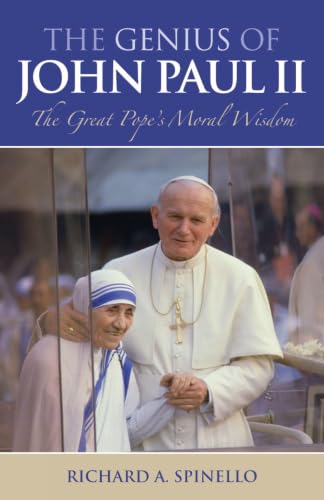
Imagen de portada de Amazon
Imagen de Amazon.com
Imagen de cubierta Syndetics
Portada de Syndetics
Imagen de OpenLibrary

The genius of John Paul II the great pope's moral wisdom Richard A. Spinello.

Por: Detalles de publicación: Lanham, MD Sheed & Ward Distributed by National Book Network c2007.Descripción: xvii, 237 p. 23 cmISBN:
  • 1580512062 (cloth : alk. paper)
  • 9781580512060 (cloth : alk. paper)
Tema(s): Clasificación CDD:
  • 241.042092 S7575g 22
Clasificación LoC:
  • BJ1249 .S637 2007
Recursos en línea:
Contenidos:
Faith, reason, and morals -- Competing moral visions -- The nature of the human person -- Freedom, the good, and the moral law -- The moral person -- Ethics for modern life -- Conclusions -- Appendix: the life and writings of John Paul II.
Valoración
    Valoración media: 0.0 (0 votos)
Existencias
Imagen de cubierta Tipo de ítem Biblioteca actual Biblioteca de origen Colección Ubicación en estantería Signatura topográfica Materiales especificados Info Vol URL Copia número Estado Notas Fecha de vencimiento Código de barras Reserva de ítems Prioridad de la cola de reserva de ejemplar Reservas para cursos
Libro Biblioteca Encarnación Valdés Colección General bev 241.042092 S7575g (Navegar estantería(Abre debajo)) Disponible 80000002502733
Total de reservas: 0

Descripciones mejoradas de Syndetics:

In this exciting new book, renowned ethicist Richard Spinello offers the first comprehensive presentation of the late John Paul II's great moral vision. Here admirers may read and understand the essential teachings of the pope in his own words as Spinello draws on his extensive research into John Paul II's writings and talks. Subjects covered include reverence for life, concern for the poor and suffering, moral law, conscience, moral choice, intrinsically evil acts, freedom, and goodness.

The purpose of this book is two-fold: it not only persuasively presents the late pope's vital teachings, but also defends them against his critics. This important new work preserves and promotes the extraordinary legacy of John Paul II by focusing on his championing of universal human dignity and objective moral truths.

Includes bibliographical references (p. 225-230) and index.

Faith, reason, and morals -- Competing moral visions -- The nature of the human person -- Freedom, the good, and the moral law -- The moral person -- Ethics for modern life -- Conclusions -- Appendix: the life and writings of John Paul II.

Tabla de contenidos provista por Syndetics

  • Acknowledgments(p. ix)
  • Preface(p. xi)
  • Abbreviations(p. xv)
  • Chapter 1 Faith, Reason, and Morals(p. 1)
  • Chapter 2 Competing Moral Visions(p. 29)
  • Chapter 3 The Nature of the Human Person(p. 57)
  • Chapter 4 Freedom, the Good, and the Moral Law(p. 89)
  • Chapter 5 The Moral Person(p. 123)
  • Chapter 6 Ethics for Modern Life(p. 147)
  • Chapter 7 Conclusions(p. 183)
  • Appendix The Life and Writings of Pope John Paul II(p. 219)
  • Bibliography(p. 225)
  • Index(p. 231)
  • About the Author(p. 237)

Reseñas proporcionadas por Syndetics

Library Journal Review

The writings and encyclicals of Pope John Paul II were infused with distinctive personalism that emphasized the dignity and rights of each human. Spinello (director, ethics programs, Boston Coll.) has gathered some of the late pope's moral writings, seeking to defend them against criticism. These pieces represent him both as a theologian and a philosopher, at times oscillating between the mystical/poetic and the densely philosophical. Spinello examines the major criticisms of John Paul's moral theology, e.g., oversimplification, failure to attribute historic consciousness, and overemphasis on evil acts and absolute moral norms. He points out to John Paul's critics that these writings are both faithful to the Catholic tradition and philosophically coherent. In presenting excerpts from encyclicals such as Veritatis splendor (The Splendor of Truth), Spinello is able to distinguish moral theology from moral philosophy. John Paul believed in the ontological goodness of all creation, and from that basis comes his truth. Recommended for religious studies and scholarly collections; John E. Fagan's The Teachings of Pope John Paul II may be more accessible for busy people at public libraries.-L. Kriz, West Des Moines P.L., IA (c) Copyright 2010. Library Journals LLC, a wholly owned subsidiary of Media Source, Inc. No redistribution permitted.

Publishers Weekly Review

Though beloved for his warmth and charismatic personality, Pope John Paul II was often portrayed in popular media as rigid and narrow-minded when it came to his pronouncements on moral issues. Spinello, director of ethics programs for the Carroll School of Management at Boston College, fiercely challenges that characterization in this overview of the late pope's moral teachings. Spinello explains that John Paul's views are founded on the Bible and the "living tradition" of the Catholic faith, including the early church fathers as well as the more recent writings of the Second Vatican Council. They are also shaped by philosophy, particularly the work of Thomas Aquinas. Spinello goes on to outline those views, often contrasting them with those of dissenting Catholic voices. Readers who want more than the sound-byte version of John Paul's moral positions and are willing to dig deeper into the underpinnings of the late pope's thinking will find Spinello's work both thoughtful and thorough. (Feb.) (c) Copyright PWxyz, LLC. All rights reserved All rights reserved.

Notas de autor provistas por Syndetics

Richard A. Spinello is director of Ethics Programs for the Carroll School of Management at Boston College. He lives in Hyde Park, Massachusetts.
Compartir
logopucpr-y-vive

Contáctanos

¡Queremos saber de ti!

Tel. 787.841.2000 Ext. 1801

bibliotecavaldes@pucpr.edu

⁣Búscanos en las redes

© 2026 Desarrollado por Ignite Online • All Rights Reserved • Powered by Koha.