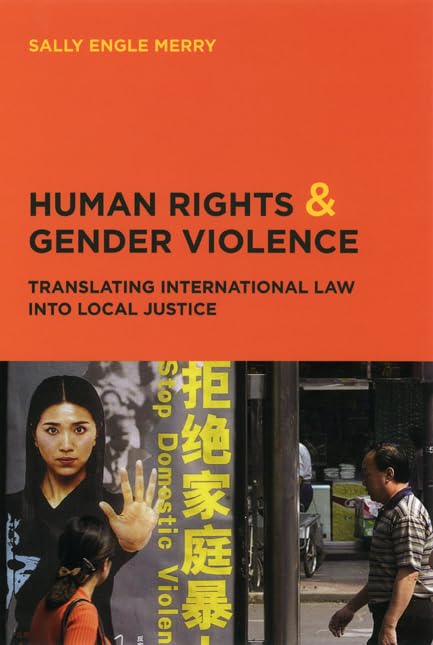

Human rights and gender violence translating international law into local justice Sally Engle Merry.
Idioma: Inglés Series The Chicago series in law and society | The Chicago series in law and societyDetalles de publicación: Chicago, Ill. University of Chicago Press Bristol University Presses Marketing distributor 2005.Descripción: ix, 269 p. 23 cmISBN:- 0226520730 (hbk.)
- 9780226520735 (hbk.)
- 0226520749 (pbk.)
- 9780226520742 (pbk.)
- 362.88082 22
- HQ 1237 .M47 2006
| Imagen de cubierta | Tipo de ítem | Biblioteca actual | Biblioteca de origen | Colección | Ubicación en estantería | Signatura topográfica | Materiales especificados | Info Vol | URL | Copia número | Estado | Notas | Fecha de vencimiento | Código de barras | Reserva de ítems | Prioridad de la cola de reserva de ejemplar | Reservas para cursos | |
|---|---|---|---|---|---|---|---|---|---|---|---|---|---|---|---|---|---|---|
| Libro | Biblioteca de Derecho Mons. Fremiot Torres Oliver Colección General biblioteca derecho | HQ 1237 .M47 2006 (Navegar estantería(Abre debajo)) | c. 1 | Disponible | 70000000896009 |
Descripciones mejoradas de Syndetics:
Human rights law and the legal protection of women from violence are still fairly new concepts. As a result, substantial discrepancies exist between what is decided in the halls of the United Nations and what women experience on a daily basis in their communities. Human Rights and Gender Violence is an ambitious study that investigates the tensions between global law and local justice.
As an observer of UN diplomatic negotiations as well as the workings of grassroots feminist organizations in several countries, Sally Engle Merry offers an insider's perspective on how human rights law holds authorities accountable for the protection of citizens even while reinforcing and expanding state power. Providing legal and anthropological perspectives, Merry contends that human rights law must be framed in local terms to be accepted and effective in altering existing social hierarchies. Gender violence in particular, she argues, is rooted in deep cultural and religious beliefs, so change is often vehemently resisted by the communities perpetrating the acts of aggression.
A much-needed exploration of how local cultures appropriate and enact international human rights law, this book will be of enormous value to students of gender studies and anthropology alike.
Includes bibliographical references and index.
Introduction: Culture and transnationalism -- Creating human rights -- Gender violence and the CEDAW process -- Disjunctures between global law and local justice -- Legal transplants and cultural translation : making human rights in the vernacular -- Localizing human rights and rights consciousness -- Conclusions.
Tabla de contenidos provista por Syndetics
- Acknowledgments(p. vii)
- Chapter 1 Introduction: Culture and Transnationalism(p. 1)
- Chapter 2 Creating Human Rights(p. 36)
- Chapter 3 Gender Violence and the CEDAW Process(p. 72)
- Chapter 4 Disjunctures between Global Law and Local Justice(p. 103)
- Chapter 5 Legal Transplants and Cultural Translation: Making Human Rights in the Vernacular(p. 134)
- Chapter 6 Localizing Human Rights and Rights Consciousness(p. 179)
- Chapter 7 Conclusions(p. 218)
- Notes(p. 233)
- References(p. 245)