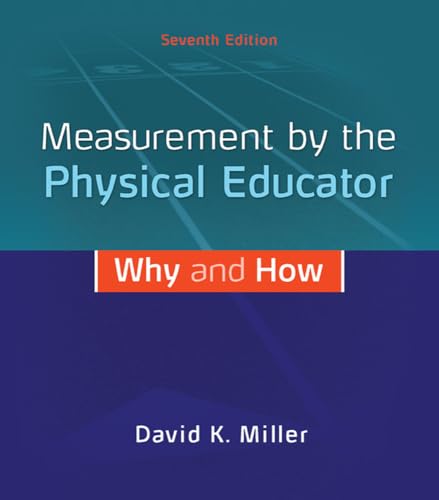

Measurement by the physical educator why and how David K. Miller, University of North Carolina at Wilmington.
Editor: New York McGraw-Hill c2014Edición: Seventh editionDescripción: xiv, 300 pages illustrations 24 cm Tipo de medio:- 9780078022685 (alk. paper)
- GV436 .M54 2014
| Imagen de cubierta | Tipo de ítem | Biblioteca actual | Biblioteca de origen | Colección | Ubicación en estantería | Signatura topográfica | Materiales especificados | Info Vol | URL | Copia número | Estado | Notas | Fecha de vencimiento | Código de barras | Reserva de ítems | Prioridad de la cola de reserva de ejemplar | Reservas para cursos | |
|---|---|---|---|---|---|---|---|---|---|---|---|---|---|---|---|---|---|---|
| Libro | Biblioteca Encarnación Valdés Colección General bev | 613.7 M6471m7 (Navegar estantería(Abre debajo)) | Disponible | 80000002506122 |
Descripciones mejoradas de Syndetics:
The purpose of this text is to help the physical education, exercise science, or kinesiology major develop the necessary confidence and skills to conduct measurement techniques properly and effectively. However, more than just measurement techniques are presented. Emphasis is placed upon the reasons for the measurement and the responsibilities after measurement is completed. These inclusions should help the student develop an appreciation of the need for measurement in a variety of settings. In addition, every effort has been made to present all the material in an uncomplicated way, and only practical measurement techniques are included.
Instructors and students can now access their course content through the Connect digital learning platform by purchasing either standalone Connect access or a bundle of print and Connect access. McGraw-Hill Connect® is a subscription-based learning service accessible online through your personal computer or tablet. Choose this option if your instructor will require Connect to be used in the course. Your subscription to Connect includes the following:
* SmartBook® - an adaptive digital version of the course textbook that personalizes your reading experience based on how well you are learning the content.
* Access to your instructor's homework assignments, quizzes, syllabus, notes, reminders, and other important files for the course.
* Progress dashboards that quickly show how you are performing on your assignments and tips for improvement.
* The option to purchase (for a small fee) a print version of the book. This binder-ready, loose-leaf version includes free shipping.
Complete system requirements to use Connect can be found here: http://www.mheducation.com/highered/platforms/connect/training-support-students.html
Includes bibliographical references (pages 285-291) and index.
Tabla de contenidos provista por Syndetics
- Preface(p. xi)
- 1 Measurement, Evaluation, Assessment, and Statistics(p. 1)
- Reasons for Measurement, Evaluation, and Assessment by the Physical Educator(p. 2)
- Motivation(p. 2)
- Diagnosis(p. 2)
- Classification(p. 3)
- Achievement(p. 3)
- Evaluation of Instruction and Programs(p. 3)
- Prediction(p. 3)
- Research(p. 4)
- Why Statistics?(p. 4)
- Analyze and Interpret Data(p. 4)
- Interpret Research(p. 4)
- Standardized Test Scores(p. 4)
- Determine the Worth (Validity and Reliability) of a Test(p. 4)
- Chapter Review Questions(p. 4)
- 2 Describing and Presenting a Distribution of Scores(p. 5)
- Statistical Terms(p. 5)
- Scales of Measurement(p. 6)
- Nominal Scale(p. 6)
- Ordinal Scale(p. 7)
- Interval Scale(p. 7)
- Ratio Scale(p. 7)
- Normal Distribution(p. 8)
- Analysis of Ungrouped Data(p. 9)
- Score Rank(p. 10)
- Measures of Central Tendency(p. 10)
- The Mean(p. 12)
- The Median(p. 13)
- The Mode(p. 14)
- Which Measure of Central Tendency Is Best for Interpretation of Test Results?(p. 14)
- Measures of Variability(p. 15)
- The Range(p. 15)
- The Quartile Deviation(p. 16)
- The Standard Deviation(p. 17)
- Relationship of Standard Deviation and Normal Curve(p. 18)
- Which Measure of Variability Is Best for Interpretation of Test Results?(p. 21)
- Percentiles and Percentile Ranks(p. 22)
- Frequency Distribution(p. 22)
- Graphs(p. 23)
- Standard Scores(p. 23)
- z-Scores(p. 23)
- T-Scores(p. 25)
- Percentiles(p. 27)
- Statistics Software(p. 27)
- Review Problems(p. 28)
- Chapter Review Questions(p. 28)
- 3 Investigating the Relationship between Scores(p. 31)
- Linear Correlation(p. 31)
- Scattergram(p. 32)
- Spearman Rank-Difference Correlation Coefficient(p. 33)
- Pearson Product-Moment Correlation Coefficient(p. 34)
- Interpretation of the Correlation Coefficient(p. 35)
- Significance of the Correlation Coefficient(p. 35)
- Coefficient of Determination(p. 37)
- Negative Correlation Coefficients(p. 37)
- Correlation, Regression, and Prediction(p. 37)
- Review Problems(p. 38)
- Chapter Review Questions(p. 39)
- 4 Investigating the Difference in Scores(p. 41)
- Testing for Significant Difference between Two Means(p. 41)
- Dependent and Independent Variables(p. 42)
- The Null Hypothesis(p. 42)
- Degrees of Freedom(p. 42)
- Level of Significance(p. 43)
- Standard Error of the Mean(p. 43)
- Standard Error of the Difference between Means(p. 44)
- t-Test for Independent Groups(p. 44)
- t-Test for Dependent Groups(p. 46)
- Review Problems(p. 47)
- Testing for Significant Difference among Three or More Means(p. 48)
- Special Terms and Symbols(p. 48)
- Analysis of Variance for Independent Groups(p. 48)
- Post Hoc Test For Independent Groups(p. 49)
- Analysis of Variance for Repeated Measures(p. 51)
- Post Hoc Test for Repeated Measures(p. 53)
- Review Problems(p. 54)
- Chapter Review Questions(p. 56)
- 5 What Is a Good Test?(p. 57)
- Criterion-Referenced Measurement(p. 57)
- Norm-Referenced Measurement(p. 58)
- Validity(p. 58)
- Validity of Criterion-Referenced Tests(p. 59)
- Validity of Norm-Referenced Tests(p. 59)
- Factors Affecting Validity(p. 62)
- Reliability(p. 62)
- Reliability of Criterion-Referenced Tests(p. 63)
- Reliability of Norm-Referenced Tests(p. 63)
- Factors Affecting Reliability(p. 64)
- Objectivity(p. 65)
- Administrative Feasibility(p. 65)
- Review Problems(p. 66)
- Chapter Review Questions(p. 66)
- 6 Construction of Knowledge Tests(p. 67)
- Steps in Construction of a Test(p. 67)
- 1 Test Planning(p. 67)
- 2 Test Item Construction(p. 69)
- 3 Test Administration(p. 70)
- 4 Item Analysis(p. 70)
- 5 Item Revision(p. 73)
- Objective Test Items(p. 73)
- True-False Items(p. 73)
- Multiple-Choice Items(p. 75)
- Matching Items(p. 76)
- Short-Answer and Completion Items(p. 77)
- Essay Test Items(p. 78)
- Review Problems(p. 80)
- Chapter Review Questions(p. 80)
- 7 Assessing and Grading the Students(p. 81)
- Characteristics of Authentic Assessment(p. 82)
- Formal Record Keeping(p. 82)
- Natural Surroundings(p. 82)
- Formative and Summative Assessment(p. 82)
- Technique (Form) and End Result(p. 82)
- Self-Assessment and Peer Assessment(p. 85)
- Portfolio Assessment(p. 85)
- National Association for Sport and Physical Education (NASPE)(p. 86)
- Grading(p. 86)
- Use of Grades(p. 87)
- Students(p. 87)
- Parents(p. 87)
- Teachers(p. 87)
- Administrators(p. 87)
- Factors Used in Grading(p. 88)
- Affective Factors(p. 88)
- Cognitive Factors(p. 88)
- Psychomotor Factors(p. 89)
- Criteria for Grades(p. 90)
- Methods of Grading(p. 91)
- Norm-Referenced Grading(p. 91)
- Criterion-Referenced Grading(p. 93)
- Which Method of Grading Is Best?(p. 95)
- Weighting of Factors(p. 95)
- Reporting of Final Grades(p. 96)
- Review Problem(p. 96)
- Chapter Review Questions(p. 97)
- 8 Construction and Administration of Psychomotor Tests(p. 99)
- Test Construction Guidelines(p. 99)
- Know What Is Required of a Good Test(p. 99)
- Define the Performance to Be Measured(p. 99)
- Analyze the Performance(p. 100)
- Review the Literature(p. 100)
- Devise the Test Items(p. 100)
- Prepare the Directions(p. 100)
- Have the Test Reviewed by Your Peers(p. 101)
- Administer the Test to a Small Group of Students(p. 101)
- Determine the Validity, Reliability, and Objectivity(p. 101)
- Develop the Norms(p. 101)
- Determine Intercorrelations(p. 101)
- Test Administration Responsibilities(p. 103)
- Pre-test Responsibilities(p. 103)
- Testing Responsibilities(p. 103)
- Post-test Responsibilities(p. 104)
- Types of Psychomotor Tests(p. 104)
- Review Problem(p. 105)
- Chapter Review Questions(p. 105)
- 9 Agility(p. 107)
- Why Measure Agility?(p. 108)
- Responsibilities after Measurement(p. 108)
- Tests of Agility(p. 108)
- Activities to Develop Agility(p. 114)
- Changes in the Height of the Body in lumps(p. 114)
- Changes in Distance(p. 114)
- Changes in Direction(p. 115)
- Other Agility Activities(p. 115)
- Review Problems(p. 115)
- Chapter Review Questions(p. 116)
- 10 Balance(p. 117)
- Why Measure Balance?(p. 117)
- Responsibilities after Measurement(p. 118)
- Tests of Balance(p. 118)
- Static Balance Tests(p. 118)
- Dynamic Balance Tests(p. 120)
- Activities to Develop Balance(p. 122)
- Static Balance Activities(p. 122)
- Dynamic Balance Activities(p. 123)
- Recapturing Balance Activities(p. 123)
- Review Problems(p. 123)
- Chapter Review Questions(p. 123)
- 11 Cardiorespiratory Fitness(p. 125)
- Why Measure Cardiorespiratory Fitness?(p. 125)
- Pre-Test/Pre-Activity Screening(p. 126)
- Responsibilities after Measurement(p. 127)
- Tests of Cardiorespiratory Fitness(p. 129)
- Development of Cardiorespiratory Fitness(p. 139)
- Review Problems(p. 141)
- Chapter Review Questions(p. 141)
- 12 Flexibility(p. 143)
- Why Measure Flexibility?(p. 143)
- Responsibilities after Measurement(p. 144)
- Tests of Flexibility(p. 145)
- Exercises to Develop Flexibility(p. 151)
- Neck(p. 153)
- Shoulder and Upper Chest(p. 153)
- Upper Back(p. 153)
- Lower Back(p. 153)
- Trunk(p. 154)
- Posterior Hip, Upper Leg, and Lower Back(p. 154)
- Anterior Hip and Thigh(p. 154)
- Groin Area(p. 154)
- Posterior Lower Leg(p. 154)
- Foot and Ankle(p. 155)
- Review Problems(p. 155)
- Chapter Review Questions(p. 155)
- 13 Muscular Strength, Endurance, and Power(p. 157)
- Why Measure Muscular Strength, Endurance, and Power?(p. 157)
- Responsibilities after Measurement(p. 158)
- Tests of Muscular Strength and Endurance(p. 158)
- Tests with Weight-Training Equipment(p. 159)
- Tests Requiring Limited Equipment(p. 161)
- Tests of Muscular Power(p. 172)
- Exercises to Develop Muscular Strength and Endurance(p. 175)
- Posterior Upper Arms, Shoulders, Chest, and Upper Back(p. 175)
- Anterior Upper Arms, Shoulders, Chest, and Upper Back(p. 175)
- Abdomen(p. 176)
- Lateral Trunk(p. 176)
- Lower Back and Buttocks(p. 176)
- Lateral Hips and Thighs(p. 176)
- Upper Legs(p. 176)
- Lower Legs(p. 177)
- Review Problems(p. 177)
- Chapter Review Questions(p. 177)
- 14 Anthropometry and Body Composition(p. 179)
- Why Measure Body Structure and Composition?(p. 180)
- Responsibilities after Measurement(p. 180)
- Body Type Classification (Somatotyping)(p. 181)
- Height-Weight Tables(p. 181)
- Elbow Breadth(p. 184)
- Ankle Girth(p. 184)
- Body Composition(p. 184)
- Bioelectrical Impedance Analysis (BIA)(p. 185)
- Air Displacement Plethysmography (BOD POD)(p. 186)
- Dual-Energy X-Ray Absorptiometry (DXA)(p. 186)
- Underwater Weighing(p. 187)
- Skinfold Tests(p. 187)
- Estimating Percent Body Fat(p. 190)
- Optimal Percent Body Fat and Desirable Body Weight(p. 191)
- Cooper Method for Determining Ideal Weight(p. 196)
- Body Mass Index (BMI)(p. 196)
- Fat Distribution(p. 197)
- Review Problems(p. 198)
- Chapter Review Questions(p. 198)
- 15 Physical Fitness(p. 199)
- Why Measure Physical Fitness?(p. 200)
- Guidelines for the Administration and Use of Fitness Tests(p. 200)
- Norm-Referenced Standards versus Criterion-Referenced Standards(p. 200)
- Responsibilities after Measurement(p. 201)
- Tests of Health-Related Physical Fitness(p. 202)
- Tests of Skill-Related Physical Fitness(p. 212)
- Review Problems(p. 218)
- Chapter Review Questions(p. 219)
- 16 Older Adults(p. 221)
- Why Measure Functional Fitness?(p. 221)
- Responsibilities after Measurement(p. 222)
- Testing Guidelines(p. 222)
- Tests of Functional Fitness(p. 222)
- Physical Activity for the Older Adult(p. 232)
- Activity(p. 233)
- Frequency(p. 233)
- Duration(p. 233)
- Intensity(p. 233)
- Review Problems(p. 233)
- Chapter Review Questions(p. 233)
- 17 Special-Needs Populations(p. 235)
- Why Measure Special-Needs Populations?(p. 235)
- Norm-Referenced or Criterion-Referenced Tests?(p. 237)
- Responsibilities after Measurement(p. 237)
- Perceptual-Motor Performance Tests(p. 237)
- Motor Performance Tests(p. 238)
- Physical Fitness Tests(p. 241)
- Review Problems(p. 247)
- Chapter Review Questions(p. 247)
- 18 Sports Skills(p. 249)
- Why Measure Sports Skills?(p. 249)
- Responsibilities after Measurement(p. 250)
- Individual and Dual Sports(p. 251)
- Archery(p. 251)
- Badminton(p. 251)
- Golf(p. 253)
- Handball(p. 255)
- Racquetball(p. 255)
- Tennis(p. 256)
- Team Sports(p. 260)
- Basketball(p. 260)
- Field Hockey(p. 262)
- Football(p. 264)
- Soccer(p. 266)
- Softball(p. 267)
- Volleyball(p. 270)
- Review Problems(p. 274)
- Chapter Review Questions(p. 274)
- Sources of Additional Sports Skills Tests(p. 274)
- Archery(p. 274)
- Badminton(p. 275)
- Basketball(p. 275)
- Bowling(p. 275)
- Field Hockey(p. 275)
- Football(p. 275)
- Golf(p. 275)
- Handball(p. 275)
- Racquetball(p. 275)
- Soccer(p. 275)
- Softball(p. 276)
- Swimming(p. 276)
- Tennis(p. 276)
- Volleyball(p. 276)
- Appendixes(p. 277)
- A Values of the Correlation Coefficient (r)(p. 277)
- B Critical Values of t (Two-Tailed Test)(p. 278)
- C F-Distribution(p. 279)
- D Values of the Studentized Range (q)(p. 283)
- References and Additional Reading(p. 285)
- Index(p. 293)