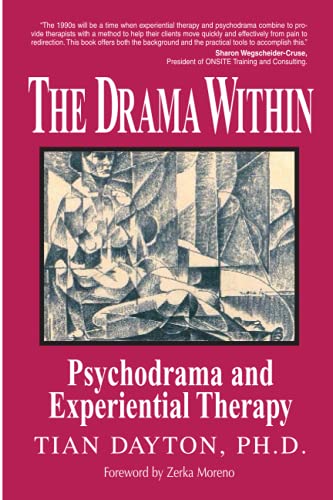
Imagen de portada de Amazon
Imagen de Amazon.com
Imagen de cubierta Syndetics
Portada de Syndetics
Imagen de OpenLibrary

The drama within psychodrama and experiential therapy Tian Dayton.

Por: Detalles de publicación: Deerfield Beach, Fla. Health Communications c1994.Descripción: xxi, 269 p. ill. 23 cmISBN:
  • 9781558742963
Tema(s): Clasificación CDD:
  • 616.89/1523 20
Clasificación LoC:
  • RC489.P7 D39 1994
Valoración
    Valoración media: 0.0 (0 votos)
Existencias
Imagen de cubierta Tipo de ítem Biblioteca actual Biblioteca de origen Colección Ubicación en estantería Signatura topográfica Materiales especificados Info Vol URL Copia número Estado Notas Fecha de vencimiento Código de barras Reserva de ítems Prioridad de la cola de reserva de ejemplar Reservas para cursos
Libro Biblioteca Encarnación Valdés Colección General bev 616.891523 D276d 1994 (Navegar estantería(Abre debajo)) Disponible 80000002486895
Total de reservas: 0

Descripciones mejoradas de Syndetics:

Here is the first comprehensive book on psychodrama, the experiential therapy rapidly gaining popularity with clinicians and treatment centers worldwide. Psychodrama is a powerful action method with very specific techniques that can be effective in reducing trauma, releasing pent-up emotions and learning new behavior.


Tian Dayton, one of the field's most respected practitioners, brings together a complete examination of the theory and practice of pyschodrama, directions for specific drama games and methods for applying the theory and games in the treatment of trauma and addiction.

Includes bibliographical references (p. 255-260) and index.

Extracto provisto por Syndetics

IntroductionIt is through direct experience that we come to know ourselves. It is through full engagement in life that all our senses, feelings and thoughts come into play. Doing is knowing--what we do we come to know, and what we come to know is stored in our brains as our baseline of learning. We can talk about swimming, read books on the subject and learn strokes on dry land--but until we get into the water, we have no direct experience of swimming. So it is with life: until we do, we do not know. Why should therapy be any different? Experiential therapy offers us a safe stage on which we can do and know, allowing our inner selves to come forward so that we can examine what we have accepted as true about a situation or ourselves. We often confine the idea of learning to a classroom setting; but from the point of view of how information is stored by the brain, all our life is a classroom. Often it is the emotional content of a given event or teaching that determines the impact of a particular learning experience. Early learning forms the basis for later learning. What we accept as true about ourselves early in life becomes the foundation upon which we build the beliefs about ourselves that we carry into adolescence and adulthood. What we are told about ourselves while we are young, either through verbal messages or the emotional atmosphere, tends to form the beginnings of our own personal mythology. The brain stores memories in clusters called cell assemblies, as interconnected or associated events. The activity of learning actually builds up and pares down cells, leaving a biological trail through the brain: in a period of from five to ten seconds, an event of one-half second has produced a structural or physical change in the brain. Not surprisingly, rich memories--the most colorful, the most ridiculous and the most painful--are those most likely to be recalled by the brain. The high emotional content of traumatic events is a powerful learning experience, which in part accounts for the ease with which a person raised in a troubled family will turn to self-defeating behavior. A man may repeatedly become involved with women who leave him, or a woman may constantly, yet unconsciously, seek out abusive men. They are acting out the same old script, a script that is literally imprinted on the brain. According to Daniel Alkon, Individual brain cells, after repeated exposure to similar events, begin to react in the same fashion each time: In other words, they learn. The human brain then starts to categorize and [to] group images, and then we use these complex sets to make abstractions. This process, created and reinforced in childhood, creates memories, which rarely go away. They may be hidden from the conscious mind, but they remain locked in the brain, waiting for a trigger to bring them to the surface.Some adults suddenly ôrememberö vivid memories of childhood abuse, sometimes even after decades, while others develop new ways to hide Excerpted from The Drama Within: Psychodrama and Experiential Therapy by Tian Dayton, Tian Dayton, All rights reserved by the original copyright owners. Excerpts are provided for display purposes only and may not be reproduced, reprinted or distributed without the written permission of the publisher.
Compartir
logopucpr-y-vive

Contáctanos

¡Queremos saber de ti!

Tel. 787.841.2000 Ext. 1801

bibliotecavaldes@pucpr.edu

⁣Búscanos en las redes

© 2026 Desarrollado por Ignite Online • All Rights Reserved • Powered by Koha.