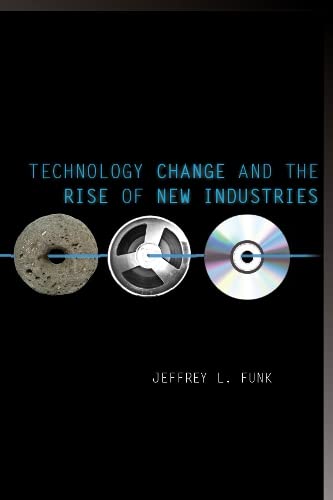

Technology change and the rise of new industries [electronic resource] Jeffrey L. Funk.
Idioma: Español Series Innovation and technology in the world economyDetalles de publicación: Stanford, California Stanford University Press 2012.Descripción: 1 onlineISBN:- 9780804784924 ebook
- 338/.064 23
- HC79.T4 F86 2012eb
| Imagen de cubierta | Tipo de ítem | Biblioteca actual | Biblioteca de origen | Colección | Ubicación en estantería | Signatura topográfica | Materiales especificados | Info Vol | URL | Copia número | Estado | Notas | Fecha de vencimiento | Código de barras | Reserva de ítems | Prioridad de la cola de reserva de ejemplar | Reservas para cursos | |
|---|---|---|---|---|---|---|---|---|---|---|---|---|---|---|---|---|---|---|
| Libro electrónico | Biblioteca de Mayagüez Acceso en línea | (HC79.T4 F86 2012eb) (Navegar estantería(Abre debajo)) | Disponible | 50000003239422 |
Descripciones mejoradas de Syndetics:
Technology Change and the Rise of New Industries explores why new industries emerge at specific moments in time and in certain countries. Part I shows that technologies which experience "exponential" improvements in cost and performance have a greater chance of becoming new industries. When "low-end" discontinuities incur exponential improvements, they often displace the dominant technologies and become "disruptive" innovations. Part II explores this phenomenon and instances in which discontinuities spawn new industries because they impact higher-level systems. Part III addresses a different set of questions--ones that consider the challenges of new industries for firms and governments. Part IV uses ideas from the previous chapters to analyze the present and future of selected technologies.
Based on analyses of many industries, including those with an electronic and clean energy focus, this book challenges the conventional wisdom that performance dramatically rises following the emergence of a new technology, that costs fall due to increases in cumulative production, and that low-end innovations automatically become disruptive ones.
Includes bibliographical references and index.
part I. What determines the potential for new technologies? Technology paradigm -- Scaling -- part II. When do technological discontinuities emerge? Computers -- Magnetic recording and playback equipment -- Semiconductors -- part III. Opportunities and challenges for firms and governments. Competition in new industries -- Different industries, different challenges -- part IV. Thinking about the future. Electronics and electronic systems -- Clean energy.