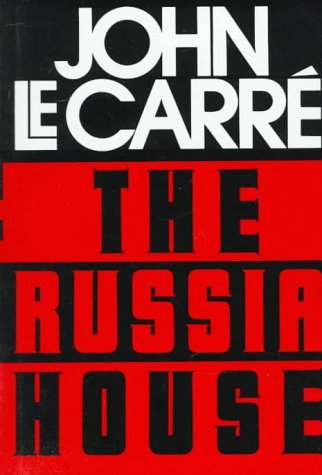

The Russia house John le Carré
Detalles de publicación: New York Knopf Distributed by Random House 1989.Edición: 1st edDescripción: 353 p. 25 cmISBN:- 0394577892
- 823/.914 19
- PR6062.E33 R87 1989
| Imagen de cubierta | Tipo de ítem | Biblioteca actual | Biblioteca de origen | Colección | Ubicación en estantería | Signatura topográfica | Materiales especificados | Info Vol | URL | Copia número | Estado | Notas | Fecha de vencimiento | Código de barras | Reserva de ítems | Prioridad de la cola de reserva de ejemplar | Reservas para cursos | |
|---|---|---|---|---|---|---|---|---|---|---|---|---|---|---|---|---|---|---|
| Libro | Biblioteca de Mayagüez Colección General mb | PR 6062 .E33 1989 (Navegar estantería(Abre debajo)) | Disponible | 50000003238952 |
Extracto provisto por Syndetics
Reseñas proporcionadas por Syndetics
Library Journal Review
A mysterious manuscript purporting to prove the Soviet defense system is unworkable is smuggled out of Moscow. It was intended for a flaky English publisher, a womanizing saxophone-playing boozer, but the smuggler has turned it over to British intelligence. In order to prove its authenticity, they recruit the publisher as an amateur spy and send him to Moscow to reestablish contact with the author. But the ``truth'' Barley Blair finds there is love and a purpose for his shambles of a life. As always with le Carre, this is a compelling spy story, a marvelous entertainment that is also as intelligent, witty, and brooding as many more self-consciously and less satisfying literary novels. It may not be the equal of The Quest for Karla trilogy or of a A Perfect Spy but it bears all the marks of a master, of the man who has both redefined and reanimated the espionage genre. BOMC main selection.-- Charles Michaud, Turner Free Lib., Randolph, Mass. (c) Copyright 2010. Library Journals LLC, a wholly owned subsidiary of Media Source, Inc. No redistribution permitted.Publishers Weekly Review
The master of the spy novel has discovered perestroika , and the genre may never be the same again . Le Carre's latest is both brilliantly up-to-date and cheeringly hopeful in a way readers of the Smiley books could never have anticipated. Barley Blair is a down-at-heels, jazz-loving London publisher who impresses a dissident Soviet physicist during a drunken evening at a Moscow Book Fair. When the physicist attempts to have Barley publish his insider's study of the chaotic state of Soviet defense, British intelligence steps in. Barley, after extensive vetting by both MI5 and the CIA, is made the go-between for further invaluable information, and in the process becomes involved with the physicist's former lover, Katya. The portraits of American and British intelligence agents are, as always, wonderfully acute, and the plot is a dazzling creation. Le Carre's Russia is funny and touching by turns but always convincing, and the love affair between Barley and Katya, subtly understated, is by far the warmest the author has created. But the singing quality of The Russia House , written at the height of le Carre's powers, is its pervading sense of the increasing waste and irrelevance of ongoing cold-war machinations: ``That is . . the tragedy of great nations. So much talent bursting to be used, so much goodness longing to come out. Yet all so miserably spoken for that sometimes we could scarcely believe it was America speaking to us at all.'' 350,000 first printing; BOMC main selection. (June) (c) Copyright PWxyz, LLC. All rights reservedBooklist Review
Spies, in the world of le Carre's utterly absorbing glasnost novel, are no longer tortured heroes but bureaucrats with "dead suburban souls." In a story that places people ahead of ideals, human values ahead of espionage objectives, le Carre dares to redefine the terms of his genre, thus becoming the first spy novelist to come in from the cold.Notas de autor provistas por Syndetics
David John Moore Cornwell was born in Poole, Dorsetshire, England in 1931. He attended Bern University in Switzerland from 1948-49 and later completed a B.A. at Lincoln College, Oxford. He taught at Eton from 1956-58 and was a member of the British Foreign Service from 1959 to 1964.He writes espionage thrillers under the pseudonym John le Carré. The pseudonym was necessary when he began writing, in the early 1960s because, at that time, he held a diplomatic position with the British Foreign Office and was not allowed to publish under his own name. When his third book, The Spy Who Came in from the Cold, became a worldwide bestseller in 1964, he left the foreign service to write full time. His other works include Call for the Dead; A Murder of Quality; Tinker, Tailor, Soldier, Spy; The Honourable Schoolboy; and Smiley's People.
He has received numerous awards for his writing, including the Grand Master Award from the Mystery Writers of America in 1986 and the Diamond Dagger from the Crime Writers Association in 1988. In 2011 he accepted the Goethe Medal. And in 2020, he accepted the Olof Palme Prize. Ten of his books have been adapted for television and motion pictures including The Spy Who Came in from the Cold, The Russia House, The Constant Gardener, A Most Wanted Man, and Our Kind of Traitor.
Le Carré's memoir, The Pigeon Tunnel: Stories from my Life, became a New York Times bestseller in 2016. In 2019, he published a spy thriller, Agent Running in the Field.
John Le Carré died on December 12, 2020 from pneumonia at the age of 89.
(Bowker Author Biography)