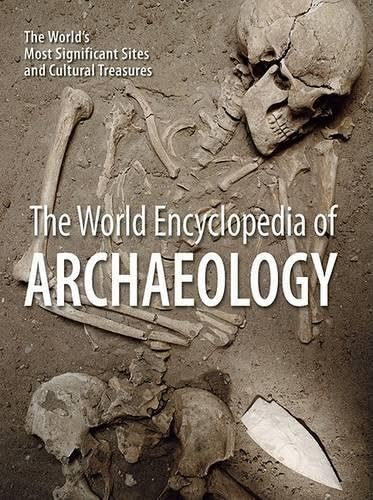

The world encyclopedia of archaeology chief consultant, Aedeen Cremin.
Detalles de publicación: Buffalo, N.Y. Firefly Books 2007.Descripción: 400 p. ill. (chiefly col.), col. maps 31 cmISBN:- 9781554073115
- 1554073111
- 930.103 W9271 22
- CC70 .W67 2007
| Imagen de cubierta | Tipo de ítem | Biblioteca actual | Biblioteca de origen | Colección | Ubicación en estantería | Signatura topográfica | Materiales especificados | Info Vol | URL | Copia número | Estado | Notas | Fecha de vencimiento | Código de barras | Reserva de ítems | Prioridad de la cola de reserva de ejemplar | Reservas para cursos | |
|---|---|---|---|---|---|---|---|---|---|---|---|---|---|---|---|---|---|---|
| Referencia | Biblioteca Encarnación Valdés Sala de Referencia bev | 930.103 W9271 (Navegar estantería(Abre debajo)) | Disponible | 80000002488503 |
Descripciones mejoradas de Syndetics:
The definitive reference on the art and science of archaeology.
The World Encyclopedia of Archaeology is a sweeping exploration of archaeology that spans the globe from the beginning of recorded history and earlier. Here is a comprehensive view of the past as seen through the remnants of civilizations as they emerge and expand. The book begins by defining modern and ancient archaeology and gives the history of archaeology through the centuries. The different types of archaeology are explored, along with the techniques used for each and the problems, concerns and issues archaeologists face today.
The main section of the book details each region of the world, with the authoritative text revealing the fascinating history of important archaeological sites. This global perspective includes more than 700 illustrations. The atlas section with detailed maps provides placements throughout history.
Accurate, in-depth and up to date, The World Encyclopedia of Archaeology is compelling reading. It serves as an outstanding reference for professionals, researchers, history buffs and general readers.
The World Encyclopedia of Archaeology includes:
The first humans Early hunter-gatherers and farmers Megalithic builders The Bronze Age The Greeks and Romans The Dark Ages Ancient Mesopotamia The Persian Empire Nomadic states The Indus civilization China's dynasties and empires Japan and Southeast Asian kingdoms Early Mesoamericans The Maya, Aztec and Inca Ancient Egypt and the Upper Nile Iron Age Africa Australian Aborigines.Highlights:
Compiled and written by an international team of archaeologists and historians Reveals the most up-to-date findings and their significance Organized geographically by region and key sites Uncovers the world's most important sites and treasures Spans all periods of human settlement Locator guide to sites by country List of World Heritage Sites 18 special features focus on intriguing topics Further readings and a glossary More than 700 color illustrations Attractive maps that show locations of key sites.Includes bibliographical references (p. 385-388) and index.
An overview of archaeology, from the history of the discipline to the problems and issues that face archaeologists today. Includes an introduction to archaeology, and archaeology of the regions of the world, their history, and their sites.
Tabla de contenidos provista por Syndetics
- Foreword
- Introduction
- What is Archaeology?
- History of Archaeology
- Concepts and Techniques
- Types of Archaeology
- Problems and Issues
- Important Questions That Archaeology Can Answer
- The Atlas
- Timelines of Archaeology
- Africa
- The First Humans
- Earliest Modern Humans
- Early Hunters and Herders
- Ancient Egypt
- Kingdoms of the Upper Nile
- Iron Age Sub-Saharan Africa
- Europe
- Earliest Peoples of Europe
- Early Hunter-Gatherers and Farmers
- Sacred Landscapes
- Mediterranean Worlds
- Mediterranean Empires
- Early Medieval Europe
- Asia
- Earliest Peoples of Asia
- The Fertile Crescent
- Ancient Mesopotamia
- The Persian Empire
- Nomadic States of Central Asia
- The Indus Civilization
- Early Chinese Dynasties
- The First Empires of China
- Japan
- Southeast Asia
- The Americas
- Earliest Peoples of the Americas
- Ancestral Pueblo
- Early Mesoamerican Cultures
- The Maya
- The Aztecs
- The Incas
- Other Cultures of the Americas
- Australia and the Pacific
- Australian Aborigines
- The Melanesians
- Polynesian Peoples
- Reference
- Guide to Sites by Country
- Further Reading
- Glossary
- Index
- Picture Credits
- Acknowledgements
Extracto provisto por Syndetics
Reseñas proporcionadas por Syndetics
Library Journal Review
Edited by archaeologist Cremin (The Celts in Europe), this encyclopedia comprises the entire history of humankind from the earliest fossil hominids 30 million years ago to the Kingdom of Hawaii in the early 19th century. After a concise overview of the history, issues, problems, and techniques of the field, the main atlas, which covers 150 archaeological sites, is arranged semichronologically within broad geographical areas. The A-to-Z entries are clearly written for a general audience by practicing archaeologists who are specialists in the subject areas covered. Many entries have inset boxes that further explore some aspect or issue related to the main article, and an archaeological time line, a glossary of terms, and a list for further reading are also included. Lavishly illustrated in full-color throughout, the volume belies its modest price and could be mistaken for a coffee-table book were the informational aspects of the work less impressive. BOTTOM LINE As with many single-volume works, certain topics are neglected, e.g., contemporary archaeology of modern urban settings. It would have also been useful had the references been printed with each article rather than together in one "Further Reading" list. However, if we view this as an introduction to the archaeological discoveries of the last few centuries, there is little here to be faulted, particularly at this price. Recommended for high school, public, and college libraries.--Amanda Sprochi, Univ. of Missouri Lib., Columbia (c) Copyright 2010. Library Journals LLC, a wholly owned subsidiary of Media Source, Inc. No redistribution permitted.CHOICE Review
Cremin (Australian National Univ.) assembled three dozen contributors to create this physically heavy work, which is less an encyclopedia than a coffee-table book. It is organized largely by world region, then roughly by chronology. Entries consist of a 1-2-page spread featuring an archaeological site (e.g., Newgrange, Teotihuacan) or a topic (e.g., iron metallurgy), with beautiful photographs, maps, and illustrations. A glossary, bibliography, and index try to tie the volume together. Entries are somewhat superficial because of the limited space allotted, and some terms are not indexed or are left undefined. Controversial topics (e.g., treasure hunting, mother goddesses) are treated tersely, sometimes without context or reference. Many researchers mentioned in the text (e.g., Tom Dillehay) are left out of the bibliography. Big gaps include postmedieval Europe and much of North and South America beyond the ancient civilizations. Friendly, but not deep, and gorgeously produced, it could be a gift book, but not one to refer students to for information at the undergraduate level. It is not recommended for academic libraries. Summing Up: Optional. General readers only. J. C. Wanser Hiram CollegeBooklist Review
Although it is called an encyclopedia, this attractive volume is more like a thematic atlas (in fact, the largest section is called The Atlas ). A team of more than 40 archaeologists, historians, and cultural anthropologists provided the text. More than 550 archival and color images, 20 regional maps, and 150 locator maps, as well as time lines, make the past ages live. An introduction covers the history, types, and techniques of archaeology and the issues facing the discipline today. The atlas section begins with time lines comparing milestones in human development and archaeology in Europe, the Americas, Australia, and the Pacific from seven million years ago to 2000. Text, which is organized by region and civilization, covers themes (for example, The Domestication of Plants and Animals, Bog Bodies ) in addition to more than 150 sites in more than 50 countries. The volume concludes with a reference section, a guide to sites by country, a bibliography, a glossary, and an index. This book is very readable as well as a useful reference tool. It can be browsed or studied, and it would engage the informal student as well as the serious reader. Although some of the sites, such as Knossos and Pompeii, may be familiar, others, such as Head-Smashed-In in Canada and Sannai Maruyama in Japan, are less so. Rich, colorful photographs and artwork are found on every page. There are a number of more comprehensive and scholarly reference works on archaeology, among them Encyclopedia of Archaeology: Histories and Discoveries (ABC-CLIO, 2001) and Milestones in Archaeology: A Chronological Encyclopedia (ABC-CLIO, 2007). The current volume is strongly recommended for public libraries needing just one basic resource.--Hogan, Patricia Copyright 2008 BooklistNotas de autor provistas por Syndetics
Dr. Aedeen Cremin is an archaeologist and a visiting Fellow at the Australian National University at Canberra. She is the general editor of Historic Environment , the author of The Celts in Europe and the co-author of Australia's Age of Iron .