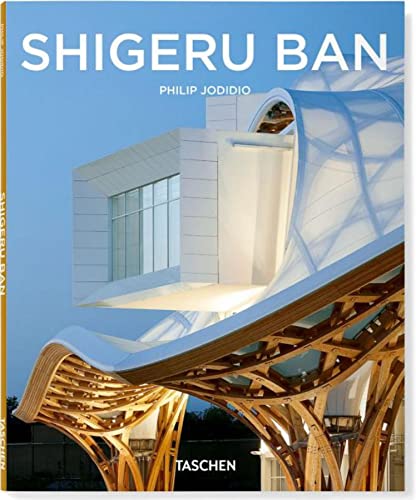

Shigeru Ban / Jodidio, Philip txt
Series Basic architectureKoln : Taschen , 2012Descripción: 96p. col. ill 23 cmTipo de contenido:- text
- unmediaded
- volume
- 9783836530767
- 720.92
- NA1559.B36 J63 2012
| Imagen de cubierta | Tipo de ítem | Biblioteca actual | Biblioteca de origen | Colección | Ubicación en estantería | Signatura topográfica | Materiales especificados | Info Vol | URL | Copia número | Estado | Notas | Fecha de vencimiento | Código de barras | Reserva de ítems | Prioridad de la cola de reserva de ejemplar | Reservas para cursos | |
|---|---|---|---|---|---|---|---|---|---|---|---|---|---|---|---|---|---|---|
| Libro | CARIBET Biblioteca Arquitectura Colección General CARIBET | General NA1559.B36 J63 2012 (Navegar estantería(Abre debajo)) | 1 | Disponible | 91000000036525 |
Descripciones mejoradas de Syndetics:
Master of innovation: Challenging accepted notions of architecture Famed Japanese architect Shigeru Ban attended SCI-Arc in California and earned his degree at the Cooper Union School of Architecture in New York. With offices in Tokyo and Paris, Ban consistently challenges accepted notions of architecture, designing a house without walls, or an exhibition space made from paper tubes and shipping containers. This survey traces his entire career to date, showing clearly why he is one of the world's most innovative and significant architects. Unlike many of his peers, Ban can create remarkable residences and still find time to design emergency relief housing for disaster areas from Kobe to New Orleans. Often using paper or cardboard tubes as a structural element, his designs give new meaning to the term "Paper Architect." His major completed works include the Furniture House at Lake Yamanaka, Japan, the Curtain Wall House in Tokyo, the Naked House in Kawagoe, Japan, the Japanese Pavilion at Hannover Expo 2000, the mobile Nomadic Museum, and his most recent masterpiece, the Centre Pompidou-Metz in France. About the Series:
Each book in TASCHEN's Basic Architecture Series features: an introduction to the life and work of the architect the major works in chronological order information about the clients, architectural preconditions as well as construction problems and resolutions a list of all the selected works and a map indicating the locations of the best and most famous buildings approximately 120 illustrations (photographs, sketches, drafts and plans)
Tabla de contenidos provista por Syndetics
- Introduction(p. 6)
- Alvar Aalto Exhibition(p. 26)
- Villa K(p. 28)
- Furniture House(p. 30)
- Paper House(p. 32)
- Curtain Wall House(p. 34)
- Paper Log House(p. 36)
- Paper Church(p. 38)
- Wall-Less House(p. 40)
- Paper Emergency Shelters for the UNHCR(p. 44)
- Japan Pavilion(p. 46)
- Naked House(p. 48)
- Picture Window House(p. 50)
- Atsushi Imai Memorial Gymnasium(p. 52)
- Glass Shutter House(p. 54)
- Shutter House for a Photographer(p. 56)
- Paper Temporary Studio(p. 58)
- Seikei University Library(p. 60)
- Nomadic Museum(p. 62)
- Papertainer Museum(p. 64)
- Takatori Church(p. 66)
- Maison E(p. 68)
- Nicolas G. Hayek Center(p. 70)
- Hualin Temporary Elementary School(p. 74)
- Haesley Nine Bridges Golf Clubhouse(p. 76)
- Centre Pompidou-Metz(p. 80)
- Metal Shutter House(p. 86)
- Villa Vista(p. 88)
- Paper Concert Hall(p. 92)
- Staff(p. 94)
- World Map(p. 95)
- Life and Work/ Bibliography / Credits /The Author(p. 96)
Reseñas proporcionadas por Syndetics
Spanish Review
"Todo el talento innovador y trascendente de Ban."Notas de autor provistas por Syndetics
The author:Philip Jodidio studied art history and economics at Harvard, and edited Connaissance des Arts for over 20 years. His books include TASCHEN's Architecture Now! series, and monographs on Tadao Ando, Norman Foster, Richard Meier, Jean Nouvel, and Zaha Hadid. He is internationally renowned as one of the most popular writers on the subject of architecture.