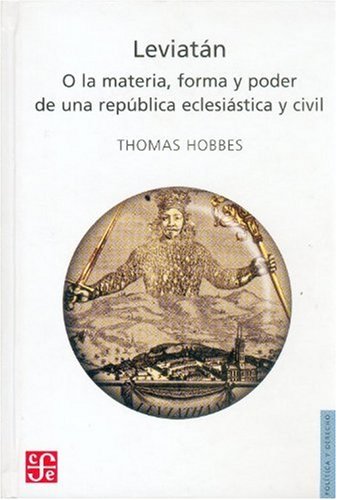

Leviatán o la materia, forma y poder de una república, eclesiástica y civil Thomas Hobbes ; traducción y prefacio : Manuel Sánchez Sarto.
Idioma: Español Lenguaje original: Inglés Detalles de publicación: Buenos Aires Fondo de Cultura Económica 2011.Descripción: xxvii, 618 p. ill. 23 cmTipo de contenido:- 9505571267
- JC153 .H652l, 1980
| Imagen de cubierta | Tipo de ítem | Biblioteca actual | Biblioteca de origen | Colección | Ubicación en estantería | Signatura topográfica | Materiales especificados | Info Vol | URL | Copia número | Estado | Notas | Fecha de vencimiento | Código de barras | Reserva de ítems | Prioridad de la cola de reserva de ejemplar | Reservas para cursos | |
|---|---|---|---|---|---|---|---|---|---|---|---|---|---|---|---|---|---|---|
| Libro | Biblioteca Encarnación Valdés Colección General bev | 320.15 H6821L E 2011 (Navegar estantería(Abre debajo)) | Disponible | 80000002487661 |
Descripciones mejoradas de Syndetics:
Cl sico de la ciencia pol tica, hace una penetrante cr tica de la Iglesia y la pol tica: Para acabar con el reino de las tinieblas y la superstici n, el nuevo Estado deber a excluir con firmeza todos los defectos org nicos del antiguo, y ser netamente racionalista y laico, un verdadero reino de la luz y de la ciencia.
Includes indexes.
Notas de autor provistas por Syndetics
Thomas Hobbes was born in Malmesbury, the son of a wayward country vicar. He was educated at Magdalen Hall, Oxford, and was supported during his long life by the wealthy Cavendish family, the Earls of Devonshire. Traveling widely, he met many of the leading intellectuals of the day, including Francis Bacon, Galileo Galilei, and Rene Descartes.As a philosopher and political theorist, Hobbes established---along with, but independently of, Descartes---early modern modes of thought in reaction to the scholasticism that characterized the seventeenth century. Because of his ideas, he was constantly in dispute with scientists and theologians, and many of his works were banned. His writings on psychology raised the possibility (later realized) that psychology could become a natural science, but his theory of politics is his most enduring achievement. In brief, his theory states that the problem of establishing order in society requires a sovereign to whom people owe loyalty and who in turn has duties toward his or her subjects. His prose masterpiece Leviathan (1651) is regarded as a major contribution to the theory of the state.
(Bowker Author Biography)