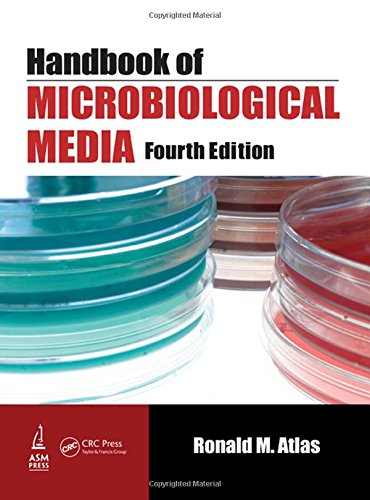

Handbook of microbiological media Ronald M. Atlas.
Detalles de publicación: Washington, D.C. ASM Press Boca Raton, FL CRC Press/Taylor & Francis c2010.Edición: 4th edDescripción: 2036 p. 29 cmISBN:- 9781439804063 (hardcover : alk. paper)
- 1439804060 (hardcover : alk. paper)
- 579.0282 A8813h4 22
- QR66.3 .A85 2010
- 2010 E-360
- QW 39
| Imagen de cubierta | Tipo de ítem | Biblioteca actual | Biblioteca de origen | Colección | Ubicación en estantería | Signatura topográfica | Materiales especificados | Info Vol | URL | Copia número | Estado | Notas | Fecha de vencimiento | Código de barras | Reserva de ítems | Prioridad de la cola de reserva de ejemplar | Reservas para cursos | |
|---|---|---|---|---|---|---|---|---|---|---|---|---|---|---|---|---|---|---|
| Libro | Biblioteca Encarnación Valdés Sala de Referencia bev | 579.0282 A8813h4 (Navegar estantería(Abre debajo)) | Disponible | 80000002487471 |
Descripciones mejoradas de Syndetics:
Handbook of Microbiological Media, Fourth Editionis an invaluable reference for every medical, veterinary, diagnostic, and academic laboratory, and now in its fourth edition, it is even more complete. This edition carries on the tradition of CRC Press handbook excellence, listing the formulations, methods of preparation, and uses for more than 7,000 microbiological media. With 1,500 more entries than any previous edition, the handbook includes both classic and modern media used for the identification, cultivation, and maintenance of diverse bacteria, archaea, and fungi.
The breadth of culture media in this comprehensive resource is enormous and has greatly expanded in recent years with the exploration of extreme habitats and the use of molecular methods to identify new lineages of bacteria and archaea. The media also represent significant advances in the ability to use chromogenic substrates to identify specific species and strains of bacteria, e.g., E. coliO157 and methicillin-resistant Staphylococcus aureus(MRSA). These media are extremely useful for clinical diagnostics and for the protection of the food supply from pathogenic microorganisms.
With over 7,000 formulations, this new edition includes all the media used for:
Routine examination of food and water Cultivating specific strains of bacteria, archaea, fungi, and protists, including many anaerobes and extremophiles Cultivating the numerous microorganisms currently available from the world's global bioresource centers (BRCs)Additionally, many culture media are now available that are free of animal components. Plant-based media eliminate possible contamination with prions, which is important for production of vaccines and pharmaceuticals.
The entries are arranged alphabetically by medium name and include composition, instructions for preparation, commercial sources, safety cautions, uses, and more. This reference contains the most comprehensive compilation of microbiological media available in a single volume. The only resource you need for all media types, it makes finding media for culturing diverse microorganisms quick and simple. With uniform presentations of media formulations and preparations, it presents easy-to-follow directions and cookbook recipesfor preparing media. You won't find a more complete or user-friendly microbiology reference anywhere.
Includes bibliographical references and index.
"Handbook of Microbiological Media, Fourth Edition is an invaluable reference for every medical, veterinary, diagnostic, and academic laboratory... and now in its fourth edition, it is even more complete. This edition carries on the tradition of CRC Press handbook excellence, listing the formulations, methods of preparation, and uses for more than 7000 microbiological media. With 1500 more entries than any previous edition, the handbook includes both classic and modern media used for the identification, cultivation, and maintenance of diverse bacteria, archaea, and fungi." "The breadth of culture media in this comprehensive resource is enormous and has greatly expanded in recent years with the exploration of extreme habitats and the use of molecular methods to identify new lineages of bacteria and archaea. The media also represent significant advances in the ability to use chromogenic substrates to identify specific species and strains of bacteria, e.g., E. coli O157 and methicillin-resistant Staphylococcus aureus (MRSA). These media are extremely useful for clinical diagnostics and for the protection of the food supply from pathogenic microorganisms." "The entries are arranged alphabetically by medium name and include composition, instructions for preparation, commercial sources, safety cautions, uses, and more. This reference contains the most comprehensive compilation of microbiological media available in a single volume. The only resource you need for all media types, it makes finding media for culturing diverse microorganisms quick and simple. With uniform presentations of media formulations and preparations, it presents easy-to-follow directions and cookbook recipes for preparing media. You won't find a more complete or user-friendly microbiology reference anywhere."--BOOK JACKET.
Reseñas proporcionadas por Syndetics
CHOICE Review
The commercial availability of standard bacteriological media has largely eliminated the need for preparation of such media by most laboratories. As a result, the composition of such media is generally overlooked. Atlas (Univ. of Louisville) provides an encyclopedia on the subject as well as a comprehensive reference containing compositions of all standard media. The book begins with an overview of the subject, defining terms and providing an extensive list of references. This section includes a summary of sterilization techniques ranging from historical (Tyndallization) to contemporary (modern autoclave). The inclusion of Web resources provides an additional source of information. The major portion of the book consists of more than 7,000 formulations of media, both common and obscure and specialized, and methods of preparation. This latest edition (1st ed., CH, Jan'94, 31-5434) also includes composition of media for identification of newly recognized pathogens such as Escherichia coli O157 and methicillin-resistant Staphylococcus aureus. In addition to the specific media entries within the book, the index includes a listing of microorganisms along with media conducive for their growth. The volume would be a necessary reference for any academic or professional laboratory that is growing bacteria. Summing Up; Recommended. Microbiology collections serving upper-division undergraduates and above. R. Adler University of Michigan, DearbornNotas de autor provistas por Syndetics
Ronald M. Atlas,University of Louisville, Kentucky, USA