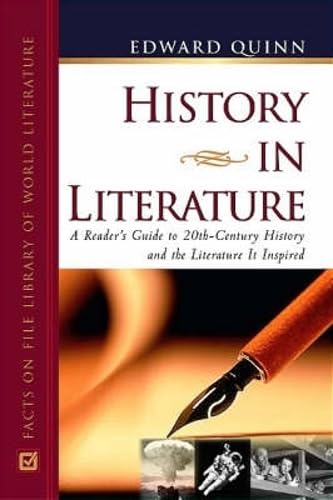

History in literature a reader's guide to 20th century history and the literature it inspired Edward Quinn.
Series Facts on File library of world literatureDetalles de publicación: New York Facts On File c2004.Descripción: xiii, 381 p. 24 cmISBN:- 081604693X (alk. paper)
- 809.9335821 Q73h 21
- PN50 .Q56 2004
| Imagen de cubierta | Tipo de ítem | Biblioteca actual | Biblioteca de origen | Colección | Ubicación en estantería | Signatura topográfica | Materiales especificados | Info Vol | URL | Copia número | Estado | Notas | Fecha de vencimiento | Código de barras | Reserva de ítems | Prioridad de la cola de reserva de ejemplar | Reservas para cursos | |
|---|---|---|---|---|---|---|---|---|---|---|---|---|---|---|---|---|---|---|
| Referencia | Biblioteca Encarnación Valdés Sala de Referencia bev | 809.9335821 Q73h (Navegar estantería(Abre debajo)) | Disponible | 80000002480625 |
Descripciones mejoradas de Syndetics:
For general readers and students of literature, History in Literature is a concise guide to 20th century historical events, periods, movements, and figures and the ways they have been depicted in specific works of literature. The book is arranged A-to-Z by historical event, with an appendix at the end listing authors and literary works. Each entry provides a description of the historical topic, followed by a discussion of the literature it inspired. Major events, such as World War II, are subdivided and include cross-references to more specific entries. This valuable reference will help students and general readers understand the historical context of 20th-century literary works. It also allows readers to compare the factual details of an event, period, or life to its literary treatment and understand how to use history for literary purposes. Entries range from 250 to 1,000 words in length, and include suggestions for further reading. Works covered include those by authors studied at the high school and lower college level, such as Joseph Conrad, Ernest Hemingway, Theodore Drelser, Ralph Ellison, William Faulkner, Pearl Buck, and Jack London along with popular authors such as Don DeLillo, E. L. Doctorow, Carlos Fuentes, Nadine Gordimer, and others.
Includes bibliographical references and index.
Tabla de contenidos provista por Syndetics
- Preface(p. IX)
- Entries by Contributors(p. XIII)
- History in Literature(p. 1)
- Chronology of Entries(p. 369)
- Index of Authors, Titles, and Entries(p. 373)
Extracto provisto por Syndetics
Reseñas proporcionadas por Syndetics
Library Journal Review
Quinn (English, emeritus, City College of New York) has been writing and editing works on literature, grammar usage, and sociological concerns since the mid-Sixties (see, e.g., Reader's Encyclopedia of Shakespeare; The Sense of the Sixties; A Dictionary of Literary and Thematic Terms). In this concise guide, he combines history and literature into a handbook that works both in and out of the classroom. Ranging from 250 to 1000 words in length, the 181 alphabetically arranged entries provide historical summaries of specific events or personalities, brief discussions of literary works that reveal the affect of an event or individual on culture, and brief bibliographic notes. (A few entries are solely cross references used to connect events.) The literature discussed encompasses fiction, poetry, and drama, allowing deeper insight into the common person's perception of an event, the crises it provoked, and its continuing cultural and political reverberations. Entries include the effect of slavery on the black culture long after its abolition, the aftershocks of Adolf Hitler's regime, the Chosin Reservoir Retreat during the Korean War, and the Triangle Shirtwaist Fire in New York City. The authors whose works are discussed include, among others, Don DeLillo, John Steinback, Joseph Conrad, and George Orwell. Rounding out the text are an events chronology and an index alphabetized by author that lists each author (along with book titles) and subject where he or she can be found. The lack of page numbers is somewhat inconvenient, but the list is invaluable as a resource for further research. Although there are more comprehensive guides connecting literature to historical events, e.g., Masterpieces of American Literature, edited by Frank N. Magill (1993), and Encyclopedia of American Literature, edited by Steven R. Serafin (1999), Quinn's handbook is less weighty, and its concepts are easy to understand. Recommended for academic and special collections in both history and literature.-Kim Harris, Rochester P.L., NY (c) Copyright 2010. Library Journals LLC, a wholly owned subsidiary of Media Source, Inc. No redistribution permitted.CHOICE Review
Based on the observation that writers are influenced by their times, Quinn pairs literary works with significant 20th-century historical events, figures, movements, and other subjects. The two- to three-page entries include battles, assassinations, and Hiroshima. Both major and minor authors are featured, from Achebe (decline of the British Empire) to Zamyatin (totalitarianism). Each entry provides a brief summary of the subject, accompanying literature, and additional readings. Although literary selections are limited to works of fiction, poetry, and drama written in or translated into English, nonfiction titles are mentioned. Interesting tidbits pepper the work, which maintains an informal and objective tone. A chronology of events at the end compensates for the awkward alphabetical arrangement, but the index excludes titles discussed only briefly. The principal criterion for selection is vague: what defines an "important" event or work of literature? The entry for African American experience discusses Ralph Ellison's Invisible Man, but Richard Wright's Native Son and Ernest Gaines's works also belong. Less comprehensive than Literature and Its Times (5v., CH, May'98; supplements, CH, Sep'03), this guide is helpful but should be used in conjunction with other reference works. ^BSumming Up: Optional. General readers; lower-division undergraduates. S. R. Moore University of Louisiana at LafayetteNotas de autor provistas por Syndetics
Edward Quinn is Professor Emeritus of English at the City College of New York. He Holds a Ph.D. from New York University and has co-edited several major reference works, including the classic The Reader's Encyclopedia of Shakespeare. Mr. Quinn lives in Brooklyn, NY.(Bowker Author Biography)