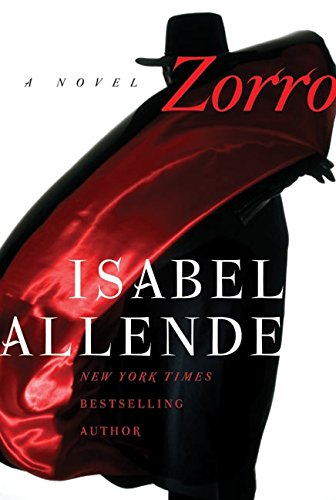

Zorro a novel Isabel Allende.
Detalles de publicación: New York,NY Harper Collins Publishers 2005.Edición: 1a edDescripción: 390 p. 23.5 cmISBN:- 0060778970
| Imagen de cubierta | Tipo de ítem | Biblioteca actual | Biblioteca de origen | Colección | Ubicación en estantería | Signatura topográfica | Materiales especificados | Info Vol | URL | Copia número | Estado | Notas | Fecha de vencimiento | Código de barras | Reserva de ítems | Prioridad de la cola de reserva de ejemplar | Reservas para cursos | |
|---|---|---|---|---|---|---|---|---|---|---|---|---|---|---|---|---|---|---|
| Libro | Biblioteca Mons. Iñaki Mallona (Arecibo) Colección General ab | Ch 863 A425z (Navegar estantería(Abre debajo)) | Disponible | 60000010141239 |
Descripciones mejoradas de Syndetics:
A swashbuckling adventure story that reveals for the first time how Diego de la Vega became the masked man we all know so well
Born in southern California late in the eighteenth century, he is a child of two worlds. Diego de la Vega's father is an aristocratic Spanish military man turned landowner; his mother, a Shoshone warrior. Diego learns from his maternal grandmother, White Owl, the ways of her tribe while receiving from his father lessons in the art of fencing and in cattle branding. It is here, during Diego's childhood, filled with mischief and adventure, that he witnesses the brutal injustices dealt Native Americans by European settlers and first feels the inner conflict of his heritage.
At the age of sixteen, Diego is sent to Barcelona for a European education. In a country chafing under the corruption of Napoleonic rule, Diego follows the example of his celebrated fencing master and joins La Justicia, a secret underground resistance movement devoted to helping the powerless and the poor. With this tumultuous period as a backdrop, Diego falls in love, saves the persecuted, and confronts for the first time a great rival who emerges from the world of privilege.
Between California and Barcelona, the New World and the Old, the persona of Zorro is formed, a great hero is born, and the legend begins. After many adventures -- duels at dawn, fierce battles with pirates at sea, and impossible rescues -- Diego de la Vega, a.k.a. Zorro, returns to America to reclaim the hacienda on which he was raised and to seek justice for all who cannot fight for it themselves.
Translated from the spanish by Margaret Sayers Peden.
Extracto provisto por Syndetics
Reseñas proporcionadas por Syndetics
Library Journal Review
How little Diego de la Vega, a child of mixed parentage from 18th-century California, becomes the indomitable Zorro. Look for The Legend of Zorro, starring Antonio Banderas, in September 2005. (c) Copyright 2010. Library Journals LLC, a wholly owned subsidiary of Media Source, Inc. No redistribution permitted.Publishers Weekly Review
Allende's lively retelling of the Zorro legend reads as effortlessly as the hero himself might slice his trademark "Z" on the wall with a flash of his sword. Born Diego de la Vega in 1795 to the valiant hidalgo, Alejandro, and the beautiful Regina, the daughter of a Spanish deserter and an Indian shaman, our hero grows up in California before traveling to Spain. Raised alongside his wet nurse's son, Bernardo, Diego becomes friends for life with his "milk brother," despite the boys' class differences. Though born into privilege, Diego has deep ties to California's exploited natives-both through blood and friendship-that account for his abiding sense of justice and identification with the underdog. In Catalonia, these instincts as well as Diego's swordsmanship intrigue Manuel Escalante, a member of the secret society La Justicia. Escalante recruits Diego into the society, which is dedicated to fighting all forms of oppression, and thus begins Diego's construction of his dashing, secret alter ego, Zorro. With loyal Bernardo at his side, Zorro hones his fantastic skills, evolves into a noble hero and returns to California to reclaim his family's estate in a breathtaking duel. All the while, he encounters numerous historical figures, who anchor this incredible tale in a reality that enriches and contextualizes the Zorro myth. Allende's latest page-turner explodes with vivid characterization and high-speed storytelling. Agent, Gloria Gutierrez at Agencia Literaria Carmen Balcells (Spain). (May) (c) Copyright PWxyz, LLC. All rights reservedBooklist Review
Allende, born in Peru and raised in Chile, now resides in California, and out of her abiding interest in Spanish American and California history and culture, she has fashioned her historical fiction (including the companion novels Daughter of Fortune0 , 1999, and Portrait in Sepia0 , 2001). In her latest historical novel, she imaginatively creates, in the words of the narrator, "the origins of the legend"--the legend being none other than Zorro, the famous Robin Hood of eighteenth-century colonial California. The novel's conceit is that the testimony offered here is a bird's-eye view of the provenance of Zorro as recorded by someone who knew him well, but the identity of that person is not revealed until the novel's end. Allende's complete familiarity with setting includes not only the "custom of the country" in Southern California when still in Spanish hands but also the complicated political atmosphere of Spain itself during the Napoleonic era, to which Diego de la Vega is dispatched as a teenager for his formal education. It is in Spain where the physical disguise of Zorro and the social-reform mentality that motivates him first bear adult fruit. (Diego is one-quarter Native American and thus understands the downtrodden.) Allende's mesmerizing narrative voice never loses timbre or flags in either tension or entertainment value. To describe her as a clever novelist is to signify that she is both inventive and intelligent. --Brad Hooper Copyright 2005 BooklistNotas de autor provistas por Syndetics
Isabel Allende was born in 1942 in Lima, Peru, the daughter of a Chilean diplomat. When her parents separated, young Isabel moved with her mother to Chile, where she spent the rest of her childhood. She married at the age of 19 and had two children, Paula and Nicolas. Her uncle was Salvador Allende, the president of Chile. When he was overthrown in the coup of 1973, she fled Chile, moving to Caracas, Venezuela.While living in Venezuela, Allende began writing her novels, many of them exploring the close family bonds between women. Her first novel, The House of the Spirits, has been translated into 27 languages, and was later made into a film. She then wrote Of Love and Shadows, Eva Luna, and The Stories of Eva Luna, all set in Latin America. The Infinite Plan was her first novel to take place in the United States. She explores the issues of human rights and the plight of immigrants and refugees in her novel, In The Midst of Winter. In Paula, Allende wrote her memoirs in connection with her daughter's illness and death. She delved into the erotic connections between food and love in Aphrodite: A Memoir of the Senses.
In addition to writing books, Allende has worked as a TV interviewer, magazine writer, school administrator, and a secretary at a U.N. office in Chile. She received the 1996 Harold Washington Literacy Award. She lives in California. Her title Maya's Notebook made The New York Times Best Seller List in 2013.
(Bowker Author Biography)