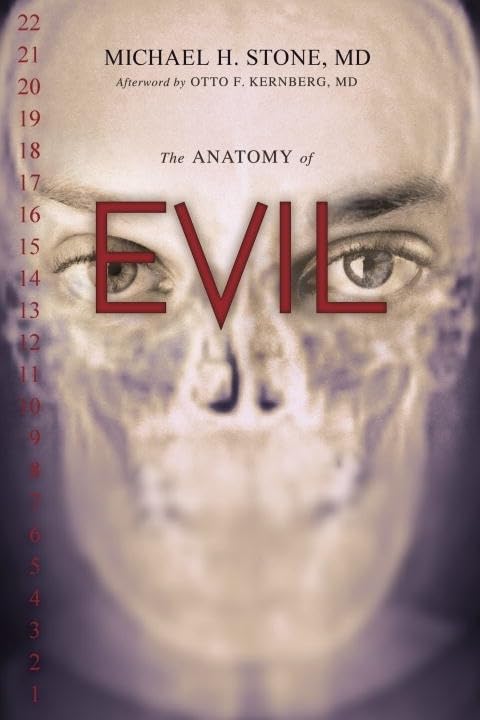

The anatomy of evil Michael H. Stone.
Detalles de publicación: Amherst, N.Y. Prometheus Books 2009.Descripción: 430 pages, [8] p. of plates col. ill. 24 cmISBN:- 9781591027263 (acid-free paper)
- 364.3 S8771a 22
- HV6080 .S85 2009
- HV 6515
| Imagen de cubierta | Tipo de ítem | Biblioteca actual | Biblioteca de origen | Colección | Ubicación en estantería | Signatura topográfica | Materiales especificados | Info Vol | URL | Copia número | Estado | Notas | Fecha de vencimiento | Código de barras | Reserva de ítems | Prioridad de la cola de reserva de ejemplar | Reservas para cursos | |
|---|---|---|---|---|---|---|---|---|---|---|---|---|---|---|---|---|---|---|
| Libro | Biblioteca Encarnación Valdés Colección General bev | 364.3 S8771a (Navegar estantería(Abre debajo)) | Disponible | 80000002460973 |
Descripciones mejoradas de Syndetics:
The crimes of Charles Manson, Ted Bundy, Jeffrey Dahmer, John Wayne Gacy, Dennis Rader, and other high-profile killers are so breathtakingly awful that most people would not hesitate to label them "evil." In this groundbreaking book, renowned psychiatrist Michael H. Stone--host of Discovery Channel's former series Most Evil--uses this common emotional reaction to horrifying acts as his starting point to explore the concept and reality of evil from a new perspective. In an in-depth discussion of the personality traits and behavior that constitute evil across a wide spectrum, Dr. Stone takes a clarifying scientific approach to a topic that for centuries has been inadequately explained by religious doctrines.
Basing his analysis on the detailed biographies of more than 600 violent criminals, Stone has created a 22-level hierarchy of evil behavior, which loosely reflects the structure of Dante's Inferno. He traces two salient personality traits that run the gamut from those who commit crimes of passion to perpetrators of the worst crimes--sadistic torture and murder. One trait is narcissism, as exhibited in people who are so self-centered that they have little or no ability to care about their victims. The other is aggression, the use of power over another person to inflict humiliation, suffering, and death.
Stone then turns to the various factors that, singly or intertwined, contribute to pushing certain people over the edge into committing heinous crimes. They include heredity, adverse environments, violence-prone cultures, mental illness or brain injury, and abuse of mind-altering drugs. All are considered in the search for the root causes of evil behavior.
What do psychology, psychiatry, and neuroscience tell us about the minds of those whose actions could be described as evil? And what will that mean for the rest of us? Stone discusses how an increased understanding of the causes of evil will affect the justice system. He predicts a day when certain persons can safely be declared salvageable and restored to society and when early signs of violence in children may be corrected before potentially dangerous patterns become entrenched.
Includes bibliographical references (p. 363-404) and index.
Evil in peacetime -- Crimes of impulse : murders of jealousy and rage -- Other crimes of impulse : emphasis on antisocial persons -- Murder on purpose : the psychopathic schemers -- Spree and mass murder : evil by the numbers -- The psychopath hard at work -- Serial killers and torturers -- The family at its worst -- Science looks at evil -- Final thoughts.
Tabla de contenidos provista por Syndetics
- Introduction(p. 9)
- Chapter 1 Evil in Peacetime(p. 27)
- Chapter 2 Crimes of Impulse: Murders of Jealousy and Rage(p. 53)
- Chapter 3 Other Crimes of Impulse: Emphasis on Antisocial Persons(p. 85)
- Chapter 4 Murder on Purpose: The Psychopathic Schemers(p. 115)
- Chapter 5 Spree and Mass Murder: Evil by the Numbers(p. 141)
- Chapter 6 The Psychopath Hard at Work(p. 165)
- Chapter 7 Serial Killers and Torturers(p. 195)
- Chapter 8 The Family at Its Worst(p. 243)
- Chapter 9 Science Looks at Evil(p. 285)
- Final Thoughts(p. 331)
- Afterword(p. 357)
- Acknowledgments(p. 361)
- Notes(p. 363)
- Index(p. 405)