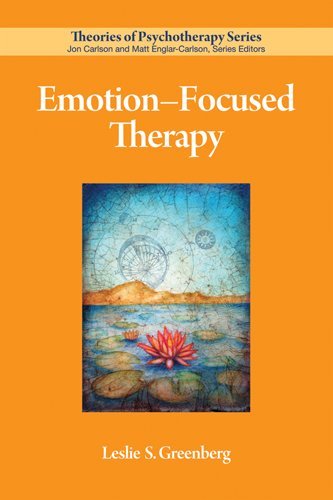

Emotion-focused therapy Leslie S. Geenberg.
Series Theories of psychotherapy seriesDetalles de publicación: Washington, DC American Psychological Association c2011.Edición: 1st edDescripción: xii, 182 p. 23 cmISBN:- 9781433808579
- 1433808579
- 616.8914 G7985e 22
- RC489.F62 G737 2011
- 2011 C-122
- WM 420
| Imagen de cubierta | Tipo de ítem | Biblioteca actual | Biblioteca de origen | Colección | Ubicación en estantería | Signatura topográfica | Materiales especificados | Info Vol | URL | Copia número | Estado | Notas | Fecha de vencimiento | Código de barras | Reserva de ítems | Prioridad de la cola de reserva de ejemplar | Reservas para cursos | |
|---|---|---|---|---|---|---|---|---|---|---|---|---|---|---|---|---|---|---|
| Libro | Biblioteca Encarnación Valdés Colección General bev | 616.8914 G7985e (Navegar estantería(Abre debajo)) | Disponible | 80000002469263 |
Descripciones mejoradas de Syndetics:
Emotion-Focused Therapy provides an introduction to the theory, history, research, and practice of this emotion-centered, humanistic approach. Emotion-focused therapy is a complete theory of human functioning based on the adaptive role of emotion and on a therapy practice founded on the idea that emotional change is central to enduring change.
This therapy emphasizes the awareness, acceptance, understanding, and transformation of emotion, and proposes that emotions themselves have an adaptive potential that, if activated, can help clients to change. Emotion-focused therapists help clients to experience their emotions in the safe setting of therapy so that, rather than avoiding or controlling their feelings, clients learn to use them as a guide to what is important or necessary in their lives.
In this book, Leslie S. Greenberg presents and explores this versatile and useful approach, its theory, history, therapy process, primary change mechanisms, the empirical basis for its effectiveness, and recent developments that have refined the theory and expanded how it may be practiced.
This essential primer, amply illustrated with case examples featuring diverse clients, is perfect for graduate students studying theories of therapy and counseling, as well as for seasoned practitioners interested in understanding how this approach has evolved and how it might be used in their practice.
Includes bibliographical references and index.
History -- Theory -- The therapy process -- Evaluation -- Future developments.