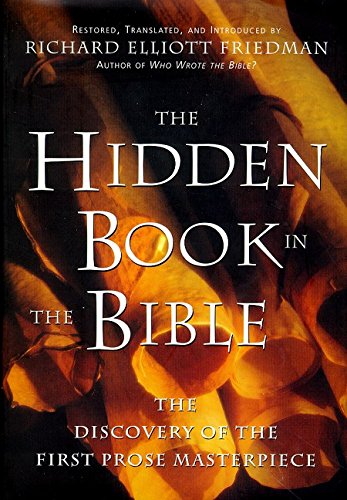
Imagen de portada de Amazon
Imagen de Amazon.com
Imagen de cubierta Syndetics
Portada de Syndetics
Imagen de OpenLibrary

The hidden book in the Bible restored, translated, and introduced by Richard Elliott Friedman.

Por: Idioma: Inglés Lenguaje original: hebreo Detalles de publicación: [San Francisco] HarperSanFrancisco c1998.Edición: 1st edDescripción: xii, 402 p. 25 cmISBN:
  • 0060630035 (hbk.)
  • 0060630043 (pbk.)
Tema(s): Clasificación CDD:
  • 222.05209 F9112h 21
Clasificación LoC:
  • BS1181.4 .F72 1998
Recursos en línea:
Valoración
    Valoración media: 0.0 (0 votos)
Existencias
Imagen de cubierta Tipo de ítem Biblioteca actual Biblioteca de origen Colección Ubicación en estantería Signatura topográfica Materiales especificados Info Vol URL Copia número Estado Notas Fecha de vencimiento Código de barras Reserva de ítems Prioridad de la cola de reserva de ejemplar Reservas para cursos
Libro Biblioteca Encarnación Valdés Colección General bev 222.05209 F9112h (Navegar estantería(Abre debajo)) Disponible 80000002468349
Total de reservas: 0

Descripciones mejoradas de Syndetics:

Renowned biblical sleuth and scholar Richard Elliott Friedman, author of Who Wrote the Bible?, reveals for the first time his most startling and revolutionary discovery: embedded within the Bible is a continuous narrative that had been sliced apart by ancient editors who interlaced it with other stories, laws, and poetry. It is a singular work of genius, the core of the Bible. Across three millennia, this great work of prose comes back to us--pieced together as it was originally meant to be read--in a fresh and powerful translation.

In recent years, Harold Bloom's The Book of J and Friedman's own Who Wrote the Bible? have made the short work called J known to the public. But in The Hidden Book in the Bible Friedman presents his landmark discovery that "J is not a work. It is the beginning section of a work: a long, exquisitely connected prose composition full of artistry and power."

Using a creative blend of scholarship and detective work, Friedman has joined together this story from the dawn of written history, and what emerges is astonishing. Far from a primitive first attempt atr writing, it is an exciting and complex saga, a passionate work of love, deception, war, and redemption. Readers will experience the story that has not been read as a single continuous narrative for almost three millennia.

Friedman begins by leading the readers through the exciting story of his discovery of this hidden work. He marshals the evidence, showing how a unique use of language and themes--from the two cases of the famous "coat of many colors" to all nine references to Sheol (the place of the dead), and from incidents of sibling rivalry to sexual violation--recur in a connected way in certain parts of hte Bible but nowhere else. Friedman dramatically illustrates how these clues establish a singular author's voice guiding more of the Bible than was ever previously suspected.

Friedman presents the work itself in a bold translation that is remarkable faithful to the original. It begins with a well-known tale of the deity's creation of a paradise that goes wrong and then conveys a sweep of history, telling the story of a family through twelve generations: a story of deception and recompense, of powerful loves and sibling rivalries, of wars and spies. The family becomes a nation, the nation finds a ruling family, and they find their way to peace. The author of this saga crafts a compelling and densely woven tale of family struggles, bitter betrayal, and, finally, the birth of a great kingdom under Solomon, the son of David.

This work, says Friedman, is a treasure. It became the core of the Bible and the beginning of prose literature. Readers now have the opportunity to see the first great prose writer's full achievement: an epic work of the struggle between God and human, and between good and bad. The Hidden Book in the Bible will forever change the way we regard the Bible. "Exciting, provocative, ambitious yet reverent," says Donald Spoto, "Friedman's latest book is, as usual, grounded in impeccable scholarship."

Includes bibliographical references (p. 393-402).

Tabla de contenidos provista por Syndetics

  • Preface and Acknowledgments(p. xi)
  • Introduction
  • 1. The Recovery of the Work(p. 3)
  • 2. Reading the Work(p. 33)
  • About the Translation(p. 57)
  • In the Day(p. 67)
  • Afterword(p. 293)
  • Textual Notes(p. 305)
  • Appendix
  • 1. Converging Evidence for the Unity of the Work(p. 327)
  • 2. The Antiquity of the Work(p. 350)
  • 3. Late for a Very Important Date(p. 361)
  • 4. Distribution of Terms in Prose Narrative(p. 379)
  • Notes(p. 391)

Extracto provisto por Syndetics

The Hidden Book in the Bible Genesis 2:4b. In the day that YHWH made earth and skies -- 5. when all produce of the field had not yet been in theearth, and all vegetation of the field had not yet grown, forYHWH had not rained on the earth, and there had been nohuman to work the ground, 6. and a river had come up fromthe earth and watered the whole face of the ground-- 7. YHWH fashioned a human, dust from the ground, and blew into his nostrils the breath of life, and the human became a living being. 8. And YHWH planted a garden in Eden at the cast, and he set the human whom He had fashioned there. 9. And YHWH caused every tree that was pleasant to the sight and good for food to grow, and the tree of life within the garden, and the tree of knowledge of good and bad. 10. And a river had gone out from Eden to water the garden, and it was dispersed from there and became four heads. I 1. The name of one was Pishon; that is the one that circles all the land of Havilah where there is gold. 12. And that land's gold is good; bdellium and onyx stone are there. 13. And the name of the second river is Gihon; that is the one that circles all the land of Cush. 14. And the name of the third river is Tigris; that is the one that goes cast of Assyria. And the fourth river: that is Euphrates. 15. And YHWH took the human and put him in the garden of Eden to work it and to watch over it. 16. And YHWH commanded the human, saying, "You may eat from every tree of the garden. 17 But from the tree of knowledge of good and bad: you shall not eat from it, because in the day you eat from it: you'll die! " 18. And YHWH said, "It's not good for the human to be by himself. I'll make for him a strength corresponding to him." 19. And YHWH fashioned from the ground every animal of the field and every bird of the skies and brought it to the human to see what he would call it. And whatever the human would call it, each living being, that would be its name. 20. And the human gave names to every beast and bird of the skies and every animal of the field. But He did not find for the human a strength corresponding to him. 21. And YHWH caused a slumber to descend on the human, and he slept. And He took one of his ribs and closed flesh in its place. 22. And YHWH built the rib that He had taken from the human into a woman and brought her to the human. 23. And the human said, "This time is it: bone of my bones and flesh of my flesh. This will be called 'woman,' for this one was taken from 'man.'" 24. On account of this a man leaves his father and his mother and clings to his woman, and they become one flesh. 25. And the two of them were naked, the human and his woman, and they were not embarrassed. 3: 1. And the snake was slier than every animal of the field that YHWH had made, and he said to the woman, "Has God indeed said you may not cat from any tree of the garden? " 2. And the woman said to the snake, "We may cat from the fruit of the trees of the garden. 3. But from the fruit of the tree that is within the garden God has said, 'You shall not cat from it, and you shalt not touch it, or else you'll die.'" 4. And the snake said to the woman, "You won't die! 5. Because God knows that in the day you cat from it your eyes will be opened, and you'll be like God--knowing good and bad." 6. And the woman saw that the tree was good for eating and that it was an attraction to the eyes, and the tree was desirable to bring about understanding, and she took some of its fruit, and she ate, and gave to her man with her, and he ate. 7 And the eyes of the two of them were opened, and they knew that they were naked. And they picked fig leaves and made loincloths for themselves. 8. And they heard the sound of YHWH walking in the garden in the wind of the day, and the human and his woman hid from YHWH among the garden's trees. 9. And YHWH called the human and said to him, "Where are you? " 10. And he said, "I heard the sound of you in the garden and was afraid because I was naked, and I hid. 11. And He said, "Who told you that you were naked? Have you eaten from the tree from which I commanded you not to cat? " 12. And the human said, "The woman, whom you placed with me, she gave me from the tree, and I ate. " 13. And YHWH said to the woman, "What is this that you've done? " And the woman said, "The snake tricked me, and I ate." 14. And YHWH said to the snake, "Because you did this, you are cursed out of every domestic animal and every animal of the field, you'll go on your belly, and you'll eat dust all the days of your life. 15. And I'll put enmity between you and the woman and between your seed and her seed. He'll strike you at the head, and you'll strike him at the heel." 16. To the woman He said, "I'll make your suffering and your labor pain great. You'll have children in pain. And your desire will be for your man, and he'll dominate you." The Hidden Book in the Bible . Copyright © by Richard Friedman . Reprinted by permission of HarperCollins Publishers, Inc. All rights reserved. Available now wherever books are sold. Excerpted from The Hidden Book in the Bible All rights reserved by the original copyright owners. Excerpts are provided for display purposes only and may not be reproduced, reprinted or distributed without the written permission of the publisher.

Notas de autor provistas por Syndetics

Richard Elliott Friedman, a world-renowned biblical scholar, is Professor of Hebrew and Comparative Literature at the University of California, San Diego. He is the author of The Hidden Face of God and the bestselling Who Wrote the Bible?
Compartir
logopucpr-y-vive

Contáctanos

¡Queremos saber de ti!

Tel. 787.841.2000 Ext. 1801

bibliotecavaldes@pucpr.edu

⁣Búscanos en las redes

© 2026 Desarrollado por Ignite Online • All Rights Reserved • Powered by Koha.