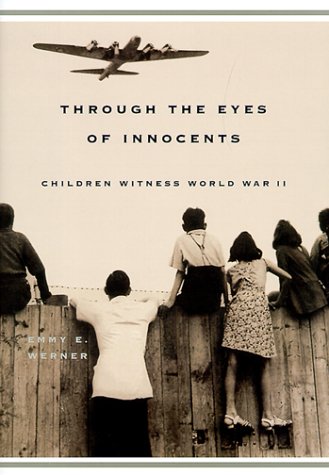
World War II was the first modern war in which more civilians than soldiers were killed or maimed: When it ended in August 1945, more than thirty-nine millions civilians had died as a direct result of the war, and some thirteen million of these were children. In Through the Eyes of Innocents, Emmy Werner tells the story of the children of World War II through their own words. Drawing on diaries, letters, and journals kept by youngsters caught up in the war, Werner shows the universality of their experience. Children and teenagers from a dozen countries - England, Germany, France, Japan, the former Soviet Union, Austria, Holland, Belgium, Denmark, Norway, Poland and the United States - are all represented in some 200 eye-witness accounts. Werner focuses on their shared reactions to the war, the hardships they endured, how they coped, and how the war experience shaped their lives. The message they share with other children in contemporary wars is an extraordinary affirmation of life and the sustaining power of hope and human decency.
Includes bibliographical references (p. 247-255) and index.
Tabla de contenidos provista por Syndetics
List of Illustrations(p. ix)
Acknowledgments and Credits(p. xiii)
Prologue(p. 1)
1 War Breaks Out(p. 7)
2 Meeting the Enemy(p. 25)
3 Leaving Home(p. 39)
4 So Far and Yet So Near(p. 61)
5 Behind Barbed Wire(p. 79)
6 The Schoolgirl and the General(p. 101)
7 In Harm's Way(p. 117)
8 Surviving the Firestorm(p. 141)
9 We Regret to Inform You(p. 163)
10 Picking Up the Pieces(p. 177)
11 The Kindness of Strangers(p. 191)
12 Whatever Happened to the Children?(p. 211)
Select Chronology of World War II(p. 231)
Notes(p. 235)
Bibliography(p. 247)
Index(p. 257)
Reseñas proporcionadas por Syndetics
Library Journal Review
Having authored several books on children's ability to survive trauma (e.g., Reluctant Witnesses: Children's Voices from the Civil War), developmental psychologist Werner now turns to children's memories of World War II and her own reminiscences of growing up in wartime Germany during "a global conflict in which more children [were] killed and maimed than in all previous wars in the world." The result is surprisingly upbeat and utterly compelling: a story of children's resiliency in the face of repeated uprootings and batterings. In the middle of the fighting, Sandra, aged ten, wrote: "Don't ever hurt the children. They are not guilty of anything." Read this affecting book, and you will be hard-pressed not to agree. While there have been numerous first-person accounts of the war, this reviewer has not come across another with quite this angle. A simply wonderful book that deserves many readers.ÄDavid Keymer, California State Univ., Stanislaus (c) Copyright 2010. Library Journals LLC, a wholly owned subsidiary of Media Source, Inc. No redistribution permitted.
CHOICE Review
Both history and psychology, this work movingly portrays the reactions of children as their lives, families, and fortunes were disrupted in the chaos of WW II. Author of numerous books on resilient children (e.g., Vulnerable but Invincible, coauthored with Ruth Smith, CH, May'82; Reluctant Witnesses: Children's Voices from the Civil War, CH, Oct'98), Werner (Univ. of California, Davis) in this volume leaves readers to ponder the magnitude of the psychological aftermath of childhoods marred by destruction. US, European, and Japanese children "speak" for themselves through diary entries, letters, and various other oral and written testimonies. A child in Germany during the war, Werner knows whereof she writes and researches in this 12-chapter book, which is peppered with poignant photographs. She successfully weaves reflections and recollections with prose designed to engender compassion and identification, if not theoretical insight into coping with trauma. Wisely, Werner does not present the experience of Jewish children in the Holocaust--a wholly different sort of terror and loss. This book will appeal to general readers, undergraduates, and practitioners interested in first-person histories and reflections on war as well as children's psychology. Researchers interested in placing their own interpretive frameworks on these childhood narratives may also be drawn to the volume. D. S. Dunn; Moravian College
Booklist Review
Werner, a developmental psychologist, recalls the days before the start of World War II when she played with young cousins and friends who would shortly be converted to enemies and orphans. In this absorbing book, Werner captures the innocence of children caught in the crossfire of social change wrought by the war that destroyed cities and families and restructured lives. She offers 200 eyewitness accounts of European, American, and Asian children, rendered through letters, diaries, and journals. The book is organized chronologically, tracking the war and its impact on the lives of ordinary people. Werner includes wartime correspondence between a seventh-grade girl in Ohio and Gen. Dwight D. Eisenhower, accounts of underaged GIs who saw the Normandy invasion, and stories of survivors and orphans. The text is supplemented by stunning photographs of children preparing for war, participating in gas-mask drills, and evacuating cities, and Japanese children being relocated to camps in California. This is a poignant account of war from the perspective of children. --Vanessa Bush
Notas de autor provistas por Syndetics
Emmy E. Werner is a developmental psychologist and research professor at the University of California at Davis. She was a child in Germany during World War II.
Through the eyes of innocents
APA
Werner E. E., . (2000). Through the eyes of innocents: children witness World War II. Boulder, CO: Westview Press.
Chicago
Werner Emmy E, . 2000. Through the eyes of innocents: children witness World War II. Boulder, CO: Westview Press.
Harvard
Werner E. E., . (2000). Through the eyes of innocents: children witness World War II. Boulder, CO: Westview Press.
MLA
Werner Emmy E, . Through the eyes of innocents: children witness World War II. Boulder, CO: Westview Press. 2000.