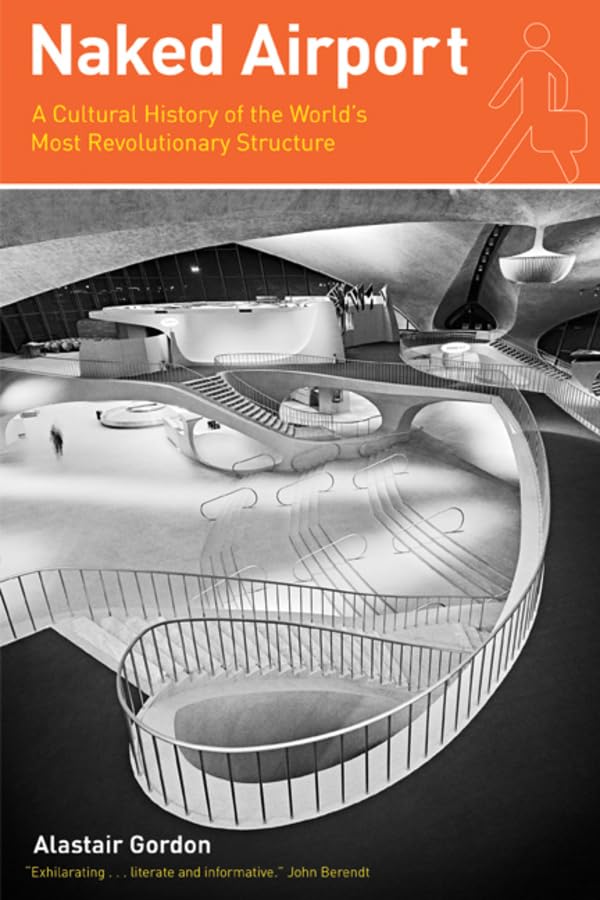

Naked airport cultural history of the world's most revolutionary structure Alastair Gordon.
Idioma: Español Detalles de publicación: New York Metropolitan Books, H. Holt 2004.Descripción: xi, 305 p. ill., maps 25 cmISBN:- 9780226304564
| Imagen de cubierta | Tipo de ítem | Biblioteca actual | Biblioteca de origen | Colección | Ubicación en estantería | Signatura topográfica | Materiales especificados | Info Vol | URL | Copia número | Estado | Notas | Fecha de vencimiento | Código de barras | Reserva de ítems | Prioridad de la cola de reserva de ejemplar | Reservas para cursos | |
|---|---|---|---|---|---|---|---|---|---|---|---|---|---|---|---|---|---|---|
| Libro | CARIBET Biblioteca Arquitectura Colección General CARIBET | TL725 G647 2004 (Navegar estantería(Abre debajo)) | Disponible | 91000000024828 |
Descripciones mejoradas de Syndetics:
Although airports are now best known for interminable waits at check-in counters, liquid restrictions for carry-on luggage, and humiliating shoe-removal rituals at security, they were once the backdrops for jet-setters who strutted, martinis in hand, through curvilinear terminals designed by Eero Saarinen. In the critically acclaimed Naked Airport , Alastair Gordon traces the cultural history of this defining institution from its origins in the muddy fields of flying machines to its frontline position in the struggle against international terrorism.
From global politics to action movies to the daily commute, Gordon shows how the airport has changed our sense of time, distance, and style, and ultimately the way cities are built and business is done. He introduces the people who shaped and were shaped by this place of sudden transition: pilots like Charles Lindbergh, architects like Le Corbusier, and political figures like Fiorello LaGuardia and Adolf Hitler. Naked Airport is a profoundly original history of a long-neglected yet central component of modern life.
"This charming history documents why airports have always been such intriguing places. Gordon wittily deconstructs air terminal architecture. . . . Here is a book with more than enough quirky details to last a long layover."-- People
"[A] splendid cultural history."-- Atlantic Monthly
"Gordon, an architecture and design critic, tells his story well, bringing to life some of the main characters and highlighting some of the important issues concerning urbanism and airports."--Michael Roth, San Francisco Chronicle
"Gordon provides a truly compelling account of how airports had over the course of three-quarters of a century become the locus of not only modern dreams but postmodern nightmares as well. Don't leave home without it."--Terence Riley, director of the Miami Art Museum
Includes bibliographical references (p. 265-289) and index.
1. Prototypes : 1924-1930 -- 2. Naked airport : 1930-1940 -- 3. New deal : 1933-1941 -- 4. Air power : 1939-1957 -- 5. Jet-land : 1957-1970 -- 6. The sterile concourse : 1970-2000 -- Epilogue : from Lindbergh to bin Laden.
"Since its origins in the muddy fields of flying machines, the airport has become one of the defining institutions of modern life. In Naked Airport, acclaimed critic Alastair Gordon traces the structure's history and architecture and explores its far-reaching effect on our culture." "From global politics to action movies to the daily commute, Gordon shows how the airport has changed our sense of time, distance, and style, and ultimately the way cities are built and business ins done. He introduces the people who shaped and were shaped by this place of sudden transition: pilots like Charles Lindbergh, architects like Eero Saarinen, politicians like Fiorello La Guardia and Adolf Hitler, who built Berlin's Tempelhof as a showcase for Nazi power. Gordon describes the airport's futuristic contributions, such as twenty-four-hour surveillance systems and credit cards in the form of fly-now-pay-later schemes, and he charts its shift in popular perception, from glamorous to infuriating. Finally, he analyzes the airport's function in war and peace - its gatekeeper role controlling immigration, its appeal to revolutionaries since the hijackings of the 1960s, and its new frontline position in the struggle against international terror."--BOOK JACKET.
Worldwide, Jun/17/05, 2005-921.
Tabla de contenidos provista por Syndetics
- Prologue(p. 1)
- 1 Prototypes: 1924-1930(p. 7)
- 2 Naked Airport: 1930-1940(p. 65)
- 3 New Deal: 1933-1941(p. 89)
- 4 Air Power: 1939-1957(p. 123)
- 5 Jet-Land: 1957-1970(p. 173)
- 6 The Sterile Concourse: 1970-2000(p. 217)
- Epilogue: From Lindbergh to Bin Laden(p. 261)
- Notes(p. 265)
- Selected Bibliography(p. 285)
- Illustration Credits(p. 291)
- Acknowledgments(p. 295)
- Index(p. 297)
Reseñas proporcionadas por Syndetics
Library Journal Review
Gordon (Beach Houses: Andrew Geller) chronicles the airport through its various mutations, illustrating how it was slowly transformed into a unique human environment and also how it changed the rest of the modern world. Beginning with Bourget as the confirmation of Lindbergh's 1927 solo transatlantic flight, the narrative includes the Croydon Aerodrome (London) as the conceptual progenitor of passenger circulation, Tempelhof as the symbol of Hitler's boastful Third Reich, Idelwild (now New York's John F. Kennedy International Airport) as the forerunner of decentralized air terminals, and a host of other airports. Gordon is at his best in characterizing those individuals who left their stamp on America's great aerial embarkation points, but he also examines the airport's impact on society, which he lists randomly as uneven grades of architecture and design, contrasting levels of rapid passenger mobility and screening bottlenecks, urban sprawl, gaudy decor and confusing signage, off-the-scale neighborhood noise and pollution levels, infuriating security measures, and air rage. Concluding with the airport's postmodern campaign against international terrorism, Gordon successfully maintains the delicate balance between his subject and the broader context of American aviation history. Recommended for architectural and aviation collections and all libraries. John Carver Edwards, Univ. of Georgia Libs. (c) Copyright 2010. Library Journals LLC, a wholly owned subsidiary of Media Source, Inc. No redistribution permitted.Publishers Weekly Review
To today's air passenger-patiently removing his or her shoes for the third time that day, swallowing overpriced fast food or slumping on chairs of sadistically molded plastic-the world of travel depicted in Gordon's lively history will feel like a vanished Golden Age. In six chapters and an epilogue, Gordon, contributing editor for House and Garden and Dwell and author of Weekend Utopia, traces the evolution of the airport from the muddy fields of the 1910s to the "sterile concourses" of the '70s with an eclectic range of reference and an eye for detail. By the late '20s, high rollers could tour the capitals of Europe in two luxurious weeks, sunseekers could take flying boats from Miami to Havana in two hours and airports-from Buffalo to Berlin's Tempelhof-reflected widely varied strains of an optimistic and triumphant modernism. Much of this history is contained in the details of abandoned projects, and Gordon's unearthing of such grand schemes as "Toledo Tomorrow" add immeasurably to his narrative. Smoothly blending cultural and aesthetic history, Gordon's book is also helped by its 108 well chosen b&w illustrations and attractive design. Though the term "airport book" has other connotations, reading Gordon's book might just restore a little of air travel's vanished glamour... until the next checkpoint. Agent, Kim Witherspoon at Witherspoon Associates. (Oct.) (c) Copyright PWxyz, LLC. All rights reservedBooklist Review
Let others savor Humphrey Bogart's steely gaze as he bids farewell to Ingrid Bergman at the end of Casablanca: as a cultural historian, Gordon has eyes only for the airport in which this famous farewell takes place. But the tarmac drama of Bogart and Bergman provides only one small tableau in this panoramic chronicle of the evolution of the airport--from the muddy pastures of the 1920s to the high-tech nerve centers of the twenty-first century. Architects receive their due in these pages--including the nearly invisible, glass-and-concrete naked airport design of Munich's Oberwiesenfeld--but Gordon also understands how often politics and economics have displaced the architect in shaping the modern airport. (Hitler successfully turned ugly ideology into the rigid monumentalism of Berlin's Tempelhof Airport.) And, in a sophisticated analysis that anticipates his 9/11 conclusion, Gordon recounts how the terrorist attacks and hijackings of the 1960s and 1970s turned airports into a fiercely contested battle zone. A cultural history linking the Wright Brothers of yesterday with the al-Qaeda cells of today will attract many appreciative readers. --Bryce Christensen Copyright 2004 BooklistNotas de autor provistas por Syndetics
Alastair Gordon is a contributing editor at House & Garden and a regular contributor to The New York Times. He resides in Princeton, NJ.