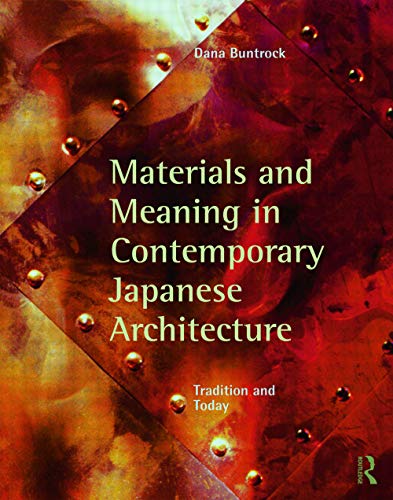

Materials and meaning in contemporary Japanese architecture tradition and today Dana Buntrock.
Idioma: Español London Routledge 2010Descripción: xi, 275 p. col. ill. 29 cmTipo de contenido:- text
- unmediaded
- volume
- 9780415778916 (pbk. : alk. paper)
- Tradition and today
- 720.952/0905 22
- NA1555.6 B86 2010
| Imagen de cubierta | Tipo de ítem | Biblioteca actual | Biblioteca de origen | Colección | Ubicación en estantería | Signatura topográfica | Materiales especificados | Info Vol | URL | Copia número | Estado | Notas | Fecha de vencimiento | Código de barras | Reserva de ítems | Prioridad de la cola de reserva de ejemplar | Reservas para cursos | |
|---|---|---|---|---|---|---|---|---|---|---|---|---|---|---|---|---|---|---|
| Libro | CARIBET Biblioteca Arquitectura Colección General CARIBET | General NA1555.6 B86 2010 (Navegar estantería(Abre debajo)) | 1 | Disponible | 91000000026278 |
Descripciones mejoradas de Syndetics:
In this beautiful and perceptive book, Dana Buntrock examines, for the first time, how tradition is incorporated into contemporary Japanese architecture. Looking at the work of five architectsnbsp;- Fumihiko Maki, Terunobu Fujimori, Ryoji Suzuki, Kengo Kuma, and Jun Aokinbsp;- Buntrock reveals the aims influencing many wonderful works barely known in the West; the sensual side of Japanese architecture borne out of approaches often less concerned with professionalism than with people and place.
The buildings described in this book illustrate an architecture that embraces uniqueness, expressing unusual stories in the rough outlines of rammed earth and rust, and demonstrating new paths opening up for architectural practice today.
For some, these examples will offer new insight into expressions of tradition in Japanese architecture; for others, this book offers inspiration for their own efforts to assert the unique heritage of other regions around the world. Compelling, insightful and groundbreaking, this book is essential for everyone studying Japanese architecture and anyone trying to invoke narrative and tradition in contemporary design.
Include index.
Includes bibliographical references (p. 245-260) and index.
Pt. 1. Black blood red to palest pink. 1. Neolithic Daddy -- 2. Lamune Hot Springs -- 3. Kengo Kkuma : from Pomo to Paulownia -- 4. Murai Museum : subtle setting for a shabby studio -- 5. Outlandish amateur, polished professional : comparing the approaches of Terunobu Fujimori and Kengo Kuma -- Pt. 2. Radical reds. 6. Looking back at Japan's Radical reds : Team Zoo -- Pt. 3. Reluctant regionalists. 7. Remaking the landscape of Kotohira Shrine -- 8. Fumihiko Maki, ancient Izumo and Oku -- 9.Jun Aoki's Aomori Museum of Art -- 10. Reluctant reds.
Notas de autor provistas por Syndetics
Dana Buntrockbegan her studies of Japanese architecture more than twenty years ago, her first visit a month-long trip that took her to tiny corners of the country to see avant-garde and out-of-the-way works. Her more recent research trips still range in remote pockets of the country, now renting cars, carrying a complex array of cameras and seeking out craftsmen who carry on age-old traditions. The architecture she sees is still often avant-garde, but today there are other approaches evident as well, ones more concerned with underscoring the uniqueness of these remote regions. Buntrock's first book,Japanese Architecture as a Collaborative Process: Opportunities in a Flexible Construction Culture(E&FN Spon, 2001) looked at professional practice and what it said about a nation's culture. Her second,Materials and Meaning in Contemporary Japanese Architecture(Routledge, 2010) is concerned with the art and craft of architecture, and how these are used to reflect the particularities of places.