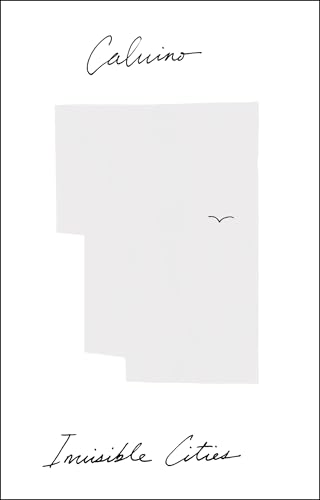

Invisible cities Italo Calvino ; translated from the Italian by William Weaver.
Idioma: Alemán Series A Harvest/HBJ bookDetalles de publicación: New York Harcourt Brace Jovanovich 1978, c1974.Edición: 1st Harvest/HBJ edDescripción: 165 p. 21 cmISBN:- 9780156453806
- 0156453800
- 853/.9/14
- PQ4809.A45 C513 1978
| Imagen de cubierta | Tipo de ítem | Biblioteca actual | Biblioteca de origen | Colección | Ubicación en estantería | Signatura topográfica | Materiales especificados | Info Vol | URL | Copia número | Estado | Notas | Fecha de vencimiento | Código de barras | Reserva de ítems | Prioridad de la cola de reserva de ejemplar | Reservas para cursos | |
|---|---|---|---|---|---|---|---|---|---|---|---|---|---|---|---|---|---|---|
| Libro | CARIBET Biblioteca Arquitectura Colección General CARIBET | PQ4809.A45.C513 1978 (Navegar estantería(Abre debajo)) | Disponible | 91000000026468 |
Descripciones mejoradas de Syndetics:
Italo Calvino's beloved, intricately crafted philosophical novel about an Emperor's travels--a brilliant journey across far-off places and distant memory.
"Cities, like dreams, are made of desires and fears, even if the thread of their discourse is secret, their rules are absurd, their perspectives deceitful, and everything conceals something else." In a garden sit the aged Kublai Khan and the young Marco Polo--Mongol emperor and Venetian traveler. Kublai Khan has sensed the end of his empire coming soon. Marco Polo diverts his host with stories of the cities he has seen in his travels around the empire: cities and memory, cities and desire, cities and designs, cities and the dead, cities and the sky, trading cities, hidden cities. As Marco Polo unspools his tales, the emperor detects these fantastic places are more than they appear.
Translation of Le città invisibili.
"A Helen and Kurt Wolff book."
Reseñas proporcionadas por Syndetics
Publishers Weekly Review
At its most basic level, Calvino's novel is a conversation between Marco Polo and Kublai Khan, as the former describes the fantastical cities and landscapes he's visited during his explorations. Of course, this is severely understating the scope of Calvino's book, which at times feels like a novel, at times like a travelogue about a voyage to mysterious and imaginary places, and at times like a series of puzzles. John Lee is the perfect performer to depict the disorienting nature of Calvino's masterpiece. Lee has become the go-to narrator for stories with unusual structures and ideas-he previously narrated China Mieville's The City & the City and David Mitchell's Cloud Atlas. In this audio edition, Lee's clipped, accented elocution encapsulates the mystery that permeates the novel's numerous settings. But Lee also adds interesting details throughout his reading-for instance he beautifully captures Marco Polo's charisma and showmanship as he crows about his findings to Khan. Despite narrating a book with no discernible plot, this is a truly entertaining and electrifying performance. A Harcourt Brace Jovanovich paperback. (June) (c) Copyright PWxyz, LLC. All rights reserved.Notas de autor provistas por Syndetics
Italo Calvino 1923-1984Novelist and short story writer Italo Calvino was born in Cuba on October 15, 1923, and grew up in Italy, graduating from the University of Turin in 1947. He is remembered for his distinctive style of fables. Much of his first work was political, including Il Sentiero dei Nidi di Ragno (The Path of the Nest Spiders, 1947), considered one of the main novels of neorealism.
In the 1950s, Calvino began to explore fantasy and myth as extensions of realism. Il Visconte Dimezzato (The Cloven Knight, 1952), concerns a knight split in two in combat who continues to live on as two separates, one good and one bad, deprived of the link which made them a moral whole. In Il Barone Rampante (Baron in the Trees, 1957), a boy takes to the trees to avoid eating snail soup and lives an entire, fulfilled life without ever coming back down.
Calvino was awarded an honorary degree from Mount Holyoke College in 1984 and died in 1985, following a cerebral hemorrhage. At the time of his death, he was the most translated contemporary Italian writer and a contender for the Nobel Prize for Literature.
(Bowker Author Biography)