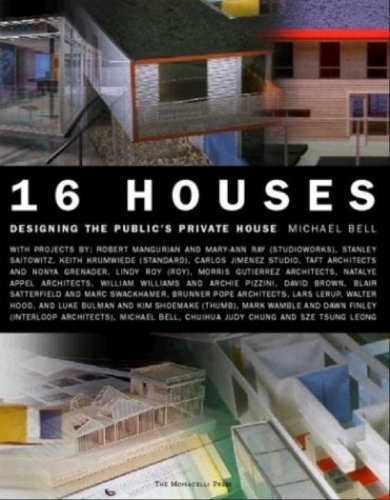

16 houses designing the public's private house [edited by] Michael Bell. txt
United States of America The Monacelli Press, Inc. 2003Descripción: 181 p. ill. (some col.), map 24 cmTipo de contenido:- text
- unmediaded
- volume
- 9781580931144
- 1580931146
- Designing the public's private house
- Sixteen houses
- HD7287.96.U62 B45 2003
| Imagen de cubierta | Tipo de ítem | Biblioteca actual | Biblioteca de origen | Colección | Ubicación en estantería | Signatura topográfica | Materiales especificados | Info Vol | URL | Copia número | Estado | Notas | Fecha de vencimiento | Código de barras | Reserva de ítems | Prioridad de la cola de reserva de ejemplar | Reservas para cursos | |
|---|---|---|---|---|---|---|---|---|---|---|---|---|---|---|---|---|---|---|
| Libro | CARIBET Biblioteca Arquitectura Colección General CARIBET | General HD7287.96.U62 B45 2003 (Navegar estantería(Abre debajo)) | 1 | Disponible | 91000000026120 |
Descripciones mejoradas de Syndetics:
In April 1998, sixteen architecture firms were brought together to design single-family houses for the Fifth Ward in Houston, Texas, one of the country's lowest-income neighborhoods. Studio Works from Los Angeles, Lindy Roy from New York, Carlos Jimenez from Houston, and Stanley Saitowitz from San Francisco, among others, worked with the Fifth Ward Community Redevelopment Corporation to produce affordable housing notable not only for innovative design but also for creative production and financing techniques. An exhibition of the architects' work was shown at galleries in Houston and Austin, Texas. 16 Houses documents these proposals with striking renderings and photographs, offering a fresh perspective on the issue of affordable housing. The model of collaborative design it outlines is genuinely new and also unusually pragmatic for a highly politicized field that has traditionally been mired in bureaucracy. By bringing together architects, developers, academics, community organizations, and public agencies in a grassroots effort, 16 Houses demonstrates a way to transcend politics, providing a blueprint for a new approach that may well represent the future of low-income housing in the United States.
Include bibliography.