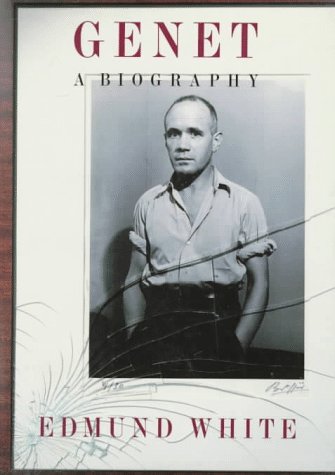

Genet a biography Edmund White ; with a chronology by Albert Dichy.
Detalles de publicación: New York Alfred A. Knopf 1993.Descripción: xlii, 728 p. ill. 25 cmISBN:- 0394571711
- 848/.91209 B 20
- PQ2613.E53 Z9 1993
| Imagen de cubierta | Tipo de ítem | Biblioteca actual | Biblioteca de origen | Colección | Ubicación en estantería | Signatura topográfica | Materiales especificados | Info Vol | URL | Copia número | Estado | Notas | Fecha de vencimiento | Código de barras | Reserva de ítems | Prioridad de la cola de reserva de ejemplar | Reservas para cursos | |
|---|---|---|---|---|---|---|---|---|---|---|---|---|---|---|---|---|---|---|
| Libro | Biblioteca de Mayagüez Colección General mb | PQ2613 .E53 Z9 1993 (Navegar estantería(Abre debajo)) | Disponible | 50000003230629 |
Descripciones mejoradas de Syndetics:
In this revelatory biography of Jean Genet, we have the first full-scale life of one of the great -- and controversial -- figures of twentieth-century literature. Edmund White shows us the writer in all his permutations: poet, dandy, homosexual, thief; a 'thug of genius', as Simone de Beauvoir called him. Moving from Genet's illegitimate birth in 1910 to his foster childhood in a farming village in central France, Edmund White explores the early milieu that transformed an inherently theatrical child into a petty criminal and prodigiously original writer, whose most startling creation may have been his invention of himself. Accused of stealing and running away, Genet was sent to reform school at Mettray, where his imagination flourished under the spell of an all-male communal life and his first homosexual experiences. In the 1930s, he deserted from the army and travelled in Europe as a vagabond, prostitute and thief, always on the lam from the police and the military. In 1942, he emerged from one of several prison stays with the first of his remarkable novels, Our Lady of the Flowers. It was admired by Cocteau, who undertook to get it published and interceded with the French authorities to keep its author out of prison. White shows us how Cocteau thrust the 'marvelous, mysterious, intolerable' Genet into the heart of literary Paris, where he enjoyed a curious celebrity as great writer and petty thief, was painted by Giacometti (from whom he stole) and was canonized by Sartre in his monumental study, Saint Genet. By 1948, Genet had produced five highly original novels. In the mid-1950s, after several years of debilitating depression, he turned to the writing of plays, of which The Balcony, The Blacks and The Screens were immediately hailed as masterpieces. Despite his ambivalence about political movements, he supported the Paris student uprising in 1968 and turned up -- as a journalist -- at the Democratic National Convention in Chicago. In 1970, he became a spokesman for the Black Panthers, but in his last decade he immersed himself -- politically and aesthetically -- in the Arab world, championing the struggle for a Palestinian homeland and writing his last, posthumously published book, Prisoner of Love. Edmund White explores the perverse extremes of Genet's life and separates the facts from the mythology that Genet himself fashioned. Drawing on interviews with Genet's friends, lovers, publishers and acquaintances, and using new material from correspondence, journals, police records, psychiatric reports and other original sources, White reveals a life animated by contradictory impulses: authenticity and dissembling, fidelity and flirtation, domination and submission, honor and betrayal. Throughout, he brilliantly interprets and appraises Genet's astonishing oeuvre, reading the fiction with the focussed attention of a novelist and opening up the dense invention of the plays. His masterful and intuitive biography fully illuminates a hitherto enigmatic literary genius.
eigm 04/2017
Includes bibliographical references (p. 641-701) and index.
Reseñas proporcionadas por Syndetics
Library Journal Review
French writer Jean Genet (1910-86) was a petty thief who produced some of the most revolutionary novels and plays of our time. White's massive biography illuminates the life and works of this ``deeply contradictory man,'' although many events from his early years of vagabondage and prostitution are beyond retrieval. A greater mystery--which even White, an accomplished novelist ( A Boy's Own Story , LJ 9/1/82; The Beautiful Room Is Empty , LJ 3/1/88), cannot solve--is how someone of Genet's limited education could have produced a first novel of such magnitude as Our Lady of the Flowers ( LJ 11/1/63). (Parallels with the case of Shakespeare are not far-fetched.) This work is a labor of love and admiration. Essential for collections of modern literature. Previewed in Prepub Alert, LJ 6/15/93.-- Grove Koger, Boise P.L., Id. (c) Copyright 2010. Library Journals LLC, a wholly owned subsidiary of Media Source, Inc. No redistribution permitted.Publishers Weekly Review
In this massive biography White gets well inside the skin of the great French writer widely known for his sensational novels, Our Lady of the Flowers and A Thief's Journal (both written in the 1940s but not published in the U.S. until two decades later), and his plays, The Maids and The Blacks . White is a master at illuminating the connections between Genet's (1910-1986) life and creative output; as a novelist himself, White ( The Beautiful Room Is Empty ) offers brilliant insight into the way experience is transformed into art. His most vivid passages fill in crucial blanks often left by literary critics in search of the source and ultimate meaning of a writer's contributions. Also valuable is White's painstaking delineation of Genet's often unpopular political involvements--he supported the Black Panthers and later in his career the Palestinians--as well as his uneasy position among French intellectuals of the postwar period. White's frank and stylish account of Genet's erotic life is not for the squeamishly heterosexual, as those familiar with Genet's works (or White's for that matter) will know, for rarely have a writer's life and work been so erotically connected as Genet's. In a biography of this length, there are inevitably moments when the biographer's concentration appears to flag and events pile up with little analysis. Yet among the pleasures here is that White's prose largely matches the seductive allure of his subject's. Photos. (Oct.) (c) Copyright PWxyz, LLC. All rights reservedCHOICE Review
This will probably remain for a long time the definitive English-language biography of the French writer Jean Genet. White traces out in meticulous detail a life that began as an abandoned child, was spent in wandering about Europe and in numerous incarcerations for petty crimes, was then given over to writing novels and plays, and ended with Genet's eccentric identification with the cause of the Palestinians. Underscoring Genet's homosexuality, White gives a detailed record of the writer's encounters and affairs, as well as account of his usually troubled relations with the world of French letters. This is not a brilliant work like Jean-Paul Sartre's Saint Genet (1963), but it is an accurate and complete account of the details of the life of a criminal who was also one of the most interesting writers that 20th-century France has produced. White has undertaken the task of correcting both Sartre's tale of Genet's "choice" to be a criminal and a homosexual, and Genet's own autobiographical presentations in his poeticized fictions of himself. The scholar of modern French fiction will find this useful, and the general reader may well be fascinated by this story of the latest of French po`etes maudits. Moreover, enthusiasts of modern theater will find interest in the story of the creation of such now modern classics for the stage as The Maids or The Blacks; and for readers wishing to see Genet's work in context, White's work also offers a fair amount of social history. Recommended for all libraries. A. Thiher; University of Missouri--ColumbiaBooklist Review
Genet is no longer quite the quandary, the quintessential bad boy, or even the radical he seemed in the 1940s, when figures such as Jean-Paul Sartre and Jean Cocteau championed him.But he's a major force in gay and lesbian studies, so White's intelligent selection of his writings is a good buy if your holdings are weak. The new reader will discover--even in translation--a demonic, dense, and lyrical stylist, who is often quotable: "The only way to avoid the horror of horror is to give in to it." That's from Our Lady of the Flowers, Genet's first novel, much of which was written in prison. From White's excerpt, it's clear why that novel remains important--as a dreamy prototype for prison narratives and, even today, for its startling, tender, bloody sexual fantasies. Yet--in retrospect--in all of these selections, there is a didacticism and an obsessive, unpleasant voice. If one is acquainted with Genet, the most interesting aspects of White's selections may be found in the later writings, when Genet suffered from long periods of depression and writer's block. He ceased writing his extraordinary fiction and turned to criticism and polemics (championing, for instance, the Black Panthers and the Palestinian cause). Here Genet is by turns cogent, paranoid, and, again, didactic. White also includes a rare interview with Genet, in which the young interviewer asks, "In what direction are you aiming your life?" Genet's answer: "Toward oblivion."That question and response might be taken as the theme of White's thorough, often tedious, but on the whole exemplary biography. One will learn much more about Genet's later, less productive years than one really wants to know. For most, Selected Writings will be sufficient in this regard. But Genet as a terrorized, arrogant, precocious child--who could not say who his father was and never knew his mother--and ward of France is troubling and always intriguing. With his graceful but essentially reportorial stance, White guides the reader through Genet's career as a petty thief and prisoner and shows how he began to write; he makes it clear how vital Genet's friendships with Sartre and Cocteau were. One will admire the man who could rise out of nothing and invent himself, but also must greet with skepticism the way--in the ongoing autobiography that comprises Genet's fiction--in which he revised his childhood and prison experiences to be bleaker than they truly were. White relies heavily on Albert Dichy, a French biographer of Genet, and because of him was able to quote from Genet's manuscripts and letters without hindrance. It's hard to imagine how the daunting task of portraying Genet could have been better accomplished. ~--John MortNotas de autor provistas por Syndetics
Author Edmund White was born in Cincinnati, Ohio on January 13, 1940. He majored in Chinese at the University of Michigan. Before spending a year in Rome, he worked for Time-Life Books from 1962 until 1970. Upon his return, he became an editor for The Saturday Review and Horizon. He lived in France from 1983 until 1990. His works have chronicled gay life with such books as A Boy's Own Story, The Beautiful Room Is Empty, and The Farewell Symphony.(Bowker Author Biography)